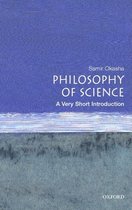
Philosophy of science: a very short introduction – Okasha
H1 What is science?
We are asking what common feature all the things on the list of activities share,
i.e. what it is that makes something a science. Surely science is just the attempt
to understand, explain, and predict the world we live in, but so do religion etc. as
well. As with many philosophical questions, the question ‘what is science?’ turns
out to be trickier than it looks at first sight. Many people believe that the
distinguishing features of science lie in the particular methods scientists use to
investigate the world. Another important feature of science is the construction
of theories.
The origins of modern science
Close attention to the history of science is indispensable for doing good
philosophy of science. The scientific revolution is a period of rapid scientific
development that occurred in Europe between the years 1500 and 1750. It
started with Aristotelianism (all earthly bodies composed of just the four
elements earth, fire, air and water). The first crucial step in the development of
the modern scientific world-view was the Copernican revolution. Copernicus
(1473-1543) attacked the geocentric model of the universe (which placed the
stationary earth at the centre of the universe with the planets and the sun in orbit
around it). He came up with the heliocentric model and suggested that the sun
was the fixed centre of the universe, and the planets, including the earth, were in
orbit around the sun. The earth regarded as just another planet. This indirectly
led to the development of modern physics, through the work of Johannes Kepler
(1571-1630) and Galileo Galilei (1564-1642). Galileo made the counter-intuitive
suggestion that all freely falling bodies will fall in a vacuum towards the earth at
the same rate, irrespective of their weight (Galileo’s law of free-fall). Galileo is
generally regarded as the first truly modern physicist. He was the first to show
that the language of mathematics could be used to describe the behaviour of
actual objects in the material world, such as falling bodies, projectiles, etc.
Galileo’s emphasis on experimental testing marks the beginning of an empirical
approach to studying nature that continues to this day. Descartes (1596-1650)
develop a radical new ‘mechanical philosophy’, according to which the physical
world consists simply of inert particles of matter interacting and colliding with one
another. The scientific revolution culminated in the work of Isaac Newton (1643-
1727), to his principle every body in the universe exerts a gravitational
attraction on every other body. Newton was able to show that Kepler’s laws of
planetary motion and Galileo’s law of free-fall (both with certain minor
modifications) were logical consequences of his laws of motion and gravitation.
Scientific confidence grew rapidly in this period, due largely to the success of
Newton’s theory. Confidence in the Newtonian picture was shattered in the early
years of the 20th century, thanks to two revolutionary new developments in
physics: relativity theory and quantum mechanics. Relativity theory discovered by
Einstein, showed that Newtonian mechanics does not give the right results when
applied to very massive objects, or objects moving at very high velocities.
Quantum mechanics, conversely, shows that the Newtonian theory does not work
when applied on a very small scale, to subatomic particles. So far our brief
account of the history of science has focused mainly on physics. Physics is both
historically very important and in a sense the most fundamental of all scientific
disciplines.
In biology, Darwin argued that contemporary species have actually
evolved from ancestral ones, through a process known as natural selection. 20th
century: the emergence of molecular biology. In 1953 Watson and Crick
discovered the structure of DNA. Possibly the most significant event of the last
30years is the rise of cognitive science, which studies various aspects of human
cognition such as perception, memory, learning, and reasoning, and has
, transformed traditional psychology. The social sciences, especially economics and
sociology, have also flourished in the 20th century.
What is philosophy of science?
The principle task of philosophy of science is to analyse the methods of enquiry
used in the various sciences. Looking at science from a philosophical perspective
allows us to probe deeper – to uncover assumptions that are implicit in scientific
practice, but which scientists do not explicitly discuss. So part of the job of
philosophy of science is to question assumptions that scientists take for granted.
But it would be wrong to imply that scientists never discuss philosophical issues
themselves.
Science and pseudo-science
Popper, an influential 20th century philosopher of science, thought that the
fundamental feature of a scientific theory is that it should be falsifiable. A
falsifiable theory is one that we might discover to be false. Popper thought that
some supposedly scientific theories did not satisfy this condition and thus did not
deserve to be called science at all; rather they were merely pseudo-science.
Freud’s psychoanalytic theory was one of Popper’s favourite examples of pseudo-
science. Whatever a patient’s behaviour, Freudians could find an explanation of it
in terms of their theory. Freud’s theory was thus unfalsifiable, as well as Marx’s
theory of history. Therefore neither theory qualifies as genuinely scientific,
according to Popper’s criterion. Popper’s attempt to demarcate science from
pseudo-science is intuitively quite plausible. There is certainly something fishy
about a theory that can be made to fit any empirical data whatsoever. But some
philosophers regard Popper’s criterion as overly simplistic. Critics on Popper: in
general, scientists do not just abandon their theories whenever they conflict with
the observational data. Usually they look for ways of eliminating the conflict
without having to give up their theory. Virtually every theory in science conflicts
with some observations – finding a theory that fits all the data perfectly is
extremely difficult. Little progress would be made if scientists simply abandoned
their theories at the first sign of trouble. Popper’s assumption that science has an
‘essential nature’ is questionable. Rather, there is a loose cluster of features most
of which are possessed by most games. But any particular game may lack any of
the features in the cluster and still be a game. The same may be true of science.
If so, a simple criterion for demarcating science from pseudo-science is unlikely to
be found.
H1 What is science?
We are asking what common feature all the things on the list of activities share,
i.e. what it is that makes something a science. Surely science is just the attempt
to understand, explain, and predict the world we live in, but so do religion etc. as
well. As with many philosophical questions, the question ‘what is science?’ turns
out to be trickier than it looks at first sight. Many people believe that the
distinguishing features of science lie in the particular methods scientists use to
investigate the world. Another important feature of science is the construction
of theories.
The origins of modern science
Close attention to the history of science is indispensable for doing good
philosophy of science. The scientific revolution is a period of rapid scientific
development that occurred in Europe between the years 1500 and 1750. It
started with Aristotelianism (all earthly bodies composed of just the four
elements earth, fire, air and water). The first crucial step in the development of
the modern scientific world-view was the Copernican revolution. Copernicus
(1473-1543) attacked the geocentric model of the universe (which placed the
stationary earth at the centre of the universe with the planets and the sun in orbit
around it). He came up with the heliocentric model and suggested that the sun
was the fixed centre of the universe, and the planets, including the earth, were in
orbit around the sun. The earth regarded as just another planet. This indirectly
led to the development of modern physics, through the work of Johannes Kepler
(1571-1630) and Galileo Galilei (1564-1642). Galileo made the counter-intuitive
suggestion that all freely falling bodies will fall in a vacuum towards the earth at
the same rate, irrespective of their weight (Galileo’s law of free-fall). Galileo is
generally regarded as the first truly modern physicist. He was the first to show
that the language of mathematics could be used to describe the behaviour of
actual objects in the material world, such as falling bodies, projectiles, etc.
Galileo’s emphasis on experimental testing marks the beginning of an empirical
approach to studying nature that continues to this day. Descartes (1596-1650)
develop a radical new ‘mechanical philosophy’, according to which the physical
world consists simply of inert particles of matter interacting and colliding with one
another. The scientific revolution culminated in the work of Isaac Newton (1643-
1727), to his principle every body in the universe exerts a gravitational
attraction on every other body. Newton was able to show that Kepler’s laws of
planetary motion and Galileo’s law of free-fall (both with certain minor
modifications) were logical consequences of his laws of motion and gravitation.
Scientific confidence grew rapidly in this period, due largely to the success of
Newton’s theory. Confidence in the Newtonian picture was shattered in the early
years of the 20th century, thanks to two revolutionary new developments in
physics: relativity theory and quantum mechanics. Relativity theory discovered by
Einstein, showed that Newtonian mechanics does not give the right results when
applied to very massive objects, or objects moving at very high velocities.
Quantum mechanics, conversely, shows that the Newtonian theory does not work
when applied on a very small scale, to subatomic particles. So far our brief
account of the history of science has focused mainly on physics. Physics is both
historically very important and in a sense the most fundamental of all scientific
disciplines.
In biology, Darwin argued that contemporary species have actually
evolved from ancestral ones, through a process known as natural selection. 20th
century: the emergence of molecular biology. In 1953 Watson and Crick
discovered the structure of DNA. Possibly the most significant event of the last
30years is the rise of cognitive science, which studies various aspects of human
cognition such as perception, memory, learning, and reasoning, and has
, transformed traditional psychology. The social sciences, especially economics and
sociology, have also flourished in the 20th century.
What is philosophy of science?
The principle task of philosophy of science is to analyse the methods of enquiry
used in the various sciences. Looking at science from a philosophical perspective
allows us to probe deeper – to uncover assumptions that are implicit in scientific
practice, but which scientists do not explicitly discuss. So part of the job of
philosophy of science is to question assumptions that scientists take for granted.
But it would be wrong to imply that scientists never discuss philosophical issues
themselves.
Science and pseudo-science
Popper, an influential 20th century philosopher of science, thought that the
fundamental feature of a scientific theory is that it should be falsifiable. A
falsifiable theory is one that we might discover to be false. Popper thought that
some supposedly scientific theories did not satisfy this condition and thus did not
deserve to be called science at all; rather they were merely pseudo-science.
Freud’s psychoanalytic theory was one of Popper’s favourite examples of pseudo-
science. Whatever a patient’s behaviour, Freudians could find an explanation of it
in terms of their theory. Freud’s theory was thus unfalsifiable, as well as Marx’s
theory of history. Therefore neither theory qualifies as genuinely scientific,
according to Popper’s criterion. Popper’s attempt to demarcate science from
pseudo-science is intuitively quite plausible. There is certainly something fishy
about a theory that can be made to fit any empirical data whatsoever. But some
philosophers regard Popper’s criterion as overly simplistic. Critics on Popper: in
general, scientists do not just abandon their theories whenever they conflict with
the observational data. Usually they look for ways of eliminating the conflict
without having to give up their theory. Virtually every theory in science conflicts
with some observations – finding a theory that fits all the data perfectly is
extremely difficult. Little progress would be made if scientists simply abandoned
their theories at the first sign of trouble. Popper’s assumption that science has an
‘essential nature’ is questionable. Rather, there is a loose cluster of features most
of which are possessed by most games. But any particular game may lack any of
the features in the cluster and still be a game. The same may be true of science.
If so, a simple criterion for demarcating science from pseudo-science is unlikely to
be found.