

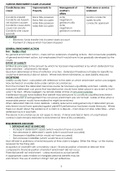
VARIOUS ENRICHMENT CLAIMS AVAILABLE
Condictiones sine Improvements to Management of Work done or service
causa Property another’s rendered
affairs
Condictio indebiti Bona fide possessor actio locatio conductio
Condictio ab turpem Bona fide occupier negotiorum operis locatio
vel iniustam causam Mala fide possessor gestorum utilis conductio operarum
Condictio causa data Mala fide occupier actio
causa non secuta negotiorum
Condictio sine cause gestorum contraria
specialis
EXAMPLES
• Electronic funds transfer into incorrect bank account
• Payment of cheque which has been stopped
GENERAL ENRICHMENT ACTION
See; Nortje v Pool
No general enrichment action – mere ad hoc extensions of existing actions. Did not exclude possibility
of general enrichment action, but emphasized that it would have to be gradually developed by the
courts.
EXTENT OF LIABILITY
Entitled (in principle) to the amount by which he has been impoverished or by which defendant has
been enriched – whichever is the lesser
Quantum determined at time of institution of action. Defendant therefore not liable for benefits he
could have derived but did not obtain. Where enrichment diminishes, so does liability reduced.
EXCEPTIONS
Liability usually fixed – calculated with reference to the date on which enrichment action was lodged.
May be fixed at an earlier date under certain circumstances:
From the moment the defendant becomes aware he has been unjustifiably enriched. Liability only
reduced if defendant can prove that loss/destruction would have taken place in any event or that it
wasn’t his fault. Where negligent, he remains liable at time of actual knowledge.
If defendant should have realised that benefit may later prove to constitute unjustified enrichment.
Liability reduced or extinguished if he can prove enrichment was not his fault. Liable at time when a
reasonable person would have realised he might be enriched.
When defendant falls into mora debitoris. Liability reduced or extinguished only if defendant proves
enrichment would have operated against plaintiff if performance had been made timeously. Where
there is a doubt about the existence of a claim or a dispute – mora does not arise. Mala fides – when
defendant acts in bad faith.
The above 4 circumstances do not apply to minors. If minor enriched in terms of unauthorised
contract claim remains restricted to enrichment at time of litis contestatio.
REQUIREMENTS DISCUSSED
1. DEFENDANT MUST BE ENRICHED
• Increase in defendant’s assets (which would not have occurred)
• Non-decrease in defendant’s assets (which would have occurred)
• Decrease in liabilities (which would not have occurred)
• Non-increase in liabilities (which would have occurred)
Must still exist in patrimony of enriched party at time claim is lodged. Either the thing – or the money
received for the thing sold.
Acquisition of a benefit with a monetary value = financial position of estate at relevant time
compared to financial position of estate if enrichment did not occur.
Potential benefit not enrichment – unless received as actual benefit.
In appropriate cases invisible or intangible personal benefits may be
enrichment. The use of another’s thing? Not yet settled law.
3
, 2. THE PLAINTIFF MUST BE IMPOVERISHED
Decrease or non-increase in assets
Increase or non-decrease in liabilities
In fully developed enrichment action all favourable and detrimental side-effects of the enriching fact
ought to be taken into account in determining defendant’s enrichment and plaintiff’s
impoverishment. However some side effects are not always taken into account – thus not fully
developed.
3. DEFENDANT’S ENRICHMENT MUST HAVE BEEN AT THE EXPENSE OF THE PLAINTIFF
Must be a causal link between the enrichment and the impoverishment. The enrichment must be at
the expense of the plaintiff.
Indirect Enrichment
A and B enter into a contract. A renders performance to B, but benefit of the performance
accrues to C. Example:
A contracts with B to build swimming pool for B.
A builds pool on C’s property believing it to be that of B’s.
De Vos:
B renders performance to A and B pays A for work. C is enriched at B’s expense (not A).
If B has not yet paid A (and he is in a position to pay) – A can enforce contractual action.
If B is insolvent or disappears - A cannot bring enrichment action against C because C is enriched at
B’s expense – NOT A. This view was endorsed in Gouws v Jester Pools Problem addressed in:
Buzzard Electrical v 158 Jan Smuts Avenue Investments
Cannot be used to confirm or reject Gouws decision – deals with subcontractor cases.
Enrichment lien – right of retention – operates against anyone, including the owner. Retain
possession until compensated. Same requirements satisfied as for enrichment action. See;
Brooklyn House Furnishers v Knoetze
4. ENRICHMENT MUST HAVE BEEN SINE CAUSA (UNJUSTIFIED)
Reason: No one would be able to make a profit at the expense of another if there is no limiting factor
– enrichment must be unjustified. DEFINITION
Enrichment is unjustified when there is not sufficient legal ground for the transfer of value from one
estate to the other or for the retention of such value (in the second estate).
Does not depend on subjective factors (i.e. mistake on part of
parties) Objectively, whether there is a legal ground to justify
enrichment.
Question of fact.
See; Buzzard Electrical
ACTIVITY
Consider the five scenarios and consider whether liability in each case should be based on
delict, contract or unjustified enrichment and explain whether the sine causa requirement has
been fulfilled in each of these cases and explain whether the general requirements for
unjustified enrichment liability have been met in each case.
The sine causa requirement deals with the underlying legal ground for the transfer of property or value. If there
is such a ground, for instance a contract, then the transfer is not sine causa. Using your knowledge of the law of
contract, delict and property law, decide in each case whether there is an underlying causa or not. Scenarios
1 to 3 provide examples of transfers that were sine causa, but scenario 4 does not.
Scenario 1
A concluded a contract with B for the sale of a stud bull, Spartacus, for R100 000. B paid a
deposit of R10 000 at the time of the signing of the contract. Unbeknown to both A and B,
Spartacus had died on the day before the conclusion of the contract. Can B reclaim the
deposit paid?
The contract was void owing to the initial impossibility on the existence of the contract. If there is no contract
between the parties, there is no underlying reason or causa for the payment of the deposit. B has been
4
,impoverished by the payment of the deposit and A has been enriched by it. As it is money which has been paid,
B can reclaim the full amount unless A can prove that the enrichment has been diminished or extinguished. A’s
enrichment has been caused by the direct transfer of the money from B and is therefore at B’s expense. B should
be able to claim back the full amount.
Scenario 2
C concluded a contract with D in terms of which D was to paint the exterior of C’s house for
R20 000 while C was on holiday. As a result of a mix-up in addresses, D painted the house
belonging to E, who was also on holiday during this period. E’s house also seemed to need a
fresh coat of paint. Can D claim anything from C or E? and also formulate your own reasoned
point of view in respect of indirect enrichment situations.
Although there is a contract between C and D there is no contract between D and E. D thought he was performing
his contract with C, but because he painted the wrong house, he did not fulfil his contractual obligations towards
C. There is no contract between D and E and consequently D has no contractual claim against E. D has clearly
been impoverished by the expenditure of his time, labour and materials, but it is not certain whether E has been
enriched, his house may not have risen in value as a result of the painting, in which case E was not enriched, Or
maybe E saved some expenses if he was going to have his house painted anyway. This is not a case of indirect
enrichment. The painter mistakenly painted the wrong house.
Scenario 4
I has concluded an agreement with J for the sale of her second-hand car at a price of R50
000. The market value of the car is only R30 000. Can J claim the difference from I?
Scenario 4 Did you consider whether there was a valid contract between the parties? If so, is the
enrichment sine causa? Scenario 4 Is there any reason to conclude from these facts that the
contract is void? If not, J should not be able to reclaim anything. He has made a bad bargain but is
bound by it.
Scenario 5
K has stolen L’s laptop computer from his office and has sold it to M for R2 000. Can L claim
anything from K or M? What would the basis of the claim be? And explain which party, if any,
has been enriched and impoverished and to what extent.
K’s conduct is clearly unlawful and L would be better advised to sue in delict than with an unjustified enrichment
action. Why? Can K use the actio rei vindicatio to reclaim his property from M, even though M may have been
bona fide? There is no transfer of ownership because the goods were stolen. The actio rei vindicatio or a
delictual claim would therefore be more appropriate.
(1) What does it mean if it is said that enrichment liability is based on a movement of assets
from the plaintiff to the defendant?
General requirements for enrichment liability
1. The defendant must be enriched
2. The plaintiff must be impoverished
3. The defendant’s enrichment must have been at the expense of the plaintiff
4. The enrichment must have been sine causa (unjustified)
With regard to requirement (1) Enrichment may take the form of:
(1) An increase in the defendant’s assets which would not have occurred had the enriching fact not taken
place;
(2) A non-decrease in his or her assets where a decrease would have taken place but for the enriching fact
(3) A decrease in liabilities which would not have taken or (4) A non-increase in liabilities which would have
taken place.
The enrichment may consist either of the thing or value received and must still exist in the patrimony of the
enriched party at the time when the claim is lodged.
With Regard to requirement 2: quantum of the plaintiff’s claim is the amount by which he been impoverished or
the amount by which the defendant has been enriched, whichever is the lesser. This implies that every
enrichment action must embrace an enquiry not only into the extent of the defendant’s enrichment but also
into the extent of the plaintiff’s impoverishment. Such impoverishment may be constituted by a decrease or non-
increase in assets or by an increase or non-decrease in liabilities. All favourable and detrimental side effects of
5
, the enriching fact or event ought to be taken into account in determining the defendant’s enrichment and the
plaintiff’s impoverishment including side effects which flow indirectly from the enriching fact.
Example 1: A pays B an amount of R2 000 which is not owing, and B uses this amount to buy household
necessaries which he consumes before A institutes an action against B for R2 000.
At this stage there is no increase in the assets of B’s estate, but if B had not received the R2 000 from A he would
have had to use R2 000 of his own money causing a decrease in his estate which, in the circumstances, did not
take place because of the R2 000 that B received from A. B’s enrichment takes the form of expenses saved and
A should consequently succeed with his action.
Example 2: A makes a payment of R50 000 to B which is not owing. B uses R5 000 of this amount to buy
household necessaries and with the balance of R45 000 she buys a car which she would not have bought had
she not received the R50 000 from A. At a later stage A institutes an action against B. B is enriched by the R5 000
in the form of expenses saved. The R45 000 spent on the car does not, constitute saved expenses as she could
not have bought the car without the money. If, at the time of litis contestatio the car has a value of R30 000; this
constitutes an increase in B’s assets. A should therefore succeed in recouping the amount of R5 000 + R30 000 =
R35 000.
Example 3: In the Nortje´ case the plaintiffs who were prospectors had, through their own efforts, discovered a
rich deposit of porcelain clay on the defendant’s farm. The question was whether the discovery of the clay had
enhanced the value of the farm. The court a quo took the view that it was not the discovery of the clay, but its
presence, which determined the value of the farm so that the defendant had not been enriched by the
prospectors’ efforts. This line of reasoning is not convincing. It is not the mere presence of minerals which
enhances the value of land, but the knowledge of their presence, and when someone makes such knowledge
available an increase in the market value of the land follows economically and juridically from his or her efforts
a. Potential Benefit
The financial position of the estate of the defendant at the relevant time is compared with the financial condition
in which the estate would have been at the relevant time if the fact causing the enrichment had not occurred.
Until a potential benefit is received as an actual benefit, it is not enrichment. Where the defendant has knowingly
neglected to appropriate or acquire a potential advantage he is not enriched by the potential benefit not
acquired. In Kruger v Navratil it was wrongly accepted that a benefit that the defendant did not acquire could
be recovered by an enrichment action. b. Moral Benefits
Unisa is of the view that the result of enrichment must be an increased estate and ‘‘moral’’ benefits cannot
increase one’s estate and cannot therefore constitute enrichment. According to Unisa the decision in Tanne v
Foggitt was incorrect where the court held that a minor who had contracted to receive typewriting lessons
could not be liable ex contractu for the price of all the lessons but could only be liable for benefits (the lessons)
actually received. This decision implies that such ‘‘moral’’ benefits could constitute enrichment. De Vos’s view,
however, is that in an appropriate case invisible or intangible personal benefits may be regarded as enrichment.
c. Use of a thing
Whether the use of a thing constitutes enrichment is unsettled. In Lodge v Modern Motors the court appears to
have been willing to allow the value of the use of a vehicle to be taken into account for purposes of calculating
the enrichment and impoverishment of the parties.
(2) Can a potential benefit and a moral benefit form part of enrichment for purposes of the
law of enrichment? Answer with reference to case law.
Unisa is of the view that the result of enrichment must be an increased estate and ‘‘moral’’ benefits cannot
increase one’s estate and cannot therefore constitute enrichment. According to Unisa the decision in Tanne v
Foggitt was incorrect where the court held that a minor who had contracted to receive typewriting lessons
could not be liable ex contractu for the price of all the lessons but could only be liable for benefits (the lessons)
actually received. This decision implies that such ‘‘moral’’ benefits could constitute enrichment. De Vos’s view,
however, is that in an appropriate case invisible or intangible personal benefits may be regarded as enrichment.
(3) Explain, with reference to an example, the importance of favourable and detrimental
side-effects for the determining of the extent of the movement of assets.
All favourable and detrimental side effects of the enriching fact or event ought to be taken into account in
determining the defendant’s enrichment and the plaintiff’s impoverishment including side effects which flow
indirectly from the enriching fact. Such side-effects may take many different forms for example:
A and B enter into a lease of land with A as the lessor and B as the lessee and the contract is void for some
reason but B remains in possession of the land for three years and constructs buildings on the land which cost B
R80 000 and which enhance the value of the land by R60 000. When A evicts him, B claims compensation based
on enrichment for the improvements to the land.
6
Condictiones sine Improvements to Management of Work done or service
causa Property another’s rendered
affairs
Condictio indebiti Bona fide possessor actio locatio conductio
Condictio ab turpem Bona fide occupier negotiorum operis locatio
vel iniustam causam Mala fide possessor gestorum utilis conductio operarum
Condictio causa data Mala fide occupier actio
causa non secuta negotiorum
Condictio sine cause gestorum contraria
specialis
EXAMPLES
• Electronic funds transfer into incorrect bank account
• Payment of cheque which has been stopped
GENERAL ENRICHMENT ACTION
See; Nortje v Pool
No general enrichment action – mere ad hoc extensions of existing actions. Did not exclude possibility
of general enrichment action, but emphasized that it would have to be gradually developed by the
courts.
EXTENT OF LIABILITY
Entitled (in principle) to the amount by which he has been impoverished or by which defendant has
been enriched – whichever is the lesser
Quantum determined at time of institution of action. Defendant therefore not liable for benefits he
could have derived but did not obtain. Where enrichment diminishes, so does liability reduced.
EXCEPTIONS
Liability usually fixed – calculated with reference to the date on which enrichment action was lodged.
May be fixed at an earlier date under certain circumstances:
From the moment the defendant becomes aware he has been unjustifiably enriched. Liability only
reduced if defendant can prove that loss/destruction would have taken place in any event or that it
wasn’t his fault. Where negligent, he remains liable at time of actual knowledge.
If defendant should have realised that benefit may later prove to constitute unjustified enrichment.
Liability reduced or extinguished if he can prove enrichment was not his fault. Liable at time when a
reasonable person would have realised he might be enriched.
When defendant falls into mora debitoris. Liability reduced or extinguished only if defendant proves
enrichment would have operated against plaintiff if performance had been made timeously. Where
there is a doubt about the existence of a claim or a dispute – mora does not arise. Mala fides – when
defendant acts in bad faith.
The above 4 circumstances do not apply to minors. If minor enriched in terms of unauthorised
contract claim remains restricted to enrichment at time of litis contestatio.
REQUIREMENTS DISCUSSED
1. DEFENDANT MUST BE ENRICHED
• Increase in defendant’s assets (which would not have occurred)
• Non-decrease in defendant’s assets (which would have occurred)
• Decrease in liabilities (which would not have occurred)
• Non-increase in liabilities (which would have occurred)
Must still exist in patrimony of enriched party at time claim is lodged. Either the thing – or the money
received for the thing sold.
Acquisition of a benefit with a monetary value = financial position of estate at relevant time
compared to financial position of estate if enrichment did not occur.
Potential benefit not enrichment – unless received as actual benefit.
In appropriate cases invisible or intangible personal benefits may be
enrichment. The use of another’s thing? Not yet settled law.
3
, 2. THE PLAINTIFF MUST BE IMPOVERISHED
Decrease or non-increase in assets
Increase or non-decrease in liabilities
In fully developed enrichment action all favourable and detrimental side-effects of the enriching fact
ought to be taken into account in determining defendant’s enrichment and plaintiff’s
impoverishment. However some side effects are not always taken into account – thus not fully
developed.
3. DEFENDANT’S ENRICHMENT MUST HAVE BEEN AT THE EXPENSE OF THE PLAINTIFF
Must be a causal link between the enrichment and the impoverishment. The enrichment must be at
the expense of the plaintiff.
Indirect Enrichment
A and B enter into a contract. A renders performance to B, but benefit of the performance
accrues to C. Example:
A contracts with B to build swimming pool for B.
A builds pool on C’s property believing it to be that of B’s.
De Vos:
B renders performance to A and B pays A for work. C is enriched at B’s expense (not A).
If B has not yet paid A (and he is in a position to pay) – A can enforce contractual action.
If B is insolvent or disappears - A cannot bring enrichment action against C because C is enriched at
B’s expense – NOT A. This view was endorsed in Gouws v Jester Pools Problem addressed in:
Buzzard Electrical v 158 Jan Smuts Avenue Investments
Cannot be used to confirm or reject Gouws decision – deals with subcontractor cases.
Enrichment lien – right of retention – operates against anyone, including the owner. Retain
possession until compensated. Same requirements satisfied as for enrichment action. See;
Brooklyn House Furnishers v Knoetze
4. ENRICHMENT MUST HAVE BEEN SINE CAUSA (UNJUSTIFIED)
Reason: No one would be able to make a profit at the expense of another if there is no limiting factor
– enrichment must be unjustified. DEFINITION
Enrichment is unjustified when there is not sufficient legal ground for the transfer of value from one
estate to the other or for the retention of such value (in the second estate).
Does not depend on subjective factors (i.e. mistake on part of
parties) Objectively, whether there is a legal ground to justify
enrichment.
Question of fact.
See; Buzzard Electrical
ACTIVITY
Consider the five scenarios and consider whether liability in each case should be based on
delict, contract or unjustified enrichment and explain whether the sine causa requirement has
been fulfilled in each of these cases and explain whether the general requirements for
unjustified enrichment liability have been met in each case.
The sine causa requirement deals with the underlying legal ground for the transfer of property or value. If there
is such a ground, for instance a contract, then the transfer is not sine causa. Using your knowledge of the law of
contract, delict and property law, decide in each case whether there is an underlying causa or not. Scenarios
1 to 3 provide examples of transfers that were sine causa, but scenario 4 does not.
Scenario 1
A concluded a contract with B for the sale of a stud bull, Spartacus, for R100 000. B paid a
deposit of R10 000 at the time of the signing of the contract. Unbeknown to both A and B,
Spartacus had died on the day before the conclusion of the contract. Can B reclaim the
deposit paid?
The contract was void owing to the initial impossibility on the existence of the contract. If there is no contract
between the parties, there is no underlying reason or causa for the payment of the deposit. B has been
4
,impoverished by the payment of the deposit and A has been enriched by it. As it is money which has been paid,
B can reclaim the full amount unless A can prove that the enrichment has been diminished or extinguished. A’s
enrichment has been caused by the direct transfer of the money from B and is therefore at B’s expense. B should
be able to claim back the full amount.
Scenario 2
C concluded a contract with D in terms of which D was to paint the exterior of C’s house for
R20 000 while C was on holiday. As a result of a mix-up in addresses, D painted the house
belonging to E, who was also on holiday during this period. E’s house also seemed to need a
fresh coat of paint. Can D claim anything from C or E? and also formulate your own reasoned
point of view in respect of indirect enrichment situations.
Although there is a contract between C and D there is no contract between D and E. D thought he was performing
his contract with C, but because he painted the wrong house, he did not fulfil his contractual obligations towards
C. There is no contract between D and E and consequently D has no contractual claim against E. D has clearly
been impoverished by the expenditure of his time, labour and materials, but it is not certain whether E has been
enriched, his house may not have risen in value as a result of the painting, in which case E was not enriched, Or
maybe E saved some expenses if he was going to have his house painted anyway. This is not a case of indirect
enrichment. The painter mistakenly painted the wrong house.
Scenario 4
I has concluded an agreement with J for the sale of her second-hand car at a price of R50
000. The market value of the car is only R30 000. Can J claim the difference from I?
Scenario 4 Did you consider whether there was a valid contract between the parties? If so, is the
enrichment sine causa? Scenario 4 Is there any reason to conclude from these facts that the
contract is void? If not, J should not be able to reclaim anything. He has made a bad bargain but is
bound by it.
Scenario 5
K has stolen L’s laptop computer from his office and has sold it to M for R2 000. Can L claim
anything from K or M? What would the basis of the claim be? And explain which party, if any,
has been enriched and impoverished and to what extent.
K’s conduct is clearly unlawful and L would be better advised to sue in delict than with an unjustified enrichment
action. Why? Can K use the actio rei vindicatio to reclaim his property from M, even though M may have been
bona fide? There is no transfer of ownership because the goods were stolen. The actio rei vindicatio or a
delictual claim would therefore be more appropriate.
(1) What does it mean if it is said that enrichment liability is based on a movement of assets
from the plaintiff to the defendant?
General requirements for enrichment liability
1. The defendant must be enriched
2. The plaintiff must be impoverished
3. The defendant’s enrichment must have been at the expense of the plaintiff
4. The enrichment must have been sine causa (unjustified)
With regard to requirement (1) Enrichment may take the form of:
(1) An increase in the defendant’s assets which would not have occurred had the enriching fact not taken
place;
(2) A non-decrease in his or her assets where a decrease would have taken place but for the enriching fact
(3) A decrease in liabilities which would not have taken or (4) A non-increase in liabilities which would have
taken place.
The enrichment may consist either of the thing or value received and must still exist in the patrimony of the
enriched party at the time when the claim is lodged.
With Regard to requirement 2: quantum of the plaintiff’s claim is the amount by which he been impoverished or
the amount by which the defendant has been enriched, whichever is the lesser. This implies that every
enrichment action must embrace an enquiry not only into the extent of the defendant’s enrichment but also
into the extent of the plaintiff’s impoverishment. Such impoverishment may be constituted by a decrease or non-
increase in assets or by an increase or non-decrease in liabilities. All favourable and detrimental side effects of
5
, the enriching fact or event ought to be taken into account in determining the defendant’s enrichment and the
plaintiff’s impoverishment including side effects which flow indirectly from the enriching fact.
Example 1: A pays B an amount of R2 000 which is not owing, and B uses this amount to buy household
necessaries which he consumes before A institutes an action against B for R2 000.
At this stage there is no increase in the assets of B’s estate, but if B had not received the R2 000 from A he would
have had to use R2 000 of his own money causing a decrease in his estate which, in the circumstances, did not
take place because of the R2 000 that B received from A. B’s enrichment takes the form of expenses saved and
A should consequently succeed with his action.
Example 2: A makes a payment of R50 000 to B which is not owing. B uses R5 000 of this amount to buy
household necessaries and with the balance of R45 000 she buys a car which she would not have bought had
she not received the R50 000 from A. At a later stage A institutes an action against B. B is enriched by the R5 000
in the form of expenses saved. The R45 000 spent on the car does not, constitute saved expenses as she could
not have bought the car without the money. If, at the time of litis contestatio the car has a value of R30 000; this
constitutes an increase in B’s assets. A should therefore succeed in recouping the amount of R5 000 + R30 000 =
R35 000.
Example 3: In the Nortje´ case the plaintiffs who were prospectors had, through their own efforts, discovered a
rich deposit of porcelain clay on the defendant’s farm. The question was whether the discovery of the clay had
enhanced the value of the farm. The court a quo took the view that it was not the discovery of the clay, but its
presence, which determined the value of the farm so that the defendant had not been enriched by the
prospectors’ efforts. This line of reasoning is not convincing. It is not the mere presence of minerals which
enhances the value of land, but the knowledge of their presence, and when someone makes such knowledge
available an increase in the market value of the land follows economically and juridically from his or her efforts
a. Potential Benefit
The financial position of the estate of the defendant at the relevant time is compared with the financial condition
in which the estate would have been at the relevant time if the fact causing the enrichment had not occurred.
Until a potential benefit is received as an actual benefit, it is not enrichment. Where the defendant has knowingly
neglected to appropriate or acquire a potential advantage he is not enriched by the potential benefit not
acquired. In Kruger v Navratil it was wrongly accepted that a benefit that the defendant did not acquire could
be recovered by an enrichment action. b. Moral Benefits
Unisa is of the view that the result of enrichment must be an increased estate and ‘‘moral’’ benefits cannot
increase one’s estate and cannot therefore constitute enrichment. According to Unisa the decision in Tanne v
Foggitt was incorrect where the court held that a minor who had contracted to receive typewriting lessons
could not be liable ex contractu for the price of all the lessons but could only be liable for benefits (the lessons)
actually received. This decision implies that such ‘‘moral’’ benefits could constitute enrichment. De Vos’s view,
however, is that in an appropriate case invisible or intangible personal benefits may be regarded as enrichment.
c. Use of a thing
Whether the use of a thing constitutes enrichment is unsettled. In Lodge v Modern Motors the court appears to
have been willing to allow the value of the use of a vehicle to be taken into account for purposes of calculating
the enrichment and impoverishment of the parties.
(2) Can a potential benefit and a moral benefit form part of enrichment for purposes of the
law of enrichment? Answer with reference to case law.
Unisa is of the view that the result of enrichment must be an increased estate and ‘‘moral’’ benefits cannot
increase one’s estate and cannot therefore constitute enrichment. According to Unisa the decision in Tanne v
Foggitt was incorrect where the court held that a minor who had contracted to receive typewriting lessons
could not be liable ex contractu for the price of all the lessons but could only be liable for benefits (the lessons)
actually received. This decision implies that such ‘‘moral’’ benefits could constitute enrichment. De Vos’s view,
however, is that in an appropriate case invisible or intangible personal benefits may be regarded as enrichment.
(3) Explain, with reference to an example, the importance of favourable and detrimental
side-effects for the determining of the extent of the movement of assets.
All favourable and detrimental side effects of the enriching fact or event ought to be taken into account in
determining the defendant’s enrichment and the plaintiff’s impoverishment including side effects which flow
indirectly from the enriching fact. Such side-effects may take many different forms for example:
A and B enter into a lease of land with A as the lessor and B as the lessee and the contract is void for some
reason but B remains in possession of the land for three years and constructs buildings on the land which cost B
R80 000 and which enhance the value of the land by R60 000. When A evicts him, B claims compensation based
on enrichment for the improvements to the land.
6


