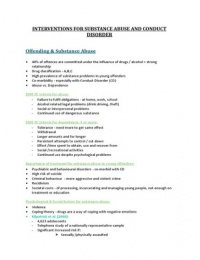
INTERVENTIONS FOR SUBSTANCE ABUSE AND CONDUCT
DISORDER
Offending & Substance Abuse
40% of offences are committed under the influence of drugs / alcohol = strong
relationship
Drug classification - A,B,C
High prevalence of substance problems in young offenders
Co-morbidity - especially with Conduct Disorder (CD)
Abuse vs. Dependence
DSM-IV criteria for abuse:
- Failure to fulfil obligations - at home, work, school
- Alcohol related legal problems (drink driving, theft)
- Social or interpersonal problems
- Continued use of dangerous substance
DSM-IV criteria for dependence: 3 or more:
- Tolerance - need more to get same effect
- Withdrawal
- Larger amounts and for longer
- Persistent attempts to control / cut down
- Effort /time spent to obtain, use and recover from
- Social /recreational activities
- Continued use despite psychological problems
Importance of treatment for substance abuse in young offenders:
Psychiatric and behavioural disorders - co-morbid with CD
High risk of suicide
Criminal behaviour - more aggressive and violent crime
Recidivism
Societal costs - of processing, incarcerating and managing young people, not enough on
treatment or education
Psychological & Social factors for substance abuse:
Violence
Coping theory - drugs are a way of coping with negative emotions
Kilpatrick et al. (2000):
- 4,023 adolescents
- Telephone study of a nationally representative sample
- Significant increased risk if:
Sexually /physically assaulted
, Witnessed violence
Patients with substance abuse problems
PTSD linked to cannabis and hard drugs
Co morbidity
Interventions for substance abuse
MST
Family therapy
Group therapy - group CBT is useful for young offenders but it is possible they may learn
bad habits from each other
Motivational interviewing - client centred, encourage motivation to change behaviour,
non judgemental, non confrontational
No systematic review for young offenders
Perry (2006):
- systematic review on all offenders - all RCTs
- 24 studies, 8936 pps
- Assess effectiveness of interventions for drug using offenders in reducing drug use
and criminal activity
- Wide range of studies, varied methodological quality
- Promising results for therapeutic communities with aftercare
- Limited conclusions can be drawn
- Broad range of studies and heterogeneity of outcome measures
- Most studies had a moderate risk of bias
Henggeler et al. (1999):
- MST vs. Usual care
- 118 met DSM criteria for substance abuse (56%) or dependence (44%)
- 4 year follow up - good - 80 pps (69%)
- 72% had psychiatric co-morbidity
- Effective in biological markers, not in self report
- No diff in psychiatric symptoms, but MST associated with a reduction in aggressive
criminal behaviour, no differences in non violent crimes
Henggeler et al. (2002):
- Follow up 4 years after Henggeler et al (1999)
- 80 pps
- Significant long term treatment effects for aggressive criminal activity (not for
property crimes)
- No long term treatment effects on psychiatric symptoms
- Some support for long term effectiveness of MST, but needs adapting
- Attrition analyses - drop out were not significantly different to completers - good
Stein et al. (2006):
- Motivational interviewing (MI) vs. Relaxation training (RT)
- In a correctional facility - not community
- 130 pps (large)
DISORDER
Offending & Substance Abuse
40% of offences are committed under the influence of drugs / alcohol = strong
relationship
Drug classification - A,B,C
High prevalence of substance problems in young offenders
Co-morbidity - especially with Conduct Disorder (CD)
Abuse vs. Dependence
DSM-IV criteria for abuse:
- Failure to fulfil obligations - at home, work, school
- Alcohol related legal problems (drink driving, theft)
- Social or interpersonal problems
- Continued use of dangerous substance
DSM-IV criteria for dependence: 3 or more:
- Tolerance - need more to get same effect
- Withdrawal
- Larger amounts and for longer
- Persistent attempts to control / cut down
- Effort /time spent to obtain, use and recover from
- Social /recreational activities
- Continued use despite psychological problems
Importance of treatment for substance abuse in young offenders:
Psychiatric and behavioural disorders - co-morbid with CD
High risk of suicide
Criminal behaviour - more aggressive and violent crime
Recidivism
Societal costs - of processing, incarcerating and managing young people, not enough on
treatment or education
Psychological & Social factors for substance abuse:
Violence
Coping theory - drugs are a way of coping with negative emotions
Kilpatrick et al. (2000):
- 4,023 adolescents
- Telephone study of a nationally representative sample
- Significant increased risk if:
Sexually /physically assaulted
, Witnessed violence
Patients with substance abuse problems
PTSD linked to cannabis and hard drugs
Co morbidity
Interventions for substance abuse
MST
Family therapy
Group therapy - group CBT is useful for young offenders but it is possible they may learn
bad habits from each other
Motivational interviewing - client centred, encourage motivation to change behaviour,
non judgemental, non confrontational
No systematic review for young offenders
Perry (2006):
- systematic review on all offenders - all RCTs
- 24 studies, 8936 pps
- Assess effectiveness of interventions for drug using offenders in reducing drug use
and criminal activity
- Wide range of studies, varied methodological quality
- Promising results for therapeutic communities with aftercare
- Limited conclusions can be drawn
- Broad range of studies and heterogeneity of outcome measures
- Most studies had a moderate risk of bias
Henggeler et al. (1999):
- MST vs. Usual care
- 118 met DSM criteria for substance abuse (56%) or dependence (44%)
- 4 year follow up - good - 80 pps (69%)
- 72% had psychiatric co-morbidity
- Effective in biological markers, not in self report
- No diff in psychiatric symptoms, but MST associated with a reduction in aggressive
criminal behaviour, no differences in non violent crimes
Henggeler et al. (2002):
- Follow up 4 years after Henggeler et al (1999)
- 80 pps
- Significant long term treatment effects for aggressive criminal activity (not for
property crimes)
- No long term treatment effects on psychiatric symptoms
- Some support for long term effectiveness of MST, but needs adapting
- Attrition analyses - drop out were not significantly different to completers - good
Stein et al. (2006):
- Motivational interviewing (MI) vs. Relaxation training (RT)
- In a correctional facility - not community
- 130 pps (large)