LCP4801 Past Paper Q & A
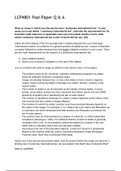
Write an essay in which you discuss the term “customary international law”. In your
essay you must define “customary international law”, describe the requirements for its
formation (with reference to applicable case law) and explain whether and to what
extent customary international law is part of South African law. [25]
Article 38 of the Statute of the ICJ provides that in settling disputes the court shall apply
“international custom, as evidence of a general practice accepted as law”. Custom is therefore
a practice followed by states because they feel legally obliged to behave in such a way. There
are two main requirements for the creation of a customary international rule:
1) Usus (settled practice)
2) Opinio iuris (a sense of obligation on the part of the states)
Usus is constant and uniform usage as defined in the Asylum case. In this regard:
The practice need not be “universal”, therefore widespread acceptance by states
would be sufficient (Fisheries Jurisdiction case).
Usage can develop between two, or only a few states to form a local or regional
custom (Case Concerning Right of Passage over Indian Territory, contrary to the
Asylum case).
The number of states is not as important as the identity of those states. In every
activity, some states’ actions are more important than others (eg the US and USSR
played an important role in developing the law of outer space).
The number of repetitions necessary to create a custom depends on the nature of the
rule involved and the number of states affected.
The duration for which the states’ practice must have persisted likewise depends on
the nature of the usage. For example, in S v Petane the court cited a GA Resolution as
a customary rule which developed with little practice (the Resolution concerned the
law of outer space).
The practice must be characterised by a degree of uniformity, or rather substantial
compliance (Nicaragua v USA). It is sufficient that the conduct of states is generally
consistent with a rule. An inconsistency should be treated as a breach of the rule,
rather than an indication that a new rule has been created.
According to the rule of the persistent objector, a state isn’t bound if it persistently
objects to the practice while the custom was being developed (AngloNorwegian
Fisheries case, North Sea Continental Shelf case).
Opinio iuris is the second requirement which must be present before the usage can become a
binding rule of customary international law. As was stated in the North Sea Continental Shelf
Q&A by yash0505
Write an essay in which you discuss the term “customary international law”. In your
essay you must define “customary international law”, describe the requirements for its
formation (with reference to applicable case law) and explain whether and to what
extent customary international law is part of South African law. [25]
Article 38 of the Statute of the ICJ provides that in settling disputes the court shall apply
“international custom, as evidence of a general practice accepted as law”. Custom is therefore
a practice followed by states because they feel legally obliged to behave in such a way. There
are two main requirements for the creation of a customary international rule:
1) Usus (settled practice)
2) Opinio iuris (a sense of obligation on the part of the states)
Usus is constant and uniform usage as defined in the Asylum case. In this regard:
The practice need not be “universal”, therefore widespread acceptance by states
would be sufficient (Fisheries Jurisdiction case).
Usage can develop between two, or only a few states to form a local or regional
custom (Case Concerning Right of Passage over Indian Territory, contrary to the
Asylum case).
The number of states is not as important as the identity of those states. In every
activity, some states’ actions are more important than others (eg the US and USSR
played an important role in developing the law of outer space).
The number of repetitions necessary to create a custom depends on the nature of the
rule involved and the number of states affected.
The duration for which the states’ practice must have persisted likewise depends on
the nature of the usage. For example, in S v Petane the court cited a GA Resolution as
a customary rule which developed with little practice (the Resolution concerned the
law of outer space).
The practice must be characterised by a degree of uniformity, or rather substantial
compliance (Nicaragua v USA). It is sufficient that the conduct of states is generally
consistent with a rule. An inconsistency should be treated as a breach of the rule,
rather than an indication that a new rule has been created.
According to the rule of the persistent objector, a state isn’t bound if it persistently
objects to the practice while the custom was being developed (AngloNorwegian
Fisheries case, North Sea Continental Shelf case).
Opinio iuris is the second requirement which must be present before the usage can become a
binding rule of customary international law. As was stated in the North Sea Continental Shelf
Q&A by yash0505