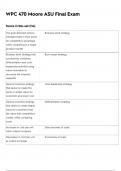
WPC 470 Moore ASU Final Exam
Terms in this set (114)
The goal-directed actions Business-level strategy
managers take in their quest
for competitive advantage
when competing in a single
product market
Business level strategy that Blue ocean strategy
successfully combines
differentiation and cost-
leadership activities using
value innovation to
reconcile the inherent
tradeoffs
Generic business strategy Cost-leadership strategy
that seeks to create the
same or similar value for
customers at a lower cost
Generic business strategy Differentiation strategy
that seeks to create higher
value for customers than
the value that competitors
create, while containing
costs
Increases in cost per unit Diseconomies of scale
when output increases
Decreases in cost per unit Economies of scale
as output increases
,Savings that come from Economies of scope
producing two or more
outputs at less cost than
producing each output
individually, despite using
the same resources and
technology
Output range needed to Minimum efficient scale (MES)
bring down the cost per
unit as much as possible,
allowing a firm to stake out
the lowest-cost position
that is achievable through
economies of scale
Choices between a cost or Strategic trade-offs
value position. Such
choices are necessary
because higher value
creation tends to generate
higher cost
A new product which Architectural innovation
known components, based
on existing technologies,
are reconfigured In a novel
way to attack new markets
An innovation that Disruptive innovation
leverages new technologies
to attack existing markets
from the bottom up
An innovation that squarely Incremental innovation
builds on an established
knowledge base and
steadily improves an
existing product or service
, New ways to produce Process innovation
existing products or deliver
existing services
The simultaneous pursuit of Value innovation
differentiation and low cost
in a way that creates a leap
in value for both the firm
and the consumers;
considered a cornerstone
of blue ocean strategy
Conceptual model that Crossing-the-chasm framework
shows how each stage of
the industry life cycle is
dominated by a different
customer group
The process by which Entrepreneurship
people undertake
economic risk to innovate-
to create new products,
processes, and sometimes
new organizations
Competitive benefits that First-mover advantages
accrue to the successful
innovator
The five different stages; Industry life cycle
introduction, growth,
shakeout, maturity, and
decline, that occur in the
evolution of an industry
over time
Terms in this set (114)
The goal-directed actions Business-level strategy
managers take in their quest
for competitive advantage
when competing in a single
product market
Business level strategy that Blue ocean strategy
successfully combines
differentiation and cost-
leadership activities using
value innovation to
reconcile the inherent
tradeoffs
Generic business strategy Cost-leadership strategy
that seeks to create the
same or similar value for
customers at a lower cost
Generic business strategy Differentiation strategy
that seeks to create higher
value for customers than
the value that competitors
create, while containing
costs
Increases in cost per unit Diseconomies of scale
when output increases
Decreases in cost per unit Economies of scale
as output increases
,Savings that come from Economies of scope
producing two or more
outputs at less cost than
producing each output
individually, despite using
the same resources and
technology
Output range needed to Minimum efficient scale (MES)
bring down the cost per
unit as much as possible,
allowing a firm to stake out
the lowest-cost position
that is achievable through
economies of scale
Choices between a cost or Strategic trade-offs
value position. Such
choices are necessary
because higher value
creation tends to generate
higher cost
A new product which Architectural innovation
known components, based
on existing technologies,
are reconfigured In a novel
way to attack new markets
An innovation that Disruptive innovation
leverages new technologies
to attack existing markets
from the bottom up
An innovation that squarely Incremental innovation
builds on an established
knowledge base and
steadily improves an
existing product or service
, New ways to produce Process innovation
existing products or deliver
existing services
The simultaneous pursuit of Value innovation
differentiation and low cost
in a way that creates a leap
in value for both the firm
and the consumers;
considered a cornerstone
of blue ocean strategy
Conceptual model that Crossing-the-chasm framework
shows how each stage of
the industry life cycle is
dominated by a different
customer group
The process by which Entrepreneurship
people undertake
economic risk to innovate-
to create new products,
processes, and sometimes
new organizations
Competitive benefits that First-mover advantages
accrue to the successful
innovator
The five different stages; Industry life cycle
introduction, growth,
shakeout, maturity, and
decline, that occur in the
evolution of an industry
over time