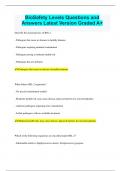
BioSafety Levels Questions and Answers Latest Version Graded A+ Describe the char acteristics of BSL -1. - Pathogens that cause no disease in healthy humans - Pathogens requiring minimal containment - Pathogens posing a moderate health risk - Pathogens that are airborne ✔✔Pathogens that cause no disease in healthy humans What defines BS L-2 organisms? - No special containment needed - Moderate health risk, may cause disease, physical barriers for aerosols/splashes - Airborne pathogens requiring strict containment - Lethal pathogens with no available treatment ✔✔Moderate health risk, may cause disease, physical barriers for aerosols/splashes Which of the following organisms are classified under BSL -2? - Salmonella enterica, Staphylococcus aureus, Streptococcus pyogenes
Exam (elaborations)
BioSafety Levels Questions and Answers Latest Version Graded A+
Rating
Sold
-
Pages
4
Grade
A+
Uploaded on
13-07-2024
Written in
2023/2024
BioSafety Levels Questions and Answers Latest Version Graded A+ Describe the characteristics of BSL-1. - Pathogens that cause no disease in healthy humans - Pathogens requiring minimal containment - Pathogens posing a moderate health risk - Pathogens that are airborne Pathogens that cause no disease in healthy humans What defines BSL-2 organisms? - No special containment needed - Moderate health risk, may cause disease, physical barriers for aerosols/splashes - Airborne pathogens requiring strict containment - Lethal pathogens with no available treatment Moderate health risk, may cause disease, physical barriers for aerosols/splashes Which of the following organisms are classified under BSL-2? - Salmonella enterica, Staphylococcus aureus, Streptococcus pyogenes - Bacillus anthracis, Mycobacterium tuberculosis - Ebola, Smallpox - Escherichia coli, Clostridium tetani Salmonella enterica, Staphylococcus aureus, Streptococcus pyogenes What are the key features of BSL-3? - Minimal health risk and no special containment - Serious/lethal airborne pathogens, special containment, restricted access - Pathogens posing moderate health risk with physical barriers - Pathogens requiring no specific containment Serious/lethal airborne pathogens, special containment, restricted access Which organisms fall under BSL-3 classification? - Ebola, Smallpox - Bacillus anthracis, Mycobacterium tuberculosis
Show more
Read less
Institution
BioSafety Levels
Course
BioSafety Levels
Whoops! We can’t load your doc right now. Try again or contact support.
Written for
- Institution
- BioSafety Levels
- Course
- BioSafety Levels
Document information
- Uploaded on
- July 13, 2024
- Number of pages
- 4
- Written in
- 2023/2024
- Type
- Exam (elaborations)
- Contains
- Questions & answers
Subjects
-
biosafety levels questions and answers latest vers
Content preview
$9.49
Get access to the full document:
100% satisfaction guarantee
Immediately available after payment
Both online and in PDF
No strings attached

Also available in package deal
Package deal
Biosafety Bundled Exams Questions and Answers Latest Versions (2024/2025) (Complete and Accurate)
12
2024
$ 120.88
More info