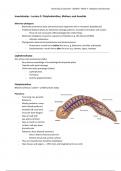
University of Leicester - BS1070 - Week 4 - Adaption and diversity
Invertebrates - Lecture 2: Platyhelminthes, Molluscs and Annelids
Bilaterian phylogeny
- Bilaterally symmetrical (one symmetrical axis) organisms with a mesoderm (triploblastic)
- Traditional bilateral phyla are defined by cleavage patterns, mesoderm formation and coelom
- These do not necessarily reflect phylogenetic relationships
- Molecular phylogeny is based on sequence similarities (e.g. 18S ribosomal RNA)
- Indicates relatedness
- Phylogenetics determined protostomes and deuterostomes
- Protostome: mouth forms before the anus e.g. flatworms, annelids, arthropods
- Deuterostomes: mouth forms after the anus e.g. humans, tigers, monkeys
Lophotrochozoa
One of two main protostome clades
- Very diverse assemblage of morphologically disparate phyla
- Typically with spiral cleavage
- Unites two major groupings (clades)
- Lophophorata
- Trochozoa
- And the platyhelminthes
Platyhelminthes
Bilateria without a coelom - 20 000 species today
Planarians
- Free living non-parasitic
flatworms
- Mostly predators, creep
with ciliated epidermis
(smaller) OR crawl with
muscular wave (larger)
- Have a head with
eye-spots and brain
- Have a mouth on ventral
surface, half way down
the belly side
- Flatworms have bilateral symmetry
- Have a distinct head and tail end
- Distinct dorsal and ventral surfaces
- They are mesodermal, therefore triploblastic
- Have tissues and organs → CNS: brain and longitudinal nerve cords
, University of Leicester - BS1070 - Week 4 - Adaption and diversity
- Planarians do not have an anus
- Eat and excrete out of their mouth
- Acoelomates: no body cavity
- Mesodermal mesenchymal fills entire space between endoderm and ectoderm
- No circulatory or respiratory organs
- Simple diffusion of gases through their body surface
- Thin and long, increases surface area
- Gut forms a gastrovascular system
Planarians - reproduction
- Sexual hermaphrodites (male and female gametes)
- Also asexually reproduce via spontaneous fissions
- Experiment and accidental regeneration
- Can be cut up lengthwise or across, each piece will degenerate into the complete animal
Parasitic platyhelminthes (endoparasites)
- Trematoda (flukes): tissue parasites - blood, liver and lungs
- Cestoda (tapeworms): gut parasites
- Consequences of living indies the gits of another organism:
- Needs for resistant covering to protect against host’s digestive enzymes → loss of cilia
- Surrounded by food, no directional external threats → reduction of nervous system, loss
of cephalisation
- Don’t need a gut for yourself → loss of gut, direct absorption through microvilli on body
surface
Lophophorata
- Filter feeders
- With a lophophore → horse shoe shaped feeding organ of ciliated tentacles around the mouth
- Have four clades (considered phyla)
- Bryozoa: ‘moss animals’
- Entoprocta/kamptozoa
- Phoronida
- Brachipoda: ‘lamp shells’
Trochozoa
- Typically develop through a planktonic trochophore
larva
- Include mollusca, annelida and nemertea
-
Form of trochozoa often found in aquatic animals.
Invertebrates - Lecture 2: Platyhelminthes, Molluscs and Annelids
Bilaterian phylogeny
- Bilaterally symmetrical (one symmetrical axis) organisms with a mesoderm (triploblastic)
- Traditional bilateral phyla are defined by cleavage patterns, mesoderm formation and coelom
- These do not necessarily reflect phylogenetic relationships
- Molecular phylogeny is based on sequence similarities (e.g. 18S ribosomal RNA)
- Indicates relatedness
- Phylogenetics determined protostomes and deuterostomes
- Protostome: mouth forms before the anus e.g. flatworms, annelids, arthropods
- Deuterostomes: mouth forms after the anus e.g. humans, tigers, monkeys
Lophotrochozoa
One of two main protostome clades
- Very diverse assemblage of morphologically disparate phyla
- Typically with spiral cleavage
- Unites two major groupings (clades)
- Lophophorata
- Trochozoa
- And the platyhelminthes
Platyhelminthes
Bilateria without a coelom - 20 000 species today
Planarians
- Free living non-parasitic
flatworms
- Mostly predators, creep
with ciliated epidermis
(smaller) OR crawl with
muscular wave (larger)
- Have a head with
eye-spots and brain
- Have a mouth on ventral
surface, half way down
the belly side
- Flatworms have bilateral symmetry
- Have a distinct head and tail end
- Distinct dorsal and ventral surfaces
- They are mesodermal, therefore triploblastic
- Have tissues and organs → CNS: brain and longitudinal nerve cords
, University of Leicester - BS1070 - Week 4 - Adaption and diversity
- Planarians do not have an anus
- Eat and excrete out of their mouth
- Acoelomates: no body cavity
- Mesodermal mesenchymal fills entire space between endoderm and ectoderm
- No circulatory or respiratory organs
- Simple diffusion of gases through their body surface
- Thin and long, increases surface area
- Gut forms a gastrovascular system
Planarians - reproduction
- Sexual hermaphrodites (male and female gametes)
- Also asexually reproduce via spontaneous fissions
- Experiment and accidental regeneration
- Can be cut up lengthwise or across, each piece will degenerate into the complete animal
Parasitic platyhelminthes (endoparasites)
- Trematoda (flukes): tissue parasites - blood, liver and lungs
- Cestoda (tapeworms): gut parasites
- Consequences of living indies the gits of another organism:
- Needs for resistant covering to protect against host’s digestive enzymes → loss of cilia
- Surrounded by food, no directional external threats → reduction of nervous system, loss
of cephalisation
- Don’t need a gut for yourself → loss of gut, direct absorption through microvilli on body
surface
Lophophorata
- Filter feeders
- With a lophophore → horse shoe shaped feeding organ of ciliated tentacles around the mouth
- Have four clades (considered phyla)
- Bryozoa: ‘moss animals’
- Entoprocta/kamptozoa
- Phoronida
- Brachipoda: ‘lamp shells’
Trochozoa
- Typically develop through a planktonic trochophore
larva
- Include mollusca, annelida and nemertea
-
Form of trochozoa often found in aquatic animals.