
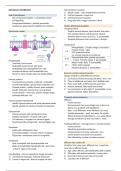
BIOLOGICAL MEMBRANES Cell membrane receptors
1) Specific shape – only complimentary can bind
Role of membranes 2) Cell that responds = target cell
- Site of chemical reactions + cytoskeleton attach 3) Membrane bound receptors
- Cell signalling 4) Drugs also bind + trigger response / block
- Compartmentalisation = partially permeable
membranes allow specific conditions for reactions Factors affecting permeability
Changing solvent
Fluid mosaic model - Organic solvents dissolve mem (alcohol, less polar)
- Pure alcohols destroy cells (bacteria), ethanol
dissolves lipids in mem, lose struc, ↑ permeability
- Nonpolar (benzene) enter membrane + disrupts
Temperature
Phospholipids ↓ kinetic energy so not move
Packed closely = rigid
<0
ATP production slows
Ice crystals may pierce membrane
Phospholipids fluid, partially permeable
0-45
Phospholipids ↑ temp ↑ kinetic energy ↑ permeability
- 7nm thick, free to move Bilayer melts, fluid, ↑ permeability
- Hydrophilic head interact with water 45 < Water inside expands
Proteins denature ↑ permeability
- Hydrophobic tail (amphipathic) form core
- Arrange into bilayer with hydrophobic core
- Barrier to water soluble subst, fat soluble diffuse Beetroot contains pigment betalain
Change method by using different solvents
Intrinsic proteins 1) Cut 5 pieces of beetroot using cork borer, rinse + dry
- Transmembrane proteins, scattered / embedded 2) Place in indifferent test tubes, 5cm3 distilled water
- Aa with hydrophobic r group interact hphobic core 3) Place water baths at diff temps for same time
- Channel protein – hphilic channel, polar moleules, 4) Remove beetroot, filter liquid into cuvette
specific molecules, passive down conc gradient 5) Use colorimeter on blue light (↑ permeability, more
- Carrier protein – move ions, protein changes shape, pigment released, higher absorption)
facilitated diffusion + AT
Transport across membrane
Extrinsic proteins (peripheral) Diffusion
- Hphilic R groups interact with polar phosphate heads - Passive process
- Specific position for chemical reaction to take place - Net movement from area of high conc to low conc
(down conc gradient) until equilibrium
Glycoproteins - Rate – conc difference, mem thickness, SA, temp
- Intrinsic proteins with carbohydrate chain - Partially permeable – small, non-polar, fat soluble
- Stabilise membrane = H bonds with water diffuse between phospholipids (o2, co2), polar diffuse
- Cell adhesion + receptors for chemical signals through membrane at slow rate (water + urea)
- Neurotransmitters/drugs bind + prevent/tigger resp
Facilitated diffusion = through carrier + channel proteins
Glycolipids - Passive process
- Lipids with carbohydrate chain - Selectively permeable membrane
- Cell marker/antigen = immune system recognises - Channel proteins for polar molecules + ions
- Glycocalyx = membrane cover for recognition - Carrier proteins only down conc gradient
- Rate affected by number of proteins present
Cholesterol
- Lipid, hydrophilic end and hydrophobic end Diffusion into model cells
- Binds to phospholipid hydrophobic tail = pack close Variation: SA in same conc, different conc + equal size,
- ↓ fluid ↑ rigid, not too solid same size in different temps
1) Agar cubes diff sizes, phenolphthalein (pink in alkali)
Cell signalling = comms responds to change (cascade) 2) Fill beaker with sodium hydroxide + insert cubes
1) Cell released messenger molecule (hormone) 3) Record the time for each cube to turn pink
2) Travels to target cell + bind to receptor on mem 4) Calculate rate of diffusion
1) Specific shape – only complimentary can bind
Role of membranes 2) Cell that responds = target cell
- Site of chemical reactions + cytoskeleton attach 3) Membrane bound receptors
- Cell signalling 4) Drugs also bind + trigger response / block
- Compartmentalisation = partially permeable
membranes allow specific conditions for reactions Factors affecting permeability
Changing solvent
Fluid mosaic model - Organic solvents dissolve mem (alcohol, less polar)
- Pure alcohols destroy cells (bacteria), ethanol
dissolves lipids in mem, lose struc, ↑ permeability
- Nonpolar (benzene) enter membrane + disrupts
Temperature
Phospholipids ↓ kinetic energy so not move
Packed closely = rigid
<0
ATP production slows
Ice crystals may pierce membrane
Phospholipids fluid, partially permeable
0-45
Phospholipids ↑ temp ↑ kinetic energy ↑ permeability
- 7nm thick, free to move Bilayer melts, fluid, ↑ permeability
- Hydrophilic head interact with water 45 < Water inside expands
Proteins denature ↑ permeability
- Hydrophobic tail (amphipathic) form core
- Arrange into bilayer with hydrophobic core
- Barrier to water soluble subst, fat soluble diffuse Beetroot contains pigment betalain
Change method by using different solvents
Intrinsic proteins 1) Cut 5 pieces of beetroot using cork borer, rinse + dry
- Transmembrane proteins, scattered / embedded 2) Place in indifferent test tubes, 5cm3 distilled water
- Aa with hydrophobic r group interact hphobic core 3) Place water baths at diff temps for same time
- Channel protein – hphilic channel, polar moleules, 4) Remove beetroot, filter liquid into cuvette
specific molecules, passive down conc gradient 5) Use colorimeter on blue light (↑ permeability, more
- Carrier protein – move ions, protein changes shape, pigment released, higher absorption)
facilitated diffusion + AT
Transport across membrane
Extrinsic proteins (peripheral) Diffusion
- Hphilic R groups interact with polar phosphate heads - Passive process
- Specific position for chemical reaction to take place - Net movement from area of high conc to low conc
(down conc gradient) until equilibrium
Glycoproteins - Rate – conc difference, mem thickness, SA, temp
- Intrinsic proteins with carbohydrate chain - Partially permeable – small, non-polar, fat soluble
- Stabilise membrane = H bonds with water diffuse between phospholipids (o2, co2), polar diffuse
- Cell adhesion + receptors for chemical signals through membrane at slow rate (water + urea)
- Neurotransmitters/drugs bind + prevent/tigger resp
Facilitated diffusion = through carrier + channel proteins
Glycolipids - Passive process
- Lipids with carbohydrate chain - Selectively permeable membrane
- Cell marker/antigen = immune system recognises - Channel proteins for polar molecules + ions
- Glycocalyx = membrane cover for recognition - Carrier proteins only down conc gradient
- Rate affected by number of proteins present
Cholesterol
- Lipid, hydrophilic end and hydrophobic end Diffusion into model cells
- Binds to phospholipid hydrophobic tail = pack close Variation: SA in same conc, different conc + equal size,
- ↓ fluid ↑ rigid, not too solid same size in different temps
1) Agar cubes diff sizes, phenolphthalein (pink in alkali)
Cell signalling = comms responds to change (cascade) 2) Fill beaker with sodium hydroxide + insert cubes
1) Cell released messenger molecule (hormone) 3) Record the time for each cube to turn pink
2) Travels to target cell + bind to receptor on mem 4) Calculate rate of diffusion


