
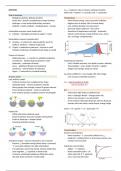
ENZYMES Vmax = maximum rate of enzyme catalysed reaction
Initial rate = fastest (↑ successful coll, ↑ substrate)
Role of enzymes
- Biological catalysts, globular proteins Temperature
- Active site = specific complimentary shape (tertiary) - More kinetic energy, more successful collisions
- Hydrogen + ionic bonds hold tertiary structure - Highest rate of activity (40c in human body)
- Anabolic = build, catabolic = breaking down + energy - Lose activity abruptly once pass point
- Decrease below optimum = less active
Intracellular enzymes (work inside cells) - Denatures if temperature too high – molecules
1) Catalase = hydrogen peroxide to oxygen + water vibrate, bonds break, change tertiary struc, active
site, no longer complimentary
Extracellular enzymes (outside cells)
1) Amylase = in saliva from salivary glands, starch to
maltose, (maltase = maltose to glucose)
2) Trypsin = produced in pancreas + secrete in small
intestine, hydrolysis of peptide bonds (large to small)
Groups of enzymes
- Oxidoreductase – e- transfer in oxidation/reduction
- Transferase – functional group between mole Temperature extremes
- Hydrolase – hydrolysis of bonds - Cold = flexible structure, less stable (oceans, altitude)
- Lyase – splitting of bonds (not hydrolysis) - Thermophiles = more stable, H bonds + sulphur
- Isomerase – isomerisation of molecules bridges (hot springs, deep sea vents)
- Ligase – 2 molecules by covalent bonding
Q10 temp coefficient = rate change with 10C change
Enzyme action 2 for enzyme controlled reactions
Lock and key model
- Tertiary structure has complimentary shape Q10 = rate of reaction at t+10c
- Substrate binds – enzyme substrate complex rate of reaction at t
- Atom groups close enough, enzyme R groups interact
- Forms temporary bonds – strain on substrate pH
- Form enzyme product complex (enzyme unchanged) - Active sites right shape at optimum pH
- Ionic + hydrogen bonds = change active site
- More H ions present = low pH (acidic)
- H ions interact with polar R groups, the less R groups
interact with each other, bonds break, change shape
Saliva = 7-8 / gastric = 1-2 / pancreatic = 8
Induced fit
- Initial interaction relatively weak
- Enzymes tertiary structure changes (strong bind)
- Strain of substrate = weaken bonds
- Lowering activation energy
Concentration
Enzyme concentration
- More enzymes = ↑ successful collision to vmax
- Substrate = limiting factor as if increase enzyme conc,
Activation energy = amount required to start reaction reaction not increased
- Enzyme ↓ activation energy (lower temp + pressure)
- ↑ successful collisions (no right orientation) Substrate concentration
- If 2 substrates need to be joined, enzyme holds them - Higher = ↑ collisions
close together, ↓ repulsion so bond easily - Reach saturation point – all
- If enzyme catalysing breakdown, fitting into active active sites full, if ↑ substrate
site puts strain on bonds = break easily conc, rate stays the same
Initial rate = fastest (↑ successful coll, ↑ substrate)
Role of enzymes
- Biological catalysts, globular proteins Temperature
- Active site = specific complimentary shape (tertiary) - More kinetic energy, more successful collisions
- Hydrogen + ionic bonds hold tertiary structure - Highest rate of activity (40c in human body)
- Anabolic = build, catabolic = breaking down + energy - Lose activity abruptly once pass point
- Decrease below optimum = less active
Intracellular enzymes (work inside cells) - Denatures if temperature too high – molecules
1) Catalase = hydrogen peroxide to oxygen + water vibrate, bonds break, change tertiary struc, active
site, no longer complimentary
Extracellular enzymes (outside cells)
1) Amylase = in saliva from salivary glands, starch to
maltose, (maltase = maltose to glucose)
2) Trypsin = produced in pancreas + secrete in small
intestine, hydrolysis of peptide bonds (large to small)
Groups of enzymes
- Oxidoreductase – e- transfer in oxidation/reduction
- Transferase – functional group between mole Temperature extremes
- Hydrolase – hydrolysis of bonds - Cold = flexible structure, less stable (oceans, altitude)
- Lyase – splitting of bonds (not hydrolysis) - Thermophiles = more stable, H bonds + sulphur
- Isomerase – isomerisation of molecules bridges (hot springs, deep sea vents)
- Ligase – 2 molecules by covalent bonding
Q10 temp coefficient = rate change with 10C change
Enzyme action 2 for enzyme controlled reactions
Lock and key model
- Tertiary structure has complimentary shape Q10 = rate of reaction at t+10c
- Substrate binds – enzyme substrate complex rate of reaction at t
- Atom groups close enough, enzyme R groups interact
- Forms temporary bonds – strain on substrate pH
- Form enzyme product complex (enzyme unchanged) - Active sites right shape at optimum pH
- Ionic + hydrogen bonds = change active site
- More H ions present = low pH (acidic)
- H ions interact with polar R groups, the less R groups
interact with each other, bonds break, change shape
Saliva = 7-8 / gastric = 1-2 / pancreatic = 8
Induced fit
- Initial interaction relatively weak
- Enzymes tertiary structure changes (strong bind)
- Strain of substrate = weaken bonds
- Lowering activation energy
Concentration
Enzyme concentration
- More enzymes = ↑ successful collision to vmax
- Substrate = limiting factor as if increase enzyme conc,
Activation energy = amount required to start reaction reaction not increased
- Enzyme ↓ activation energy (lower temp + pressure)
- ↑ successful collisions (no right orientation) Substrate concentration
- If 2 substrates need to be joined, enzyme holds them - Higher = ↑ collisions
close together, ↓ repulsion so bond easily - Reach saturation point – all
- If enzyme catalysing breakdown, fitting into active active sites full, if ↑ substrate
site puts strain on bonds = break easily conc, rate stays the same


