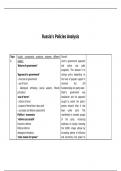
Russia’s Policies Analysis
Topic Usually comparative questions between different Overall:
1 leaders: Lenin’s government approach
‘Nature of government’ and nature was quite
pragmatic. This allowed it to
‘Approach to government’ change policy depending on
- structure of government the level of popular support it
- use of terror received but still
- ideological orthodoxy (social aspects, Marxist fundamentally one party-state
principles) Stalin’s government was
‘use of terror’ totalitarian and his approach
- victims of terror sought to extent the party’s
- purpose of terror/how it was used powers beyond what it had
- successes and failures assessment been under Lenin. This
Politics + economics manifested in constant purges
‘reforms successful’ of the party, increasing
Economic reforms emphasis on loyalty, boosting
Political reforms the USSR’s image abroad by
Ideological orthodoxy increasing sphere of influence
‘main reason for power’ and becoming rival power to
, Bureaucracy (politics) USA.
Policy (economics) Khrushchev’s government was
Terror defined by its attempts to
reform the system. He wanted
increasing regional power to
try and recreate what the
original Bolsheviks may have
intended but he still relied on
fundamental aspects of the
system to continue: terror, one
party-state, patronage, a good
international image
Brezhnev’s government was
defined by his attempts to
conserve the system which led
to stagnation, growth of
corruption and gerontocracy.
Any changes he made were to
conserve the existing socialist
system and make
improvements enough to
sustain it.
Topic Cost benefit or how well it modernised (s/f question): Heavy industrialisation did
2 Stalin included in 5/7 modernise the Soviet Union
, How well policy ‘modernised’ Soviet Union Agricultural collectivisation
- Industry (split into: rearmament, heavy, light failed as the human cost too
industry) high so productivity was low
- Agriculture (split into: collective farms, outside Russia and any reforms still did
regions, social aspect) relatively poorly compared to
- Ideological orthodoxy (workers rights and social USA agriculture
aspects)
Politics + economics
‘reforms successful’
‘main reason for power’
Topic Extent a policy changed/success of control Policy on religion changed a
3 Role of named factor eg secret police lost by Brezhnev as it ended up
Government restrictions (arts culture- 2) being more reconciliatory
Mass media and propaganda (1) which was not the case under
Personality cults (1) Lenin and Khrushchev. Under
Religion (2) Stalin, government attitudes
very much depended on the
- Aims/way policy was enacted and how this changed external circumstances.
- victims of policy and how this differed Policy on secret police was
- successes and failures of the policy and how this largely similar though there
differed were some detailed changes
like the fact that Stalin’s
purges were much more
extensive, Khrushchev and
Brezhnev adopted more of a
, surveillance and repressive
approach
Policy on arts and culture did
change as it reflected differing
trends amidst the Soviet
Union- began with
revolutionary art then became
quite industry focused, then
with de-Stalinization it became
much more satirical. By the
time Brezhnev was leader,
there was an increasing divide
between dissident artwork and
nostalgic ‘conservative’
artwork
Soviet control of the media
was largely the same.
Fundamentally, censorship was
key however key differences
arose between Stalin and other
periods because Stalin
extended use of media to be
totalitarian (rather than just
serving as propaganda)
whereas after de-Stalinization,
Topic Usually comparative questions between different Overall:
1 leaders: Lenin’s government approach
‘Nature of government’ and nature was quite
pragmatic. This allowed it to
‘Approach to government’ change policy depending on
- structure of government the level of popular support it
- use of terror received but still
- ideological orthodoxy (social aspects, Marxist fundamentally one party-state
principles) Stalin’s government was
‘use of terror’ totalitarian and his approach
- victims of terror sought to extent the party’s
- purpose of terror/how it was used powers beyond what it had
- successes and failures assessment been under Lenin. This
Politics + economics manifested in constant purges
‘reforms successful’ of the party, increasing
Economic reforms emphasis on loyalty, boosting
Political reforms the USSR’s image abroad by
Ideological orthodoxy increasing sphere of influence
‘main reason for power’ and becoming rival power to
, Bureaucracy (politics) USA.
Policy (economics) Khrushchev’s government was
Terror defined by its attempts to
reform the system. He wanted
increasing regional power to
try and recreate what the
original Bolsheviks may have
intended but he still relied on
fundamental aspects of the
system to continue: terror, one
party-state, patronage, a good
international image
Brezhnev’s government was
defined by his attempts to
conserve the system which led
to stagnation, growth of
corruption and gerontocracy.
Any changes he made were to
conserve the existing socialist
system and make
improvements enough to
sustain it.
Topic Cost benefit or how well it modernised (s/f question): Heavy industrialisation did
2 Stalin included in 5/7 modernise the Soviet Union
, How well policy ‘modernised’ Soviet Union Agricultural collectivisation
- Industry (split into: rearmament, heavy, light failed as the human cost too
industry) high so productivity was low
- Agriculture (split into: collective farms, outside Russia and any reforms still did
regions, social aspect) relatively poorly compared to
- Ideological orthodoxy (workers rights and social USA agriculture
aspects)
Politics + economics
‘reforms successful’
‘main reason for power’
Topic Extent a policy changed/success of control Policy on religion changed a
3 Role of named factor eg secret police lost by Brezhnev as it ended up
Government restrictions (arts culture- 2) being more reconciliatory
Mass media and propaganda (1) which was not the case under
Personality cults (1) Lenin and Khrushchev. Under
Religion (2) Stalin, government attitudes
very much depended on the
- Aims/way policy was enacted and how this changed external circumstances.
- victims of policy and how this differed Policy on secret police was
- successes and failures of the policy and how this largely similar though there
differed were some detailed changes
like the fact that Stalin’s
purges were much more
extensive, Khrushchev and
Brezhnev adopted more of a
, surveillance and repressive
approach
Policy on arts and culture did
change as it reflected differing
trends amidst the Soviet
Union- began with
revolutionary art then became
quite industry focused, then
with de-Stalinization it became
much more satirical. By the
time Brezhnev was leader,
there was an increasing divide
between dissident artwork and
nostalgic ‘conservative’
artwork
Soviet control of the media
was largely the same.
Fundamentally, censorship was
key however key differences
arose between Stalin and other
periods because Stalin
extended use of media to be
totalitarian (rather than just
serving as propaganda)
whereas after de-Stalinization,