BS1070 - Week 4 - Adaptation and Diversity
Invertebrates - Lecture 1: Porifera and Cnidaria
What is a phylum?
- A phylum unites animals with similar body plans
- DIfferent phyla show fundamentally different body plans
- Common body plans also reflect relatedness in descent
- Phyla are simply major clades - how major does a clade have to be to count as a phylum?
- What are the fundamental body plan features?
- Body symmetry: radial or bilateral?
- Number of germ layers: diploblast or triploblast?
- Type of body cavity
- Developmental fate of the blastopore: protostomes or deuterostomes
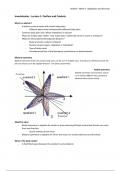
Bilateral symmetry
Bilateral symmetry in fish. Has various body axes, can be ‘cut’ in multiple ways. To produce an identical animal, the
fish can only be cut in the sagittal direction - one plane of symmetry.
Radial symmetry
Radially symmetric sea anemone. Can be
cut in various different axes, producing
identical halves of the animal.
Adaptive value
- Radial symmetry is adaptive for sessile or slow-swimming lifestyle as food and threats can come
from any direction
- Sessile animals do not move
- Bilateral symmetry is adaptive for life on the move, for animals that hunt and find food
What is the body cavity?
- A fluid filled space between the ectoderm and endoderm
Invertebrates - Lecture 1: Porifera and Cnidaria
What is a phylum?
- A phylum unites animals with similar body plans
- DIfferent phyla show fundamentally different body plans
- Common body plans also reflect relatedness in descent
- Phyla are simply major clades - how major does a clade have to be to count as a phylum?
- What are the fundamental body plan features?
- Body symmetry: radial or bilateral?
- Number of germ layers: diploblast or triploblast?
- Type of body cavity
- Developmental fate of the blastopore: protostomes or deuterostomes
Bilateral symmetry
Bilateral symmetry in fish. Has various body axes, can be ‘cut’ in multiple ways. To produce an identical animal, the
fish can only be cut in the sagittal direction - one plane of symmetry.
Radial symmetry
Radially symmetric sea anemone. Can be
cut in various different axes, producing
identical halves of the animal.
Adaptive value
- Radial symmetry is adaptive for sessile or slow-swimming lifestyle as food and threats can come
from any direction
- Sessile animals do not move
- Bilateral symmetry is adaptive for life on the move, for animals that hunt and find food
What is the body cavity?
- A fluid filled space between the ectoderm and endoderm