
1. Lecture 1
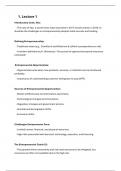
Introductory Case: Jibo:
- The case of Jibo, a social home robot launched in 2017 and shut down in 2019, to
illustrate the challenges in entrepreneurship despite initial success and funding.
Defining Entrepreneurship:
- Traditional views (e.g., Cantillon's and Kihlstrom & Laffont's perspectives on risk).
- A modern definition by H. Stevenson: "the pursuit of opportunity beyond resources
controlled."
Entrepreneurial Opportunities:
- Opportunities arise when new products, services, or methods can be introduced
profitably.
- Importance of understanding customer willingness-to-pay (WTP).
Sources of Entrepreneurial Opportunities:
- Market inefficiencies and information asymmetry.
- Technological changes and innovations.
- Regulatory changes and government actions.
- Societal and demographic shifts.
- Economic shifts.
Challenges Entrepreneurs Face:
- Limited human, financial, and physical resources.
- High risks associated with demand, technology, execution, and financing.
The Entrepreneurial Catch-22:
- The paradox where uncertainty and risk need resources to be mitigated, but
resources are often not available due to the high risk.
,Importance of Entrepreneurship:
- Startups' significant contribution to productivity growth and job creation/destruction.
1.1 Eisenmann 2013
Tom Eisenmann's article, "Entrepreneurship: A Working Definition," published in the
Harvard Business Review in 2013, offers a clear and practical definition of
entrepreneurship, drawing on the work of Howard Stevenson from Harvard Business
School.
Key Points of the Article:
1. Elastic Definition of Entrepreneurship:
- The term "entrepreneurship" has varied meanings for different people. Some
associate it with venture capital-backed startups, others with any small business, and
still others with corporate entrepreneurship.
2. Howard Stevenson’s Definition:
- Stevenson defines entrepreneurship as "the pursuit of opportunity beyond resources
controlled." This definition emphasizes the relentless focus and urgency entrepreneurs
must maintain, as they often work against a ticking clock with limited resources.
3. Components of the Definition:
- Pursuit: Reflects the focused and urgent approach entrepreneurs must adopt due to
limited resources and the need for rapid progress.
- Opportunity: Involves offering something novel, whether through innovative products,
new business models, improved existing products, or targeting new customer segments.
- Beyond Resources Controlled: Highlights the resource constraints entrepreneurs
face at the outset, relying primarily on their own capital and needing to bootstrap or seek
additional resources to grow.
,4. Types of Risks in Entrepreneurship:
- Demand Risk: Uncertainty about whether customers will adopt the product.
- Technology Risk: Challenges in achieving necessary scientific or engineering
breakthroughs.
- Execution Risk: Difficulties in attracting the right talent and partners.
- Financing Risk: Issues in securing external capital under reasonable terms.
5. Managing the Entrepreneurial Catch-22:
- Entrepreneurs must balance the need to reduce risk while lacking sufficient
resources, making it challenging to attract further resources without proving the concept
first.
- Four tactics to manage this include:
- Lean Experimentation: Using a Minimum Viable Product (MVP) to test business
model hypotheses quickly and cheaply.
- Staged Investing: Addressing risks sequentially, using resources only as needed to
reach specific milestones.
- Partnering: Leveraging another organization’s resources or renting resources to avoid
large fixed costs.
- Storytelling: Inspiring others with a compelling vision to garner support and
resources despite high risks.
6. Practical Implications of the Definition:
- Entrepreneurial Management: Entrepreneurship is viewed as a unique management
approach rather than a specific phase or role within a company.
- Guidance for Action: The definition provides a framework for entrepreneurial action,
highlighting the importance of being inventive, opportunistic, and persuasive due to
resource constraints.
, Eisenmann concludes by emphasizing the broad applicability of this definition. It
encourages a wider understanding of entrepreneurship as a driving force for economic
development and societal change, applicable within various organizational contexts,
including large corporations. This perspective is meant to inspire and guide aspiring
entrepreneurs by focusing on managing opportunities beyond their immediate control.
1.2 Eckhardt & Shane 2003
Summary of "Opportunities and Entrepreneurship" by Eckhardt and Shane (2003)
Introduction
The article by Eckhardt and Shane extends the theoretical framework of
entrepreneurship by focusing on the role of opportunities in the entrepreneurial process.
This perspective moves away from traditional views that focus on the individual traits of
entrepreneurs, instead highlighting the importance of the nexus between enterprising
individuals and valuable opportunities.
Existing Theories of Entrepreneurship
The article critiques traditional theories of entrepreneurship that often assume
equilibrium conditions and stable individual traits. These theories typically use cross-
sectional empirical tests to compare different types of people, assuming that
entrepreneurial behavior can be explained by stable attributes. Eckhardt and Shane
argue that these equilibrium assumptions are problematic and insufficient for
understanding entrepreneurship.
Moving Away from Existing Theories
The authors advocate for a disequilibrium framework that focuses on the existence and
characteristics of opportunities. They emphasize that opportunities, rather than
individual traits, should be the primary unit of analysis in entrepreneurship research.
This approach recognizes that opportunities can arise from changes in technology,
regulation, market inefficiencies, and societal shifts, and that prices do not always
reflect their existence.
Types of Opportunities
Introductory Case: Jibo:
- The case of Jibo, a social home robot launched in 2017 and shut down in 2019, to
illustrate the challenges in entrepreneurship despite initial success and funding.
Defining Entrepreneurship:
- Traditional views (e.g., Cantillon's and Kihlstrom & Laffont's perspectives on risk).
- A modern definition by H. Stevenson: "the pursuit of opportunity beyond resources
controlled."
Entrepreneurial Opportunities:
- Opportunities arise when new products, services, or methods can be introduced
profitably.
- Importance of understanding customer willingness-to-pay (WTP).
Sources of Entrepreneurial Opportunities:
- Market inefficiencies and information asymmetry.
- Technological changes and innovations.
- Regulatory changes and government actions.
- Societal and demographic shifts.
- Economic shifts.
Challenges Entrepreneurs Face:
- Limited human, financial, and physical resources.
- High risks associated with demand, technology, execution, and financing.
The Entrepreneurial Catch-22:
- The paradox where uncertainty and risk need resources to be mitigated, but
resources are often not available due to the high risk.
,Importance of Entrepreneurship:
- Startups' significant contribution to productivity growth and job creation/destruction.
1.1 Eisenmann 2013
Tom Eisenmann's article, "Entrepreneurship: A Working Definition," published in the
Harvard Business Review in 2013, offers a clear and practical definition of
entrepreneurship, drawing on the work of Howard Stevenson from Harvard Business
School.
Key Points of the Article:
1. Elastic Definition of Entrepreneurship:
- The term "entrepreneurship" has varied meanings for different people. Some
associate it with venture capital-backed startups, others with any small business, and
still others with corporate entrepreneurship.
2. Howard Stevenson’s Definition:
- Stevenson defines entrepreneurship as "the pursuit of opportunity beyond resources
controlled." This definition emphasizes the relentless focus and urgency entrepreneurs
must maintain, as they often work against a ticking clock with limited resources.
3. Components of the Definition:
- Pursuit: Reflects the focused and urgent approach entrepreneurs must adopt due to
limited resources and the need for rapid progress.
- Opportunity: Involves offering something novel, whether through innovative products,
new business models, improved existing products, or targeting new customer segments.
- Beyond Resources Controlled: Highlights the resource constraints entrepreneurs
face at the outset, relying primarily on their own capital and needing to bootstrap or seek
additional resources to grow.
,4. Types of Risks in Entrepreneurship:
- Demand Risk: Uncertainty about whether customers will adopt the product.
- Technology Risk: Challenges in achieving necessary scientific or engineering
breakthroughs.
- Execution Risk: Difficulties in attracting the right talent and partners.
- Financing Risk: Issues in securing external capital under reasonable terms.
5. Managing the Entrepreneurial Catch-22:
- Entrepreneurs must balance the need to reduce risk while lacking sufficient
resources, making it challenging to attract further resources without proving the concept
first.
- Four tactics to manage this include:
- Lean Experimentation: Using a Minimum Viable Product (MVP) to test business
model hypotheses quickly and cheaply.
- Staged Investing: Addressing risks sequentially, using resources only as needed to
reach specific milestones.
- Partnering: Leveraging another organization’s resources or renting resources to avoid
large fixed costs.
- Storytelling: Inspiring others with a compelling vision to garner support and
resources despite high risks.
6. Practical Implications of the Definition:
- Entrepreneurial Management: Entrepreneurship is viewed as a unique management
approach rather than a specific phase or role within a company.
- Guidance for Action: The definition provides a framework for entrepreneurial action,
highlighting the importance of being inventive, opportunistic, and persuasive due to
resource constraints.
, Eisenmann concludes by emphasizing the broad applicability of this definition. It
encourages a wider understanding of entrepreneurship as a driving force for economic
development and societal change, applicable within various organizational contexts,
including large corporations. This perspective is meant to inspire and guide aspiring
entrepreneurs by focusing on managing opportunities beyond their immediate control.
1.2 Eckhardt & Shane 2003
Summary of "Opportunities and Entrepreneurship" by Eckhardt and Shane (2003)
Introduction
The article by Eckhardt and Shane extends the theoretical framework of
entrepreneurship by focusing on the role of opportunities in the entrepreneurial process.
This perspective moves away from traditional views that focus on the individual traits of
entrepreneurs, instead highlighting the importance of the nexus between enterprising
individuals and valuable opportunities.
Existing Theories of Entrepreneurship
The article critiques traditional theories of entrepreneurship that often assume
equilibrium conditions and stable individual traits. These theories typically use cross-
sectional empirical tests to compare different types of people, assuming that
entrepreneurial behavior can be explained by stable attributes. Eckhardt and Shane
argue that these equilibrium assumptions are problematic and insufficient for
understanding entrepreneurship.
Moving Away from Existing Theories
The authors advocate for a disequilibrium framework that focuses on the existence and
characteristics of opportunities. They emphasize that opportunities, rather than
individual traits, should be the primary unit of analysis in entrepreneurship research.
This approach recognizes that opportunities can arise from changes in technology,
regulation, market inefficiencies, and societal shifts, and that prices do not always
reflect their existence.
Types of Opportunities


