Vital Signs Practice for NCLEX Questions and Answers with complete solutions
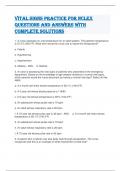
Vital Signs Practice for NCLEX Questions and Answers with complete solutions 1. A nurse assesses an oral temperature for an adult patient. The patient's temperature is 37.5°C (99.5°F). What term would the nurse use to report this temperature? a. Febrile b. Hypothermia c. Hypertension d. Afebrile - ANS- d. Afebrile 2. A nurse is assessing the vital signs of patients who presented at the emergency department. Based on the knowledge of age-related variations in normal vital signs, which patients would the nurse document as having a normal vital sign? Select all that apply. a. A 4-month old infant whose temperature is 38.1°C (100.5°F) b. A 3-year old whose blood pressure is 118/80 c. A 9-year old whose temperature is 39°C (102.2°F) d. An adolescent whose pulse rate is 70 bpm e. An adult whose respiratory rate is 20 bpm f. A 72-year old whose pulse rate is 42 bpm - ANS- a. A 4-month old infant whose temperature is 38.1°C (100.5°F) d. An adolescent whose pulse rate is 70 bpm e. An adult whose respiratory rate is 20 bpm f. A 72-year old whose pulse rate is 42 bpm 3. A patient who is febrile may lose body heat through perspiration. The nurse recognizes that this is an example of what mechanism of heat loss? a. Evaporation b. Convection c. Radiation d. Conduction - ANS- a. Evaporation 4. The rectal temperature, a core temperature, is considered to be one of the most accurate routes. In which cases would taking a rectal temperature be contraindicated? Select all that apply. a. A newborn who has hypothermia b. A child who has pneumonia c. An older patient who is post myocardial infarction (heart attack) d. A teenager who has leukemia e. A patient receiving erythropoietin to replace red blood cells f. An adult patient who is newly diagnosed with pancreatitis - ANS- a. A newborn who has hypothermia c. An older patient who is post myocardial infarction (heart attack) d. A teenager who has leukemia e. A patient receiving erythropoietin to replace red blood cells 5. While taking an adult patient's pulse, a nurse finds the rate to be 140 beats/min. What should the nurse do next? a. Check the pulse again in 2 hours. b. Check the blood pressure. c. Record the information. d. Report the rate to the primary care provider. - ANS- d. Report the rate to the primary care provider. 6. A patient complains of severe abdominal pain. When assessing the vital signs, the nurse would not be surprised to find what assessments? Select all that apply. a. An increase in the pulse rate b. A decrease in body temperature c. A decrease in blood pressure d. An increase in respiratory depth e. An increase in respiratory rate f. An increase in body temperature - ANS- a. An increase in the pulse rate e. An increase in respiratory rate 7. Two nurses are taking an apical-radial pulse and note a difference in pulse rate of 8 beats per minute. The nurse would document this difference as which of the following? a. Pulse deficit b. Pulse amplitude c. Ventricular rhythm d. Heart arrhythmia - ANS- a. Pulse deficit 8. The nurse instructor is teaching student nurses about the factors that may affect a patient's blood pressure. Which statements accurately describe these factors? Select all that apply. a. Blood pressure decreases with age. b. Blood pressure is usually lowest on arising in the morning. c. Women usually have lower blood pressure than men until menopause. d. Blood pressure decreases after eating food. e. Blood pressure tends to be lower in the prone or supine position. f. Increased blood pressure is more prevalent in African Americans. - ANS- b. Blood pressure is usually lowest on arising in the morning. c. Women usually have lower blood pressure than men until menopause. e. Blood pressure tends to be lower in the prone or supine position.
Written for
- Institution
- Vital Signs Practice for NCLEX
- Course
- Vital Signs Practice for NCLEX
Document information
- Uploaded on
- July 9, 2024
- Number of pages
- 6
- Written in
- 2023/2024
- Type
- Exam (elaborations)
- Contains
- Questions & answers
Subjects
-
vital signs practice for nclex questions and answe

Also available in package deal