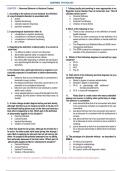
Mosby's Review for NBDHE . _____ 1. X -ray photon passed through atom unchanged; no interaction _____ 2. Coherent scatter _____ 3. Photoelectric effect _____ 4. Compton scatter _____ 5. Bremsstrahlung radiation _____ 6. Radioactivity A. Electrons stop suddenly as they hit the anode. B. Ionization takes place when the photon ejects an outer shell electron. This results in the loss of energy for the photon and a negative charged electron. The low energy photon changes direction. C. An unstable atom releases energy. D. This is responsible for producing the densities on the receptor or film. E. Ionization takes place when photons are absorbed by patient tissues. F. No loss of energy and no ionization occur when this low -energy photon interacts with an outer shell electron. The unaffected photon changes direction. - 1D 2F 3E 4B 5A 6C ___1. Median palatine suture ___2. Genial tubercles ___3. Incisive foramen ___4. Mylohyoid ridge ___5. Mental foramen ___6. Floor of nasal cavity ___7. Coronoid process A. Ring -shaped radiopacity noted apical to mandibular incisors B. Dense radiopaque band extending from the molar region downward toward the premolar area of the mandible C. Thin radiolucent line between maxillary central incisors D. Triangular -shaped radiopacity superimposed over or seen inferior to the maxillary tuberosity area E. Small oval or round radiolucency seen in the apical region of mandibular premolars F. Dense radiopaque band of bone seen apical to maxillary incisors G. Small oval or round radiolucency seen between the roots of maxillary central incisors - 1C 2A 3G 4B 5E 6F 7D 1. A periapical (PA) image is needed on the maxillary left premolar area. The patient presents with a large maxillary torus. Using the paralleling, or right -angle, technique, the image receptor film or sensor is to be placed A distal to the maxillary premolar area. B mesial to the maxillary premolar area. C as close to the maxillary left premolar as possible. D as far from the maxillary left premolar as possible. - D as far from the maxillary left premolar as possible. 1. A program for tobacco use cessation is an essential component of the dental hygiene care plan for appropriate patients. The first step for tobacco dependence intervention is to: A advise users about using tobacco products. B ask patients about their current tobacco use habits. C suggest the use of a nicotine replacement gum or lozenges. D educate patients about the risks of tobacco use to themselves and others. - B ask patients about their current tobacco use habits. B>A>C>D 1. For each drug listed, select the most closely linked mechanism of action from the list provided. 1. Lisinopril (Zestril) 2. Diazepam (Valium) system (CNS) and spinal cord 3. Ibuprofen (Motrin) 4.Hydrochlorothiazide (HCTZ) 5. Nifedipine (Procardia) 6. Lovastatin (Mevacor) 7. Epinephrine 8. Candesartan (Atacand) 9. Codeine 10. Nitroglycerin (Nitrobid) A. Blocks angiotensin II receptors B. Bind to mu -, kappa -, and delta -receptors in the central nervous C. Produces vascular smooth muscle relaxation throughout the body D. Inhibits the reabsorption of sodium from the distal tubule E. Stimulates both alpha - and beta -receptors F. Facilitates the action of the neurotransmitter gamma aminobutyric acid (GABA) G. Inhibits the movement of calcium during the contraction of cardiac and vascular smooth muscles H. Inhibits 3 -hydroxy -3- methyl coenzyme A (HMG -CoA) reductase I. Blocks the conversion of angiotensin I to angiote - 1I 2F 3J 4D 5G 6H 7E 8A 9B 10C 10. A radiographic image will have increased density if the operator A increases the kVp. B decreases the kVp. C decreases the milliampere (mA). D increases the distance of the x -ray source to the image receptor. - A increases the kVp. 10. Second -generation antihistamines such as loratadine (Claritin) are less sedating than their predecessors in therapeutic doses because they A bind only to histamine 2 (H2) -receptors. B do not penetrate the blood -brain barrier. C are combined with decongestants for their central nervous system (CNS) stimulant activity. - B do not penetrate the blood -brain barrier. 10. The highest pH level at which demineralization occurs in enamel is between A 2.5 and 3.5. B 3.5 and 4.5. C 4.5 and 5.5. D 6.0 and 6.7. E 7.0 and 7.2. - C 4.5 and 5.5. 10. Under which category does a blood pressure reading of 126/86 mm Hg fall? A Prehypertension B Normal blood pressure C Stage 1 hypertension D Stage 2 hypertension - A Prehypertension 11. A caries management by risk assessment (CAMBRA) protocol for enamel remineralization involves chewing of xylitol gum or mints because xylitol reduces the levels of Streptococcus mutans and promotes remineralization. A Both the statement and reason are correct and related. B Both the statement and reason are correct and NOT related. C The statement is correct, but the reason is NOT. D The statement is NOT correct, but the reason is correct.
Exam (elaborations)
Mosby's Review for NBDHE Questions and Answers Fully Solved 100%
Rating
Sold
-
Pages
50
Grade
A+
Uploaded on
09-07-2024
Written in
2023/2024
_____ 1. X-ray photon passed through atom unchanged; no interaction _____ 2. Coherent scatter _____ 3. Photoelectric effect _____ 4. Compton scatter _____ 5. Bremsstrahlung radiation _____ 6. Radioactivity A. Electrons stop suddenly as they hit the anode. B. Ionization takes place when the photon ejects an outer shell electron. This results in the loss of energy for the photon and a negative charged electron. The low energy photon changes direction. C. An unstable atom releases energy. D. This is responsible for producing the densities on the receptor or film. E. Ionization takes place when photons are absorbed by patient tissues. F. No loss of energy and no ionization occur when this low-energy photon interacts with an outer shell electron. The unaffected photon changes direction. - 1D 2F 3E 4B 5A 6C ___1. Median palatine suture ___2. Genial tubercles ___3. Incisive foramen ___4. Mylohyoid ridge ___5. Mental foramen ___6. Floor of nasal cavity ___7. Coronoid process A. Ring-shaped radiopacity noted apical to mandibular incisorsB. Dense radiopaque band extending from the molar region downward toward the premolar area of the mandible C. Thin radiolucent line between maxillary central incisors D. Triangular-shaped radiopacity superimposed over or seen inferior to the maxillary tuberosity area E. Small oval or round radiolucency seen in the apical region of mandibular premolars F. Dense radiopaque band of bone seen apical to maxillary incisors G. Small oval or round radiolucency seen between the roots of maxillary central incisors - 1C 2A 3G 4B 5E 6F 7D 1. A periapical (PA) image is needed on the maxillary left premolar area. The patient presents with a large maxillary torus. Using the paralleling, or right-angle, technique, the image receptor film or sensor is to be placed A distal to the maxillary premolar area. B mesial to the maxillary premolar area. C as close to the maxillary left premolar as possible. D as far from the maxillary left premolar as possible. - D as far from the maxillary left premolar as possible. 1. A program for tobacco use cessation is an essential component of the dental hygiene care plan for appropriate patients. The first step for tobacco dependence intervention is to: A advise users about using tobacco products. B ask patients about their current tobacco use habits. C suggest the use of a nicotine replacement gum or lozenges. D educate patients about the risks of tobacco use to themselves and others. - B ask patients about their current tobacco use habits. B>A>C>D 1. For each drug listed, select the most closely linked mechanism of action from the list provided. 1. Lisinopril (Zestril)2. Diazepam (Valium) system (CNS) and spinal cord 3. Ibuprofen (Motrin) 4.Hydrochlorothiazide (HCTZ) 5. Nifedipine (Procardia) 6. Lovastatin (Mevacor) 7. Epinephrine 8. Candesartan (Atacand) 9. Codeine 10. Nitroglycerin (Nitrobid) A. Blocks angiotensin II receptors B. Bind to mu-, kappa-, and delta-receptors in the central nervous C. Produces vascular smooth muscle relaxation throughout the body D. Inhibits the reabsorption of sodium from the distal tubule E. Stimulates both alpha- and beta-receptors F. Facilitates the action of the neurotransmitter gamma aminobutyric acid (GABA) G. Inhibits the movement of calcium during the contraction of cardiac and vascular smooth muscles H. Inhibits 3-hydroxy-3- methyl coenzyme A (HMG-CoA) reductase I. Blocks the conversion of angiotensin I to angiote - 1I 2F 3J 4D 5G 6H 7E 8A 9B 10C
Show more
Read less
Institution
NBDHE.
Course
NBDHE.
Whoops! We can’t load your doc right now. Try again or contact support.
Written for
- Institution
- NBDHE.
- Course
- NBDHE.
Document information
- Uploaded on
- July 9, 2024
- Number of pages
- 50
- Written in
- 2023/2024
- Type
- Exam (elaborations)
- Contains
- Questions & answers
Subjects
Content preview
$7.99
Get access to the full document:
100% satisfaction guarantee
Immediately available after payment
Both online and in PDF
No strings attached

Also available in package deal

Package deal
NBDHE Package Deal With Verified Study Solutions (Questions And Answers) Rated A+
16
2024
$ 127.84
More info