

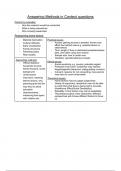
Answering Methods in Context questions
Factors to consider:
- How the research would be conducted
- What is being researched
- Who is being researched
Researching home factors:
- Material deprivation Practical issues:
- Cultural attitudes - Access: gaining access to peoples’ homes (can
- Early socialisation affect the method used e.g. questionnaires vs.
observation)
- Family structures
- Time: length of time to distribute/complete/analyse
- Parenting styles data, time taken away from school
- Role models - Sample size: how to obtain one
- Variables: operationalising concepts
Appropriate methods:
Ethical issues:
- Official statistics:
- Social sensitivity e.g. poverty, potential neglect
household income, - Protection from harm: researcher may witness
family structure, social illegal/neglectful behaviour, safeguarding concerns
background - Consent: reasons for not consenting, how parents
- Unstructured may react to covert observation
interviews: meaning Theoretical issues:
behind actions, why - Home factors may be judged subjectively
parents/pupils feel the - Variety of responses: researcher may not be able
way they do about to verify that what they’re being told is accurate
education (Hawthorne Effect/Social Desirability)
- Reliability: home factors may not be repeatable
- Questionnaires:
- Theoretical position of the researcher: different
measuring time spent perspectives will choose different factors to focus
with children etc. on
Factors to consider:
- How the research would be conducted
- What is being researched
- Who is being researched
Researching home factors:
- Material deprivation Practical issues:
- Cultural attitudes - Access: gaining access to peoples’ homes (can
- Early socialisation affect the method used e.g. questionnaires vs.
observation)
- Family structures
- Time: length of time to distribute/complete/analyse
- Parenting styles data, time taken away from school
- Role models - Sample size: how to obtain one
- Variables: operationalising concepts
Appropriate methods:
Ethical issues:
- Official statistics:
- Social sensitivity e.g. poverty, potential neglect
household income, - Protection from harm: researcher may witness
family structure, social illegal/neglectful behaviour, safeguarding concerns
background - Consent: reasons for not consenting, how parents
- Unstructured may react to covert observation
interviews: meaning Theoretical issues:
behind actions, why - Home factors may be judged subjectively
parents/pupils feel the - Variety of responses: researcher may not be able
way they do about to verify that what they’re being told is accurate
education (Hawthorne Effect/Social Desirability)
- Reliability: home factors may not be repeatable
- Questionnaires:
- Theoretical position of the researcher: different
measuring time spent perspectives will choose different factors to focus
with children etc. on


