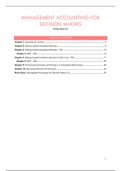
MANAGEMENT ACCOUNTING FOR
DECISION MAKERS
Finance block 4.2
TABLE OF CONTENTS
Chapter 7: Acounting for Control ............................................................................................................................. 2
Chapter 8: Making Capital Investment Decisions .................................................................................................. 9
Chapter 4: Making Capital Investment Decisions – FIM ................................................................................... 15
Chapter 4: MPC – FIM......................................................................................................................................... 15
Chapter 5: Making Capital Investment decisions: Further Issue – FIM ........................................................... 17
Chapter 5: MPC – FIM ........................................................................................................................................ 27
Chapter 9: Performance Evaluation and Pricing in a Competitive Environment .......................................... 29
Chapter 10: Measuring Divisional Performance ................................................................................................ 35
Mock Exam: Management Accounting for Decision Makers 4.2 .................................................................... 39
1
,CHAPTER 7: ACOUNTING FOR CONTROL
The budgetary control process:
Budgets can act as a system of both feedback and feedforward control. To exercise control, budgets
can be flexed to match actual volume of output.
1. Prepare budgets;
2. Perform and collect information on actual performance;
3. Identify variances between planned (budgeted) and actual performance;
4. Respond to variances between planned and actual performance and exercise control.
Feedback control:
Steps are taken to get operations back on track as soon as there is a signal that they have gone wrong.
For instance; compare budget cash flow with an actual cash flow.
− Reactive;
− React to existing problems;
− Remedial. (beter makend)
Feedforward control:
Predictions are made as to what can go wrong and steps are taken to avoid any undesirable outcome.
For instance; compare a cash budget with a forecast of an actual cash flow.
− Proactive;
− Anticipate problems beforehand;
− Preventive.
2
,Flexible budgets:
Flexing a budget Revising a budget, assuming a different volume of
output.
A more valid comparison can be made between the budget (using the flexed figures) and the actual
results.
Relationship between the budgeted and actual profit:
Actual profit = budgeted profit + All favorable variances – All adverse variances.
Sales variances:
Sales volume variance Difference between profit shown in original
budget and profit shown in flexed budget.
Sales price variance Difference between actual sales and sales shown
in the flexed budget.
3
, Materials variances:
Total direct material variance Difference between actual direct material
cost and direct material cost as per the flexed
budget. (budgeted usage for the actual output)
Direct material usage variance Difference between actual amount of direct
materials used and amount as per flexed budget.
(budgeted usage for actual output) Multiplied by
the budgeted direct material cost per unit.
Direct material price variance Difference between actual cost of the direct
material used and direct material cost allowed.
(actual quantity of material used at the budgeted
direct material cost)
Labour variances:
Total direct labour variance Difference between actual direct labour cost and
direct labour cost as per the flexed budget.
(budgeted direct labour hours for the actual output)
Direct labour efficiency variance Difference between actual direct labour hours and
direct labour hours as per the flexed budget.
(budgeted direct labour hours for the actual output)
Multiplied by the budgeted direct labour rate per
hour.
Direct labour rate variance Difference between actual cost of direct labour
hours and direct labour cost allowed. (actual
direct labour hours worked at the budgeted labour
rate)
4
DECISION MAKERS
Finance block 4.2
TABLE OF CONTENTS
Chapter 7: Acounting for Control ............................................................................................................................. 2
Chapter 8: Making Capital Investment Decisions .................................................................................................. 9
Chapter 4: Making Capital Investment Decisions – FIM ................................................................................... 15
Chapter 4: MPC – FIM......................................................................................................................................... 15
Chapter 5: Making Capital Investment decisions: Further Issue – FIM ........................................................... 17
Chapter 5: MPC – FIM ........................................................................................................................................ 27
Chapter 9: Performance Evaluation and Pricing in a Competitive Environment .......................................... 29
Chapter 10: Measuring Divisional Performance ................................................................................................ 35
Mock Exam: Management Accounting for Decision Makers 4.2 .................................................................... 39
1
,CHAPTER 7: ACOUNTING FOR CONTROL
The budgetary control process:
Budgets can act as a system of both feedback and feedforward control. To exercise control, budgets
can be flexed to match actual volume of output.
1. Prepare budgets;
2. Perform and collect information on actual performance;
3. Identify variances between planned (budgeted) and actual performance;
4. Respond to variances between planned and actual performance and exercise control.
Feedback control:
Steps are taken to get operations back on track as soon as there is a signal that they have gone wrong.
For instance; compare budget cash flow with an actual cash flow.
− Reactive;
− React to existing problems;
− Remedial. (beter makend)
Feedforward control:
Predictions are made as to what can go wrong and steps are taken to avoid any undesirable outcome.
For instance; compare a cash budget with a forecast of an actual cash flow.
− Proactive;
− Anticipate problems beforehand;
− Preventive.
2
,Flexible budgets:
Flexing a budget Revising a budget, assuming a different volume of
output.
A more valid comparison can be made between the budget (using the flexed figures) and the actual
results.
Relationship between the budgeted and actual profit:
Actual profit = budgeted profit + All favorable variances – All adverse variances.
Sales variances:
Sales volume variance Difference between profit shown in original
budget and profit shown in flexed budget.
Sales price variance Difference between actual sales and sales shown
in the flexed budget.
3
, Materials variances:
Total direct material variance Difference between actual direct material
cost and direct material cost as per the flexed
budget. (budgeted usage for the actual output)
Direct material usage variance Difference between actual amount of direct
materials used and amount as per flexed budget.
(budgeted usage for actual output) Multiplied by
the budgeted direct material cost per unit.
Direct material price variance Difference between actual cost of the direct
material used and direct material cost allowed.
(actual quantity of material used at the budgeted
direct material cost)
Labour variances:
Total direct labour variance Difference between actual direct labour cost and
direct labour cost as per the flexed budget.
(budgeted direct labour hours for the actual output)
Direct labour efficiency variance Difference between actual direct labour hours and
direct labour hours as per the flexed budget.
(budgeted direct labour hours for the actual output)
Multiplied by the budgeted direct labour rate per
hour.
Direct labour rate variance Difference between actual cost of direct labour
hours and direct labour cost allowed. (actual
direct labour hours worked at the budgeted labour
rate)
4