FEINBERG RIGHTS
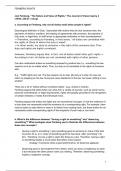
Joel Feinberg, “The Nature and Value of Rights,” The Journal of Value Inquiry 4
(1970): 243-57. (14 pp)
a. According to Feinberg, why not all duties entail other people's rights?
Etymological definition of Duty: “associated with actions that are due someone else, the
payments of debts to creditors, the keeping of agreements with promises, the payment of
club dues, or legal fees, or tariff levies to appropriate authorities or their representatives”.
→ Therefore, according to Feinberg, in that sense, “all duties are correlated with
the rights of those to whom the duty is owed”.
→ In other words, my duty to someone = the right of this someone else. Thus
duty and rights are highly correlated.
However, Feinberg argues that, in fact, not all duties entail other ppl’s rights →
According to him, all duties are not correlated with rights of other persons.
Can also understand duties as something imposed by positive law (i.e., something the law
requires us to do no matter what). Thus, my duty is not correlated to the rights of someone
else.
E.g., “Traffic lights turn red. The law requires me to stop. My duty is to stop. No one can
claim my stopping as his due. Everyone owes obedience to the law, but owes nothing to one
another”.
There are a lot of “duties-without correlative-rights”. (e.g., Duties to charity)
Feinberg argues that while duties can arise from a variety of sources, such as social norms,
personal commitments, or legal requirements, rights are typically grounded in the recognition
of certain interests or needs that individuals have.
Feinberg argues that duties and rights are not symmetrical concepts, in that the existence of
a duty does not necessarily entail the existence of a corresponding right. For example, there
may be duties to help others in need or to refrain from causing harm, but these duties do not
necessarily entail corresponding rights of the recipients of such help or non-harm.
b. What is the difference between "having a right to something" and "deserving
something"? What analogies does Feinberg use to illustrate the differences between
these two concepts?
- Having a right to something: I give something good to someone in virtue of the kind
of person he is, or in virtue of something good he has done, after “promising” it to
him.. Therefore, he has a right to claim this thing as a due. Therefore, having a right
to something implies a moral claim that others must respect.
- Analogy: if someone does a good performance, he deserves applause.
- Deserving good or bad treatment from others: when you have no legitimacy to claim
a due because the other person owes you nothing. Therefore, deserving something
implies a subjective concept.
1
Joel Feinberg, “The Nature and Value of Rights,” The Journal of Value Inquiry 4
(1970): 243-57. (14 pp)
a. According to Feinberg, why not all duties entail other people's rights?
Etymological definition of Duty: “associated with actions that are due someone else, the
payments of debts to creditors, the keeping of agreements with promises, the payment of
club dues, or legal fees, or tariff levies to appropriate authorities or their representatives”.
→ Therefore, according to Feinberg, in that sense, “all duties are correlated with
the rights of those to whom the duty is owed”.
→ In other words, my duty to someone = the right of this someone else. Thus
duty and rights are highly correlated.
However, Feinberg argues that, in fact, not all duties entail other ppl’s rights →
According to him, all duties are not correlated with rights of other persons.
Can also understand duties as something imposed by positive law (i.e., something the law
requires us to do no matter what). Thus, my duty is not correlated to the rights of someone
else.
E.g., “Traffic lights turn red. The law requires me to stop. My duty is to stop. No one can
claim my stopping as his due. Everyone owes obedience to the law, but owes nothing to one
another”.
There are a lot of “duties-without correlative-rights”. (e.g., Duties to charity)
Feinberg argues that while duties can arise from a variety of sources, such as social norms,
personal commitments, or legal requirements, rights are typically grounded in the recognition
of certain interests or needs that individuals have.
Feinberg argues that duties and rights are not symmetrical concepts, in that the existence of
a duty does not necessarily entail the existence of a corresponding right. For example, there
may be duties to help others in need or to refrain from causing harm, but these duties do not
necessarily entail corresponding rights of the recipients of such help or non-harm.
b. What is the difference between "having a right to something" and "deserving
something"? What analogies does Feinberg use to illustrate the differences between
these two concepts?
- Having a right to something: I give something good to someone in virtue of the kind
of person he is, or in virtue of something good he has done, after “promising” it to
him.. Therefore, he has a right to claim this thing as a due. Therefore, having a right
to something implies a moral claim that others must respect.
- Analogy: if someone does a good performance, he deserves applause.
- Deserving good or bad treatment from others: when you have no legitimacy to claim
a due because the other person owes you nothing. Therefore, deserving something
implies a subjective concept.
1