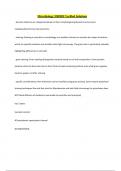
Microbiology NBDHE Verified Solutions
- bacteria: Bacteria are categorized based on their morphological (physical structure) and
metabolic/biochemical characteristics.
- staining: Staining is essential in microbiology as it enables clinicians to visualize the shape of bacteria,
which are typically colorless and invisible under light microscopy. The gram stain is particularly valuable,
highlighting differences in cell walls.
- gram staining: Gram staining distinguishes bacteria based on cell wall composition. Gram-positive
bacteria retain the blue stain due to their thick cell walls containing teichoic acid, while gram-negative
bacteria appear red after staining.
- specific considerations: Not all bacteria can be classified using gram staining. Some require specialized
staining techniques like acid-fast stain for Mycobacteria and dark field microscopy for spirochetes.does
NOT block diffusion of antibiotics (vulnerable to penicillins and lysozyme)
has 2 layers
low lipid content
NO periplasmic space/porin channel
NO ENDOTOXIN
,gram - cell wall ✔️very thin
cell wall has murein lipoprotein
contains 3 layers
high lipid content
has periplasmic space and porin channel
outer cell membrane contains endotoxin (lipid A)
design allows gram - cells to block diffusion of substances that attack cell walls such as penicillins and
lysozyme
mycobacterium tuberculosis ✔️the causative organism for tuberculosis is a bacteria called....?
tuberculosis is acquired via airborne transmission
disease causing organisms ✔️most disease causing microorganisms are gram - rods or gram -
pleomorphic bacteria
,There are 8 exceptions:
2 gram + cocci (streptococcus and staphylococcus)
4 gram + rods (bacillus, clostridium, cornebacterium and listeria)
1 gram - cocci (Neisseria)
1 gram - spiral shaped organism (spirochete)
gram + cocci ✔️do NOT form spores
Non-mobile *
has hyaluronidase--used to invade tissue for most non-mobile organisms
ex. streptococcus
hyaluronidase ✔️'spreading factor' and that it is necessary for invading tissue during spread of infection
for non-mobile microorganisms
streptococcus ✔️spherical gram + cocci usually arranged in chains or pairs
, all are catalase negative
divided into 3 groups based on their ability to hemolyse red blood cells
(TIP: groups are based on microbes ability to BAG a RBC)
1. beta-hemolytic streptococcus (completely lyse RBCS)
2. alpha-hemolytic streptococcus (partially lyse RBCs)
3. gamma-hemolytic streptococcus (unable to lyse RBCs)
beta-hemolytic streptococcus ✔️hemolytic ability is due to production of hemolysins
arranged in groups A-U (known as Lancefield groups)
Group A are among the most important human pathogens--can stick on any surface
many strains are anti-phagocytic
partially due to their ability to adhere to pharyngeal epithelium, Group A streptococci are causative for:
streptococcal pharyngitis
pyogenic infection
- bacteria: Bacteria are categorized based on their morphological (physical structure) and
metabolic/biochemical characteristics.
- staining: Staining is essential in microbiology as it enables clinicians to visualize the shape of bacteria,
which are typically colorless and invisible under light microscopy. The gram stain is particularly valuable,
highlighting differences in cell walls.
- gram staining: Gram staining distinguishes bacteria based on cell wall composition. Gram-positive
bacteria retain the blue stain due to their thick cell walls containing teichoic acid, while gram-negative
bacteria appear red after staining.
- specific considerations: Not all bacteria can be classified using gram staining. Some require specialized
staining techniques like acid-fast stain for Mycobacteria and dark field microscopy for spirochetes.does
NOT block diffusion of antibiotics (vulnerable to penicillins and lysozyme)
has 2 layers
low lipid content
NO periplasmic space/porin channel
NO ENDOTOXIN
,gram - cell wall ✔️very thin
cell wall has murein lipoprotein
contains 3 layers
high lipid content
has periplasmic space and porin channel
outer cell membrane contains endotoxin (lipid A)
design allows gram - cells to block diffusion of substances that attack cell walls such as penicillins and
lysozyme
mycobacterium tuberculosis ✔️the causative organism for tuberculosis is a bacteria called....?
tuberculosis is acquired via airborne transmission
disease causing organisms ✔️most disease causing microorganisms are gram - rods or gram -
pleomorphic bacteria
,There are 8 exceptions:
2 gram + cocci (streptococcus and staphylococcus)
4 gram + rods (bacillus, clostridium, cornebacterium and listeria)
1 gram - cocci (Neisseria)
1 gram - spiral shaped organism (spirochete)
gram + cocci ✔️do NOT form spores
Non-mobile *
has hyaluronidase--used to invade tissue for most non-mobile organisms
ex. streptococcus
hyaluronidase ✔️'spreading factor' and that it is necessary for invading tissue during spread of infection
for non-mobile microorganisms
streptococcus ✔️spherical gram + cocci usually arranged in chains or pairs
, all are catalase negative
divided into 3 groups based on their ability to hemolyse red blood cells
(TIP: groups are based on microbes ability to BAG a RBC)
1. beta-hemolytic streptococcus (completely lyse RBCS)
2. alpha-hemolytic streptococcus (partially lyse RBCs)
3. gamma-hemolytic streptococcus (unable to lyse RBCs)
beta-hemolytic streptococcus ✔️hemolytic ability is due to production of hemolysins
arranged in groups A-U (known as Lancefield groups)
Group A are among the most important human pathogens--can stick on any surface
many strains are anti-phagocytic
partially due to their ability to adhere to pharyngeal epithelium, Group A streptococci are causative for:
streptococcal pharyngitis
pyogenic infection