Cwna Questions with Correct Answers graded A+
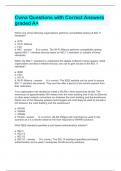
Cwna Questions with Correct Answers graded A+ Which one of the following organizations performs compatibility testing of 802.11 hardware? a. IETF b. Wi-Fi Alliance c. FCC d. MIC B is correct. The Wi-Fi Alliance performs compatibility testing against 802.11 wireless devices based on 802.11 standards or subsets of those standards. Within the 802.11 standard to understand the details of Beacon frame options. What organization provides a website that you can use to gain access to the 802.11 standard? a. IEEE b. FCC c. ITU-R d. Wi-Fi Alliance A is correct. The IEEE website can be used to access 802.11 standard documents. They are free after a period of six months passes from their ratification. Your organization has decided to install a WLAN in their warehouse facility. The warehouse is approximately 400 meters from the main building and it has no Ethernet or other wired network connection run between the main building and the warehouse. Which one of the following wireless technologies will most likely be used to provide a link between the main building and the warehouse? a. WPAN b. WMAN c. WWAN d. WLAN D is correct. WLAN bridges will most likely be used in this scenario as it is a shorter distance link than required by WWAN solutions. What IEEE standard specified a port-based authentication solution? a. 802.3 b. 802.1X c. 802.1Q d. 802.1D B is correct. The 802.1X standard specified port-based authentication and is used in enterprise WLAN security solutions. What frequency bands are most commonly used by WLAN hardware? a. 2.4 GHz and 5 GHz b. 2.4 GHz and 100 GHz c. 5 GHz and 10 MHz d. None of these A is correct. While the sub-1 GHz, TV whitespace, and 60 GHz bands are used, by far the most commonly utilized bands are 2.4 GHz and 5 Ghz. What is indicated when a device is certified by the Wi-Fi Alliance as 802.11b/g/n certified? a. It is a 5 GHz-only device b. It is a 2.4 GHz-only device c. It supports WPA2-Enterprise d. It supports WPA-Personal B is correct. When the certificate indicates only 802.11b/g/n, it indicates 2.4 GHz-only support as these amendments are all operable in 2.4 GHz and, if 5 GHz were supported, 802.11a would be listed as well. What is based on an IETF document and defines communications between a lightweight access point and a controller? a. CAPWAP b. 802.1Q c. EAP d. RADIUS A is correct. CAPWAP and LWAPP are defined in IETF RFCs. They both specify methods of communications between an access point and a controller. What Wi-Fi Alliance certification ensures proper VoIP communications even when moving from one access point to another? a. WMM b. Voice-Personal c. Voice-Enterprise d. WPS C is correct. Voice-Enterprise is a certification that ensures proper communications for VoIP across a WLAN even when roaming between access points. Voice-Personal only ensures such communications when connected to a single AP. You have purchased an AP for a specific regulatory domain. You now that you cannot turn up the transmit power beyond a specific level. What is the likely cause of this behavior? a. Firmware problems b. Radio failure c. Regulatory constraints d. IEEE constraints C is correct. One area of constraint imposed by regulatory agencies is output power. When an AP ships for a specific regulatory domain, those constraints are enforced. In what mode is an access point operating when clients connect to it in order to gain access to a printer? a. Distribution b. Core c. Access d. None of these 1C is correct. When an access point is in access mode, it is providing access to the resources to which it is connected for clients connected to the access point. What denotes the strength of an RF wave or signal? a. Wavelength b. Phase c. Amplitude d. Modulation C is correct. The amplitude is the strength or power of the RF wave. 2. What is decreased as the frequency of a wave increases? a. Wavelength b. Phase c. Modulation d. Coding A is correct. As the frequency increases, the wavelength decreases. Alternatively, as the wavelength increases, the frequency decreases. 3. What RF behavior is similar to light waves as seen in a mirror? a. Absorption b. Attenuation c. Reflection d. Phase C is correct. Reflection occurs in RF waves as well as light waves and is analogous to light in a mirror. 4. What kind of modulation is not used in WLANs? a. PSK b. FSK c. ASK d. BPSK B is correct. Frequency Shift Keying (FSK) is not used in WLANs. Both ASK and PSK are used, and BPSK is a form of PSK modulation. 5. What is the common ohm rating in equipment designed for use in WLANs? a. 75 b. 50 c. 25 d. 100 B is correct. In most cases, WLAN equipment uses a 50 ohm rating for resistance. 6. What happens when RF energy is converted to heat when passing through some materials? a. Absorption b. Reflection c. Phase shifting d. Frequency shifting A is correct. Absorption occurs when RF energy is converted to heat, and the result is an attenuation of the RF signal as it exits the absorbing medium. 7. What phenomenon is good for MIMO systems, but must be handled with something like diversity in SISO systems? a. Modulation b. Multipath c. FSPL d. Refraction B is correct. Multipath is good for MIMO systems because it allows for the transmission of multiple spatial streams. In SISO systems, diversity antennas are most often used to address the issues presented by multipath. 8. What amount of additional signal strength doubles the usable range of an RF signal in free space? a. 2 dB b. 3 dB c. 6 dB d. 10 dB C is correct. The inverse square law results in the reality that an increase of 6 dB doubles the distance at which a signal is usable and a reduction of -6 dB halves the usable distance. 9. What comparative attribute relates an RF wave to another wave? a. Wavelength b. Frequency c. Amplitude d. Phase D is correct. The phase of an RF wave is an attribute that compares one wave with another wave. They can either be 'in phase' or, to some degree, out of phase. 10. What occurs as an RF signal moves through space and spreads to cover an ever larger area? a. Amplification b. FSPL c. VSWR d. Diffraction B is correct. FSPL occurs naturally as the RF signal moves through space and the wave front spreads to cover an ever larger area. 1. What metric is often used for indoor access point output power definition? a. W b. RSSI c. mW d. dBd C is correct. mW (milliwatt) is more often used for indoor access points as output power levels rarely require above 100 mW. What signal metric has become very popular for both transmit and receive power levels? a. W b. RSSI c. dBm d. dBi C is correct. Decibels to milliwatts (dBm) is the most common metric used for both transmit and receive power levels today. 3. Why is the RSSI metric not typically a good signal metric for comparison across vendors? a. Each vendor specifies the RSSI percentage formula differently b. Each vendor specifies the RSSI_MAX value differently c. RSSI is no longer supported in WLAN devices d. RSSI is not a signal metric; it is a modulation method B is correct. The RSSI_MAX value can be up to 255 and vendors set it at varying values from 31 to 100 commonly. The end result is inconsistencies in what the metric means across vendors. 4. You start with a power level of 50 mW and add 7 dB, what is the resulting power level? a. 500 mW b. 100 mW c. 200 mW d. 250 mW D is correct. 50 mW + 10 dB + (-3 dB) = 250 mW. 5. An AP has an output power setting of 20 dBm. The antennas provide 5 dB of gain. What is the EIRP? a. 500 mW b. 320 mW c. 3200 mW d. 4 W B is correct. The answer is 320 mW. First, 20 dBm is equal to 100 mW. Then, you can add 3 dB five times to get to 15 dB. That means you calculate 100 mW 2 2 2 2 * 2 = 3200 mW. Now you have to remove 10 dB to get back to the 5 dBi gain of the antenna. 3200 / 10 = 320 mW. An AP has an output power setting of 13 dBm. The antenna is directly connected and has 3 dBi gain. What is the output power at the intentional radiator? a. 400 mW b. 40 mW c. 100 mW d. 20 mW D is correct. The output power of the AP is 13 dBm, which is equal to 20 mW. Given that the antenna is directly connected, the IR power is the same as the AP power, so it is 20 mW. The antenna gain only becomes a factor for EIRP and not for IR calculations. 7. You are calculating an outdoor bridge link. You have determined the bridge output power levels, antenna gain and losses incurred by all cables and connectors on both ends. What additional factor is missing? a. FSPL b. RSSI c. Fade Margin d. Wind resistance A is correct. FSPL must be factored into outdoor bridge links. How do you calculate the dBi of an antenna when the gain is provided in dBd? a. Subtract 2.14 b. Add 2.14 c. Multiple by 2.14 d. Divide by 2.1 B is correct. To convert from dBd to dBi, add 2.14 dB. To convert from dBi to dBd, subtract 2.14 dB. 9. You are calculating power levels and have been given the following values: +3 dB, +5 dB, -21 dB, +11 dB, and +3 dB. How can you simplify the calculation? a. Just use the value +1 dB b. Ignore the negative values c. Ignore the positive values d. You cannot simplify it you must calculate all dB changes in sequence A is correct. Because the values +3 dB, +5 dB, -21 dB, +11 dB, and +3 dB total +1 dB, you can simplify calculations to 1 dB of gain in this system. 10. What metric is preferred by engineers and is used to represent received signal strength? a. RSSI b. dB c. dBm d. Frequency C is correct. While RSSI is a common metric as well, engineers prefer dBm because it is an absolute power measurement, whereas RSSI is arbitrary and uniquely specified by WLAN vendors.
Written for
- Institution
- CWNA - Certified Wireless Network Administrator
- Course
- CWNA - Certified Wireless Network Administrator
Document information
- Uploaded on
- July 7, 2024
- Number of pages
- 26
- Written in
- 2023/2024
- Type
- Exam (elaborations)
- Contains
- Questions & answers
Subjects
-
cwna questions with correct answers graded a
-
which one of the following organizations performs
-
within the 80211 standard to understand the detai
-
what frequency bands are most commonly used by wla

Also available in package deal