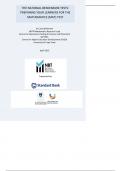
THE NATIONAL BENCHMARK TESTS:
Dr Carol Bohlmann
PREPARING YOUR LEARNERS FOR THE
MATHEMATICS (MAT) TEST
Dr Carol Bohlmann
NBTP Mathematics Research Lead
Centre for Educational Testing for Access and Placement
(CETAP):
Centre for Higher Education Development (CHED)
University of Cape Town
April 2015
Supported by:
,Contents
INTRODUCTION 3
1. BACKGROUND AND PURPOSE OF THE MAT TESTS 4
1a. MATHEMATICS TEST ACHIEVEMENT LEVELS 4
2. NSC and NBT 8
2a. NBT TOPICS IN THE NSC CONTEXT 8
2b. COMPLEMENTARITY OF NSC MATHEMATICS AND NBT MAT TESTS 9
2c. DIFFERENCES BETWEEN THE NSC MATHEMATICS EXAM AND THE
MAT TESTS 10
3a. MAT TEST TOPICS 12
3. WHAT SHOULD TEACHERS DO? 15
4a. PRINCIPLES FOR PROACTIVE TEACHING 15
4. PREPARING FOR THE NBTs 18
5a. Internet assistance 18
5b. Extra lessons 18
5. FREQUENTLY ASKED QUESTIONS ABOUT THE MAT TESTS: TWO
QUESTIONS THAT BOTHER PARENTS AND TEACHERS 19
6. EXEMPLAR QUESTIONS 21
6a. A FEW SAMPLE QUESTIONS 21
2
, INTRODUCTION
This booklet will assist you in understanding what the NBT MAT test is about
and tell you how to prepare your learners for it.
The National Benchmark Tests (NBTs) are a set of tests that measure an
applicant’s academic readiness for university. They complement and support,
rather than replace or duplicate the National Senior Certificate.
A number of universities in South Africa use the NBTs to help interpret the
National Senior Certificate (NSC) results. Universities use the NBT results in
different ways:
- Some use them to help make decisions about an applicant’s access to
university. This means that the NBT results, in combination with the
NSC results, are used to determine whether an applicant is ready for
academic study.
- Some use them for placement within university. This means that the
results are used to decide whether an applicant will need extra
academic support after he/she has been admitted to university.
- Some use them to help develop curricula within their universities.
There are two tests: AQL, which is the Academic Literacy and Quantitative
Literacy test, and MAT, which is the Mathematics test.
3
Dr Carol Bohlmann
PREPARING YOUR LEARNERS FOR THE
MATHEMATICS (MAT) TEST
Dr Carol Bohlmann
NBTP Mathematics Research Lead
Centre for Educational Testing for Access and Placement
(CETAP):
Centre for Higher Education Development (CHED)
University of Cape Town
April 2015
Supported by:
,Contents
INTRODUCTION 3
1. BACKGROUND AND PURPOSE OF THE MAT TESTS 4
1a. MATHEMATICS TEST ACHIEVEMENT LEVELS 4
2. NSC and NBT 8
2a. NBT TOPICS IN THE NSC CONTEXT 8
2b. COMPLEMENTARITY OF NSC MATHEMATICS AND NBT MAT TESTS 9
2c. DIFFERENCES BETWEEN THE NSC MATHEMATICS EXAM AND THE
MAT TESTS 10
3a. MAT TEST TOPICS 12
3. WHAT SHOULD TEACHERS DO? 15
4a. PRINCIPLES FOR PROACTIVE TEACHING 15
4. PREPARING FOR THE NBTs 18
5a. Internet assistance 18
5b. Extra lessons 18
5. FREQUENTLY ASKED QUESTIONS ABOUT THE MAT TESTS: TWO
QUESTIONS THAT BOTHER PARENTS AND TEACHERS 19
6. EXEMPLAR QUESTIONS 21
6a. A FEW SAMPLE QUESTIONS 21
2
, INTRODUCTION
This booklet will assist you in understanding what the NBT MAT test is about
and tell you how to prepare your learners for it.
The National Benchmark Tests (NBTs) are a set of tests that measure an
applicant’s academic readiness for university. They complement and support,
rather than replace or duplicate the National Senior Certificate.
A number of universities in South Africa use the NBTs to help interpret the
National Senior Certificate (NSC) results. Universities use the NBT results in
different ways:
- Some use them to help make decisions about an applicant’s access to
university. This means that the NBT results, in combination with the
NSC results, are used to determine whether an applicant is ready for
academic study.
- Some use them for placement within university. This means that the
results are used to decide whether an applicant will need extra
academic support after he/she has been admitted to university.
- Some use them to help develop curricula within their universities.
There are two tests: AQL, which is the Academic Literacy and Quantitative
Literacy test, and MAT, which is the Mathematics test.
3