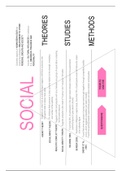
Considers aspects of HUMAN BEHAVIOUR that
involve the individual’s RELATIONSHIP TO OTHER
PERSONS, GROUPS AND SOCIETY
Includes CULTURAL INFLUENCES on behaviour
E.G. OBEDIENCE, PREJUDICE AND
PERSONALITY
SOCIAL
AGENCY THEORY Suggests an order from an authority figure triggers a shift from autonomy into
the agentic state to relieve moral strain
SOCIAL IMPACT THEORY An individual feels pressure to obey authority relative to the strength, immediacy
THEORIES
and number of the authority
REALISTIC CONFLICT THEORY Suggests conflict and prejudice will occur between any groups of equal status competing
for the same resource
SOCIAL IDENTITY THEORY Suggests prejudice is the result of “in-group” and “out-group” formation
MILGRAM (1963) Found that 65% of participants in the agent state followed orders from the experimenter STUDIES
(authority figure) to give electric shocks)
BURGER (2009) Replication of Milgram’s original study, found that 70% of participants would still follow the orders
of an authority figure
SHERIF ET AL Found that when two groups of young boys were brought together through competition, hostility
(1961) occurs, which suggests competition can lead to hostility
Found that working towards superordinate goals can reduce tension and prejudice
METHODS
THEMATIC
QUESTIONNAIRE
ANALYSIS
involve the individual’s RELATIONSHIP TO OTHER
PERSONS, GROUPS AND SOCIETY
Includes CULTURAL INFLUENCES on behaviour
E.G. OBEDIENCE, PREJUDICE AND
PERSONALITY
SOCIAL
AGENCY THEORY Suggests an order from an authority figure triggers a shift from autonomy into
the agentic state to relieve moral strain
SOCIAL IMPACT THEORY An individual feels pressure to obey authority relative to the strength, immediacy
THEORIES
and number of the authority
REALISTIC CONFLICT THEORY Suggests conflict and prejudice will occur between any groups of equal status competing
for the same resource
SOCIAL IDENTITY THEORY Suggests prejudice is the result of “in-group” and “out-group” formation
MILGRAM (1963) Found that 65% of participants in the agent state followed orders from the experimenter STUDIES
(authority figure) to give electric shocks)
BURGER (2009) Replication of Milgram’s original study, found that 70% of participants would still follow the orders
of an authority figure
SHERIF ET AL Found that when two groups of young boys were brought together through competition, hostility
(1961) occurs, which suggests competition can lead to hostility
Found that working towards superordinate goals can reduce tension and prejudice
METHODS
THEMATIC
QUESTIONNAIRE
ANALYSIS