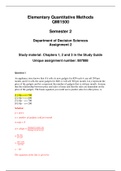
Elementary Quantitative Methods
QMI1500
Semester 2
Department of Decision Sciences
Assignment 2
Study material: Chapters 1, 2 and 3 in the Study Guide
Unique assignment number: 887888
Question 1
An appliance store knows that if it sells its new gadgets for R50 each it can sell 200 per
month, and if it sells the same gadgets for R40, it will sell 300 per month. Let p represent the
price of the gadgets and let n represent the number of gadgets that is sold per month. Assume
that the relationship between price and sales is linear and that the sales are dependent on the
price of the gadgets. The linear equation you could use to predict sales for other prices, is
[1] 10p + n = 700
[2] 10p + n = 600
[3] 10p − n = 700
[4] 10p − n = 200
Solution:
p = price
n = number of gadgets sold per month
𝑛 =𝑎𝑝 + 𝑏
𝐶ℎ𝑎𝑛𝑔𝑒 𝑖𝑛 𝑠𝑎𝑙𝑒𝑠 (𝑛)
𝑎 = 𝑠𝑙𝑜𝑝𝑒 = 𝐶ℎ𝑎𝑛𝑔𝑒 𝑖𝑛 𝑝𝑟𝑖𝑐𝑒 (𝑝)
𝑛1−𝑛2
= 𝑝1−𝑝2
300−200
= 40−50
= −10
The equation of the line is given by:
,𝑛 −𝑛1 = (𝑝−𝑝1)
𝑛 −200 = −10(𝑝−50)
𝑛 −200 = −10𝑝+500
10𝑝 + 𝑛 = 500+200
10𝑝 + 𝑛 = 700
Question 2
The line parallel to
2x + y + 1 = 0
Is
[1] 3x + 2y + 1 = 0
[2] 2x + 2y + 1 = 0
[3] 3x + 2y + 1 = 0
[4] 4x + 2y + 1 = 0
Solution:
Parallel lines have the same value of slope, 𝑎 in their standard equations, 𝑦=𝑎𝑥+𝑏
Expressed in standard form the equation 2𝑥+𝑦+1=0 becomes 𝑦=−2𝑥−1
By inspection, expressing Option [4] in standard form will yield the following:
4𝑥 + 2𝑦 + 1 = 0
2𝑦 = −4𝑥 − 1
2𝑦 −4𝑥 1
= −
2 2 2
1
𝑦 = −2 − 2
Question 3 and 4 are based on the information below:
Given the function y = 4x − x
Question 3
Determine the vertex of the function.
[1] 4; 0.
[2] 2; 0.
[3] 2; 4.
[4] 4; 2.
Solution:
Determine the vertex of the function. 𝑦 = − 𝑥2 + 4𝑥
A = -1
B=4
, C=0
𝑏 4
At the vertex, 𝑥 = − 2𝑎 = − =2
2(−1)
𝑦 = −(2)2 + 4(2) = 4
Vertex: (2; 4)
Question 4
Determine the intercepts of the function.
[1] 4; 0 and (2; 0).
[2] 4; 0 and (0; 0).
[3] −2; 0 and (0; 0).
[4] 2; 0 and (0; 0).
Solution:
Determine the "(𝑥)" intercepts of the function.
𝑥 − intercepts (roots) are found when 𝑦 = 0
𝑦 = 4𝑥 − 𝑥2 = 0
Factorisation
4𝑥 − 𝑥2 = 0
(4−𝑥) = 0
𝑥 = 0 𝑎𝑛𝑑 4 – 𝑥 = 0
𝑥 = 0 𝑎𝑛𝑑 4 = 𝑥 𝑜𝑟 𝑥 = 4
𝑥 − intercepts: (4; 0) and (0; 0)
Questions 5 and 6 are based on the following information below:
If R10 000 is invested for 6%, compounded monthly, then the future value of the investment
S after x years is given by S = 10 000(1.005)12x
Question 5
Find the value of the investment after 5 years.
[1] R10 252.51
[2] R13 000.00
[3] R13 488.50
[4] R14 185.19
Solution:
Given 𝑥 = 5
𝑆 = 10 000(1.005)12(5) = 𝑅13 488.50
Or by using the Sharp EL-738F calculator:
QMI1500
Semester 2
Department of Decision Sciences
Assignment 2
Study material: Chapters 1, 2 and 3 in the Study Guide
Unique assignment number: 887888
Question 1
An appliance store knows that if it sells its new gadgets for R50 each it can sell 200 per
month, and if it sells the same gadgets for R40, it will sell 300 per month. Let p represent the
price of the gadgets and let n represent the number of gadgets that is sold per month. Assume
that the relationship between price and sales is linear and that the sales are dependent on the
price of the gadgets. The linear equation you could use to predict sales for other prices, is
[1] 10p + n = 700
[2] 10p + n = 600
[3] 10p − n = 700
[4] 10p − n = 200
Solution:
p = price
n = number of gadgets sold per month
𝑛 =𝑎𝑝 + 𝑏
𝐶ℎ𝑎𝑛𝑔𝑒 𝑖𝑛 𝑠𝑎𝑙𝑒𝑠 (𝑛)
𝑎 = 𝑠𝑙𝑜𝑝𝑒 = 𝐶ℎ𝑎𝑛𝑔𝑒 𝑖𝑛 𝑝𝑟𝑖𝑐𝑒 (𝑝)
𝑛1−𝑛2
= 𝑝1−𝑝2
300−200
= 40−50
= −10
The equation of the line is given by:
,𝑛 −𝑛1 = (𝑝−𝑝1)
𝑛 −200 = −10(𝑝−50)
𝑛 −200 = −10𝑝+500
10𝑝 + 𝑛 = 500+200
10𝑝 + 𝑛 = 700
Question 2
The line parallel to
2x + y + 1 = 0
Is
[1] 3x + 2y + 1 = 0
[2] 2x + 2y + 1 = 0
[3] 3x + 2y + 1 = 0
[4] 4x + 2y + 1 = 0
Solution:
Parallel lines have the same value of slope, 𝑎 in their standard equations, 𝑦=𝑎𝑥+𝑏
Expressed in standard form the equation 2𝑥+𝑦+1=0 becomes 𝑦=−2𝑥−1
By inspection, expressing Option [4] in standard form will yield the following:
4𝑥 + 2𝑦 + 1 = 0
2𝑦 = −4𝑥 − 1
2𝑦 −4𝑥 1
= −
2 2 2
1
𝑦 = −2 − 2
Question 3 and 4 are based on the information below:
Given the function y = 4x − x
Question 3
Determine the vertex of the function.
[1] 4; 0.
[2] 2; 0.
[3] 2; 4.
[4] 4; 2.
Solution:
Determine the vertex of the function. 𝑦 = − 𝑥2 + 4𝑥
A = -1
B=4
, C=0
𝑏 4
At the vertex, 𝑥 = − 2𝑎 = − =2
2(−1)
𝑦 = −(2)2 + 4(2) = 4
Vertex: (2; 4)
Question 4
Determine the intercepts of the function.
[1] 4; 0 and (2; 0).
[2] 4; 0 and (0; 0).
[3] −2; 0 and (0; 0).
[4] 2; 0 and (0; 0).
Solution:
Determine the "(𝑥)" intercepts of the function.
𝑥 − intercepts (roots) are found when 𝑦 = 0
𝑦 = 4𝑥 − 𝑥2 = 0
Factorisation
4𝑥 − 𝑥2 = 0
(4−𝑥) = 0
𝑥 = 0 𝑎𝑛𝑑 4 – 𝑥 = 0
𝑥 = 0 𝑎𝑛𝑑 4 = 𝑥 𝑜𝑟 𝑥 = 4
𝑥 − intercepts: (4; 0) and (0; 0)
Questions 5 and 6 are based on the following information below:
If R10 000 is invested for 6%, compounded monthly, then the future value of the investment
S after x years is given by S = 10 000(1.005)12x
Question 5
Find the value of the investment after 5 years.
[1] R10 252.51
[2] R13 000.00
[3] R13 488.50
[4] R14 185.19
Solution:
Given 𝑥 = 5
𝑆 = 10 000(1.005)12(5) = 𝑅13 488.50
Or by using the Sharp EL-738F calculator: