
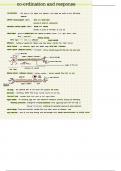
co-ordination and response
co-ordination the the and the body made to work efficiently
way all organs systems In are
· -
together
·
Central nervous system (CNS) brain and spinal cord
·
consists of areas of coordination
peripheral nervous system (DNS) nerves and neurons
·
connect all parts of the body to the CNS
·
sense organs
-
group of receptor cells that respond to specific Stimuli /I .
e .
light , sound , touch ,
temp . , chemical)
1
- sensory impulses
sense organ > CNS effectors
impulses
·
-
motor
-
-
-
·
effectors -
muscles or glands that respond when they receive impulses from motor neurons
ner ve impulse
-
an electrical signal that
passes along nerve cells (neurones
·
motor neuron /efferent neurons) -
multipolar -
carry impulses away from the brain and spinal cord
dendrites
T
Y
-
-
1E myelin sheath (insulator ( D
- endings
S nerve
EnF i
.
..&
-
-
- 3
-
--
-
-
I
-
Manu ...
& -
-
Ti
,Y L
=
#3-
.... - axon terminals
T
-
-
ax
-
(nerve fibre ( j
nodes of Ranvier
-
-
I
direction of impulse
cell body
·
sensory neuron (afferent neuron) -
mostly unipolar
-
carries impulses from PNS to CNS
A
cell
I
dendron
body axon terminals
-
-
#>
LM -
Y
-
i myelin sheath axon
#
sensory
receptors
·
cell body -
the spherical part of the neuron that contains the nucleus
·
dendrites -
branching fibres that
brings imprises towards the cell body
·
Schwann's cells -
secretes lipids that make up the myelin sheath
·
myelin sheath -
an
insulating layer that allow electrical impulses to transmit quickly and efficiently
·
saltatory conduction -
propagation of ac tion potentials along myelinated axons from one node of
Ranvier to the next ,
increasing the conduction velocity of action potentials
·
nerve endings
-
fibre that transmitts impulses from the motor neuron to effector cells
that release neurotransmitters to another neuron
·
axon terminals -
part of the nerve
endings that are enlarged
, sensory receptors dendrites of neurons specialized for receiving specific stimul
sensory
· -
·
axon-carry imprises towards the cell
·
nerve fibres -
a
long filament of cytoplasm that runs from the cell body of the neuron
axon
synapse a junction between two neurons where impulses pass -
-
·
·
Yv
by a diffusion of neurotransmitters
I1
&
-
&
-
8
88
speeds up transmissions of impulses from one neuron to another 8
L
8
88S j& &
j
- - 8 -
&88
d
-B88-
·
prevents ruptures &
Up
-
·
synaptic cleft) also known as a synaptic gap) -
the space between -
neurons at a nerve synapse
signal transmissions
I
electrical chemical
-
-
changes In the
charge of fluid in the axon creates an between neurons , small molecules called neurotransmitters
at
impulse which can be moved down the length of the cell are exchanged the
synapse
-faster transmissions -
more precise and selective
-sand an lon cur rent
flowing directly from the -
slower transmissions
cytoplasm of a neuron to another
through -
much easier to control
gap junctions -found In most of the neuron
junctions
-found In the retina , olfactory bulb , cerebral I
way transmission
cortex , etc
.
2
way signal
-
specialized intercellular connection between multitude of animal cells that allow various
gap junctions a
· -
molecules , lons and electrical impulses to pass through
-I
-
-
Eh
1Y
-
N&3
& =
-
-
presynaptic
neuron
·
presynaptic neuron-neuron that fires the neurotransmitter
-
&S
&2 1=
-
&
# & ↓ - as a result of an action potential
E
-
-
S & entering its axon terminal
"
-
&
<
&
terminal holds bunch of vesicle
presynaptic a
tiny synaptic sacs
· -
·
synaptic vesicle -
contains thousands of molecules of a
presynaptic &
& &YL p S-
- ()8 "R
neurotransmitter
given
W
↳
-
-
F & jE
terminal
-
the Neurotransmitter
postsynaptic neuron -neuron that receives
Wi
·
&
&~
postsynaptic
-
neuron
I
co-ordination the the and the body made to work efficiently
way all organs systems In are
· -
together
·
Central nervous system (CNS) brain and spinal cord
·
consists of areas of coordination
peripheral nervous system (DNS) nerves and neurons
·
connect all parts of the body to the CNS
·
sense organs
-
group of receptor cells that respond to specific Stimuli /I .
e .
light , sound , touch ,
temp . , chemical)
1
- sensory impulses
sense organ > CNS effectors
impulses
·
-
motor
-
-
-
·
effectors -
muscles or glands that respond when they receive impulses from motor neurons
ner ve impulse
-
an electrical signal that
passes along nerve cells (neurones
·
motor neuron /efferent neurons) -
multipolar -
carry impulses away from the brain and spinal cord
dendrites
T
Y
-
-
1E myelin sheath (insulator ( D
- endings
S nerve
EnF i
.
..&
-
-
- 3
-
--
-
-
I
-
Manu ...
& -
-
Ti
,Y L
=
#3-
.... - axon terminals
T
-
-
ax
-
(nerve fibre ( j
nodes of Ranvier
-
-
I
direction of impulse
cell body
·
sensory neuron (afferent neuron) -
mostly unipolar
-
carries impulses from PNS to CNS
A
cell
I
dendron
body axon terminals
-
-
#>
LM -
Y
-
i myelin sheath axon
#
sensory
receptors
·
cell body -
the spherical part of the neuron that contains the nucleus
·
dendrites -
branching fibres that
brings imprises towards the cell body
·
Schwann's cells -
secretes lipids that make up the myelin sheath
·
myelin sheath -
an
insulating layer that allow electrical impulses to transmit quickly and efficiently
·
saltatory conduction -
propagation of ac tion potentials along myelinated axons from one node of
Ranvier to the next ,
increasing the conduction velocity of action potentials
·
nerve endings
-
fibre that transmitts impulses from the motor neuron to effector cells
that release neurotransmitters to another neuron
·
axon terminals -
part of the nerve
endings that are enlarged
, sensory receptors dendrites of neurons specialized for receiving specific stimul
sensory
· -
·
axon-carry imprises towards the cell
·
nerve fibres -
a
long filament of cytoplasm that runs from the cell body of the neuron
axon
synapse a junction between two neurons where impulses pass -
-
·
·
Yv
by a diffusion of neurotransmitters
I1
&
-
&
-
8
88
speeds up transmissions of impulses from one neuron to another 8
L
8
88S j& &
j
- - 8 -
&88
d
-B88-
·
prevents ruptures &
Up
-
·
synaptic cleft) also known as a synaptic gap) -
the space between -
neurons at a nerve synapse
signal transmissions
I
electrical chemical
-
-
changes In the
charge of fluid in the axon creates an between neurons , small molecules called neurotransmitters
at
impulse which can be moved down the length of the cell are exchanged the
synapse
-faster transmissions -
more precise and selective
-sand an lon cur rent
flowing directly from the -
slower transmissions
cytoplasm of a neuron to another
through -
much easier to control
gap junctions -found In most of the neuron
junctions
-found In the retina , olfactory bulb , cerebral I
way transmission
cortex , etc
.
2
way signal
-
specialized intercellular connection between multitude of animal cells that allow various
gap junctions a
· -
molecules , lons and electrical impulses to pass through
-I
-
-
Eh
1Y
-
N&3
& =
-
-
presynaptic
neuron
·
presynaptic neuron-neuron that fires the neurotransmitter
-
&S
&2 1=
-
&
# & ↓ - as a result of an action potential
E
-
-
S & entering its axon terminal
"
-
&
<
&
terminal holds bunch of vesicle
presynaptic a
tiny synaptic sacs
· -
·
synaptic vesicle -
contains thousands of molecules of a
presynaptic &
& &YL p S-
- ()8 "R
neurotransmitter
given
W
↳
-
-
F & jE
terminal
-
the Neurotransmitter
postsynaptic neuron -neuron that receives
Wi
·
&
&~
postsynaptic
-
neuron
I

