ob/peds exam 3 quiz questions with correct answers verified 100%
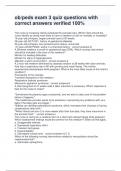
ob/peds exam 3 quiz questions with correct answers verified 100% The nurse is reviewing clients scheduled for prenatal care. Which client should the nurse identify as being most likely to have a newborn at risk for mortality or morbidity? 16-year-old primipara, began prenatal care at 30 weeks 28-year-old G2 P1001, history of gestational diabetes 23-year-old primipara, low socioeconomic status, unmarried 37-year-old G8 P2323, works in a chemical factory - correct answers-D A 38-week newborn is small for gestational age (SGA). Which nursing intervention should be included in the care of this newborn? Monitor for feeding difficulties Monitor for signs of hyperglycemia Maintain a warm environment - correct answers-d A 2-hour-old newborn delivered by cesarean section at 38 weeks with clear amniotic fluid has a respiratory rate of 80 with grunting and nasal flaring. The mother experienced preeclampsia while pregnant. What is the most likely cause of this infant's condition? Prematurity of the neonate Transient tachypnea of the newborn Respiratory distress syndrome Meconium aspiration syndrome - correct answers-b A client pregnant at 41 weeks asks if labor induction is necessary. Which response is best for the nurse to make? "Sometimes the placenta ages excessively, and we want to take care of that problem before it happens." "The healthcare provider wants to be proactive in preventing any problems with your baby if the baby gets any bigger." "Babies can develop postmaturity syndrome, which increases their chances of having complications after birth." "When infants are born 2 or more weeks after their due date, they have meconium in the amniotic fluid." - correct answers-c The nurse is caring for a newborn born to a client who abused drugs while pregnant. Which assessment findings would be common for this newborn? Select all that apply. a. Exaggerated reflexes b. Depressed respiratory effort c. Transient tachypnea d. Hyperirritability e. Decreased muscle tone - correct answers-A C D Which of the following nursing interventions related to resuscitation should be implemented first? a. Administer epinephrine. b. Administer 21% oxygen in a positive-pressure ventilator. c. Perform chest compressions. d. Rub the infant's back with a blanket. - correct answers-d An infant with type A Rh-positive blood becomes visibly jaundiced at 12 hours of age. The mother with type O Rh-positive blood asks why this has occurred. How should the nurse respond? a. "The RhoGAM you received at 28 weeks' gestation did not prevent alloimmunization." b. "Your body has made antibodies against the baby's blood that are destroying her red blood cells." C. "The red blood cells of your baby are breaking down because you both have Rh-positive blood." D. Your baby's liver is too immature to eliminate the red blood cells that are no longer needed." - correct answers-b The nurse is assessing a newborn at 1 hour of age. Which finding requires an immediate intervention? a. Mean blood pressure 55 mmHg b. Pauses in respiration lasting >30 seconds c. Respiratory rate 60, crackles present bilaterally d. Pulse rate 145, systolic murmur heard - correct answers-b The nurse is planning the care of a 1-day-old infant. Which intervention would protect the newborn from heat loss by convection? a. Placing the newborn away from air currents b. Prewarming the examination table c. Drying the newborn thoroughly. d. Removing wet linens from the isolette - correct answers-a Nursing students describe actions while practicing physical assessment of a newborn using a model. Which nursing student's statement indicates the need for further teaching? a. "I obtained the infant's heart rate by observing the cardiac monitor." b. "I counted respiratory rate for a full minute." c. "I palpated peripheral pulses in all the newborn's extremities." - correct answers-a The nurse notes the presence of a cephalohematoma on the head of a newborn. What did the nurse use to make this clinical determination? Select all that apply. a. The mass appeared on the second day after birth. b. The mass appears only on one side of the head. c. The head appears symmetric. d. The mass overrides the suture line. e. The mass appears larger when the newborn cries. - correct answers-a b The nurse attempts to take the vital sign of the newborn, but the newborn is crying. What intervention would be appropriate? a. Placing a gloved finger in the newborn's mouth b. Swaddling the newborn with several warm blankets in an attempt to calm the newborn c. Waiting until the newborn stops crying d. Taking the vital signs - correct answers-a Before the nurse begins to dry the newborn off a download for complete and clear document
Written for
- Institution
- Nr Peds Ob
- Course
- Nr Peds Ob
Document information
- Uploaded on
- July 2, 2024
- Number of pages
- 6
- Written in
- 2023/2024
- Type
- Exam (elaborations)
- Contains
- Questions & answers
Subjects
-
obpeds exam 3 quiz questions with correct answers

Also available in package deal