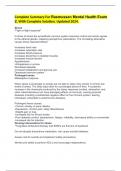
Complete Summary For Rasmussen Mental Health Exam
2, With Complete Solution. Updated 2024.
Stress
"Fight or flight response"
In times of stress the sympathetic nervous system assumes control and sends signals
to the adrenal glands, releasing epinephrine (adrenaline). The circulating adrenaline
causes these expected effects:
Increases heart rate
Increases respiration rate
Increases blood pressure
Increases blood flow to skeletal muscles
Increases muscle tension
Apprehension
Unhappiness or sorrow
Decreased appetite
Increased metabolism and glucose use
Depressed immune system
Prolonged stress
Maladaptive response
When stress is prolonged or people are not able to relax, they remain in chronic low
levels of stress. The body stays alert for a prolonged period of time. A sustained
increase in the chemicals produced by the stress response (cortisol, adrenaline, and
other catecholamines) can have damaging effects on the body, causing physical
diseases including a substantial negative effect on the immune system, leaving
individuals vulnerable to autoimmune diseases.
Prolonged stress causes:
-Chronic anxiety or panic attacks
-Depression, chronic pain, sleep disturbances
-Weight gain or loss
-Increased risk for MI and stroke
-Poor diabetes control, hypertension, fatigue, irritability, decreased ability to concentrate
-Increased risk for infection
Nursing interventions for stress
**Cognitave behavioral therapy and SSRI's are first line of treatment
Do not abruptly discontinue medication; can cause suicidal ideations
Assess risk for suicide and implement safety precautions
Monitor pt's ability to perform ADL's and encourage independence
,Therapeutic communication develop nurse-client relationship
Counseling
Posttraumatic Stress Disorder (PTSD)
People who experience/witness any traumatic event. Will feel extraordinary
helplessness or powerlessness in the face of stressors; lack of energy; sad with blunted
affect; poor grooming/lack of hygiene; slow speech, decreased verbalization, delayed
responses.
Four cardinal symptoms of PTSD
• Intrusive reexperiencing of the initial trauma (flashbacks, nightmares, unwanted
distressing memories of the event, feelings of unreality)
• Avoidance (avoid all memories and feelings as well as people or places that might
recall the event)
• Persistent negative alterations in cognitions and mood (distorted cognitions about
themselves and others [fear, guilt] and feelings of detachment)
• Alteration and arousal and activity (irritability, angry outbursts, self-destructive
behavior, exaggerated startle response, hypervigilance, sleep difficulties)
Optimal outcomes for PTSD patients
• Patient and others will remain safe.
• Patient will receive treatment for co-occurring conditions.
• Patient will attend support group meetings.
• Patient will expand social support network.
• Patient will exhibit an increase in restful sleep periods.
• Patient will have fewer nightmares and flashbacks.
• Patient will express decreased irritability.
• Patient will be able to demonstrate effective anxiety reduction techniques
Pharmacotherapy for PTSD
Depression -> Antidepressants
Flashbacks -> SSRI antidepressants (fluoxetine), buspirone augmentation of SSRI,
second-generation antipsychotics
Panic attacks -> Antidepressants, MAOI's, high-potency benzodiazepines
Hyperarousal -> Antidepressants, benzodiazepines, α2-adrenergic agonists,
,anticonvulsants
Nightmares -> prazosin (Minipress)
Nursing diagnosis for PTSD
Disturbed thought process
Sleep deprivation r/t nightmares associated with traumatic event
Post-trauma syndrome r/t exposure to traumatic event
***Prioritize nursing diagnoses for PTSD related to safety/violence and self-harm
Cognitive behavioral therapy
Uses cognitive reframing to help the patient identify negative thoughts that produce
anxiety, examine the cause, and develop supportive ideas that replace negative self-
talk.
Stress management techniques
Relaxation techniques
-Meditation
-Guided imagery
-Breathing exercises
-Journal writing
-Priority restructuring
Reframing
-Changes the way we look at and feel about things
-There are many ways to interpret the same reality such as seeing the glass as half full
rather than half empty
Sleep
-Getting healthy amounts of sleep (8 hrs)
Aerobic exercise
-It is recommended for at least 30 minutes, three times a week
Lower/eliminate caffeine intake
-Such a simple measure can lead to more energy, fewer muscle aches, and greater
relaxation
Anxiety
Feeling of apprehension, uneasiness, uncertainty, or dread resulting from a real or
perceived threat whose actual source is unknown or unrecognized.
Generalized anxiety disorder (GAD)
Basically, GAD is characterized by excessive, persistent, and uncontrollable anxiety,
and by excessive and constant worrying. It is sometimes referred to as the "worry
disease."
**Symptoms lasted for 6 months
, (e.g., What if I'm late? ...What if I fail? ...What if I am fired?)
Manifestations of GAD
Restlessness
Muscle tension
Avoidance of stressful activities or events
Procrastination in decision making
Increased effort preparing for stressful activities
Seeks repeated reassurance
Pacing
Mild anxiety
May have heightened perceptual field.
Is alert and can see, hear, and grasp what is happening in the environment. Can identify
issues that are disturbing and are producing anxiety.
Able to work effectively toward a goal and examine alternatives.
Manifestations of mild anxiety
-Slight discomfort
-Attention-seeking behaviors
-Restlessness
-Irritability or impatience
-Mild tension-relieving behavior: foot or finger tapping, lip chewing, fidgeting
Moderate anxiety
Has narrow perceptual field; grasps less of what is occurring. Can attend to more if
pointed out by another (selective inattention).
Able to solve problems but not at optimal ability
Benefits from guidance of others.
Manifestations of moderate anxiety
-Voice tremors
-Change in voice pitch
-Difficulty concentrating; SELECTIVE ATTENTION
-Shakiness
-Repetitive questioning
-Somatic complaints (e.g., urinary frequency and urgency, headache, backache,
insomnia)
2, With Complete Solution. Updated 2024.
Stress
"Fight or flight response"
In times of stress the sympathetic nervous system assumes control and sends signals
to the adrenal glands, releasing epinephrine (adrenaline). The circulating adrenaline
causes these expected effects:
Increases heart rate
Increases respiration rate
Increases blood pressure
Increases blood flow to skeletal muscles
Increases muscle tension
Apprehension
Unhappiness or sorrow
Decreased appetite
Increased metabolism and glucose use
Depressed immune system
Prolonged stress
Maladaptive response
When stress is prolonged or people are not able to relax, they remain in chronic low
levels of stress. The body stays alert for a prolonged period of time. A sustained
increase in the chemicals produced by the stress response (cortisol, adrenaline, and
other catecholamines) can have damaging effects on the body, causing physical
diseases including a substantial negative effect on the immune system, leaving
individuals vulnerable to autoimmune diseases.
Prolonged stress causes:
-Chronic anxiety or panic attacks
-Depression, chronic pain, sleep disturbances
-Weight gain or loss
-Increased risk for MI and stroke
-Poor diabetes control, hypertension, fatigue, irritability, decreased ability to concentrate
-Increased risk for infection
Nursing interventions for stress
**Cognitave behavioral therapy and SSRI's are first line of treatment
Do not abruptly discontinue medication; can cause suicidal ideations
Assess risk for suicide and implement safety precautions
Monitor pt's ability to perform ADL's and encourage independence
,Therapeutic communication develop nurse-client relationship
Counseling
Posttraumatic Stress Disorder (PTSD)
People who experience/witness any traumatic event. Will feel extraordinary
helplessness or powerlessness in the face of stressors; lack of energy; sad with blunted
affect; poor grooming/lack of hygiene; slow speech, decreased verbalization, delayed
responses.
Four cardinal symptoms of PTSD
• Intrusive reexperiencing of the initial trauma (flashbacks, nightmares, unwanted
distressing memories of the event, feelings of unreality)
• Avoidance (avoid all memories and feelings as well as people or places that might
recall the event)
• Persistent negative alterations in cognitions and mood (distorted cognitions about
themselves and others [fear, guilt] and feelings of detachment)
• Alteration and arousal and activity (irritability, angry outbursts, self-destructive
behavior, exaggerated startle response, hypervigilance, sleep difficulties)
Optimal outcomes for PTSD patients
• Patient and others will remain safe.
• Patient will receive treatment for co-occurring conditions.
• Patient will attend support group meetings.
• Patient will expand social support network.
• Patient will exhibit an increase in restful sleep periods.
• Patient will have fewer nightmares and flashbacks.
• Patient will express decreased irritability.
• Patient will be able to demonstrate effective anxiety reduction techniques
Pharmacotherapy for PTSD
Depression -> Antidepressants
Flashbacks -> SSRI antidepressants (fluoxetine), buspirone augmentation of SSRI,
second-generation antipsychotics
Panic attacks -> Antidepressants, MAOI's, high-potency benzodiazepines
Hyperarousal -> Antidepressants, benzodiazepines, α2-adrenergic agonists,
,anticonvulsants
Nightmares -> prazosin (Minipress)
Nursing diagnosis for PTSD
Disturbed thought process
Sleep deprivation r/t nightmares associated with traumatic event
Post-trauma syndrome r/t exposure to traumatic event
***Prioritize nursing diagnoses for PTSD related to safety/violence and self-harm
Cognitive behavioral therapy
Uses cognitive reframing to help the patient identify negative thoughts that produce
anxiety, examine the cause, and develop supportive ideas that replace negative self-
talk.
Stress management techniques
Relaxation techniques
-Meditation
-Guided imagery
-Breathing exercises
-Journal writing
-Priority restructuring
Reframing
-Changes the way we look at and feel about things
-There are many ways to interpret the same reality such as seeing the glass as half full
rather than half empty
Sleep
-Getting healthy amounts of sleep (8 hrs)
Aerobic exercise
-It is recommended for at least 30 minutes, three times a week
Lower/eliminate caffeine intake
-Such a simple measure can lead to more energy, fewer muscle aches, and greater
relaxation
Anxiety
Feeling of apprehension, uneasiness, uncertainty, or dread resulting from a real or
perceived threat whose actual source is unknown or unrecognized.
Generalized anxiety disorder (GAD)
Basically, GAD is characterized by excessive, persistent, and uncontrollable anxiety,
and by excessive and constant worrying. It is sometimes referred to as the "worry
disease."
**Symptoms lasted for 6 months
, (e.g., What if I'm late? ...What if I fail? ...What if I am fired?)
Manifestations of GAD
Restlessness
Muscle tension
Avoidance of stressful activities or events
Procrastination in decision making
Increased effort preparing for stressful activities
Seeks repeated reassurance
Pacing
Mild anxiety
May have heightened perceptual field.
Is alert and can see, hear, and grasp what is happening in the environment. Can identify
issues that are disturbing and are producing anxiety.
Able to work effectively toward a goal and examine alternatives.
Manifestations of mild anxiety
-Slight discomfort
-Attention-seeking behaviors
-Restlessness
-Irritability or impatience
-Mild tension-relieving behavior: foot or finger tapping, lip chewing, fidgeting
Moderate anxiety
Has narrow perceptual field; grasps less of what is occurring. Can attend to more if
pointed out by another (selective inattention).
Able to solve problems but not at optimal ability
Benefits from guidance of others.
Manifestations of moderate anxiety
-Voice tremors
-Change in voice pitch
-Difficulty concentrating; SELECTIVE ATTENTION
-Shakiness
-Repetitive questioning
-Somatic complaints (e.g., urinary frequency and urgency, headache, backache,
insomnia)