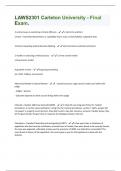
LAWS2301 Carleton University - Final Exam Questions And Answers Rated A+ 2024 Updates
2 central issues in examining criminal offences - o Harm (to another) o Fault - moral blameworthiness or culpability (mens rea); no-fault liability; subjective fault 2 Factors Impacting Judicial Decision-Making - Internal Factors and External Factors 2 models in assessing criminal process - o Crime control model o Due process model Acquisitive Crimes - Acquiring something (ex. theft, robbery, tax evasion) Adversarial Model of Judicial Review - - Canada's process, legal council makes case before the judge - Judges = passive - Outcome depends on what council brings before the judge Chaoulli v. Quebec (Attorney General) (2005) - o Chaoulli case-long wait times for medical procedures, in certain cases waiting for a long time for medical procedures, section 7 rights, people did not expect in majority court decision, they didn't want a two-tier outcome, account of public policy, they let the govt decide, the gov't has to respond, the dialogue between the two Charkaoui v. Canada (Citizenship and Immigration) (2007) - A few years later in Charkaoui-3 appellants who had security certificates, arrested here in Canada, they were found to be security threats, the case was appealed, ultimately at play was the provision of URPA, are detentions reasonable? The court found in favour of the appellants, the courts gave a year for the legislature to deal with the statutesCharter of Rights and Freedoms: Section 10 - Right to be informed of reasons for your arrest, to attain council, have validity of detention determined, to be released if detention isn't lawful Charter of Rights and Freedoms: Section 11 - Rights after being charged (ie. presumption of innocence, tried within a reasonable time, reasonable bail. Charter of Rights and Freedoms: Section 12 - Right to be free from cruel and unusual punishment Charter of Rights and Freedoms: Section 13 - Witness Rights, not to have incriminating evidence used against them Charter of Rights and Freedoms: Section 14 - Right to assistance of an interpreter. Charter of Rights and Freedoms: Section 7 - Life, Liberty, Security Charter of Rights and Freedoms: Section 8 - Secure against unreasonable search and seizure Charter of Rights and Freedoms: Section 9 - right against arbitrary detainment Contextualism - the least contentious, considers the larger and broader social factors, should the judge be considering the broader social, historical factors, should the judge be doing this? Crime Control Model - - Pre-Charter - Emphasis on arrests/jail - Increased police - Prioritizes power - Less emphasis on civil liberty ex. Harper Tough on Crimes AgendaDefence Position in a Plea Bargain - - duty to seek lesser sentence - resources are limited (legal aid) Distributive Justice - can be seen as economic, but it is broader than that, benefits of resources, notions of equity, and equality, and need, equality of outcome, one's reward is equal to one's contribution, everyone has the same opportunity, the issue of need, those who need more get more, and those who need less, get less, issues of distribution of justice Due Process Model - - limitations on police power - focus on individual liberties - more just/fair outcomes Expand on Access to Justice - A fundamental right to everyone (theoretically) Representation by a qualified lawyer Expected to give reasonable cost Provides fairness, quick resolution, affirms rule of law. Expand on Indigenous Accused and Victimization - Indigenous women are doubly disadvantaged Indigenous peoples are often unaware of rights Began with colonization Incarceration rate ~65% on East Coast Expand on Security Certificates - - Proof of existence is in overrepresentation in prisons (ex. Trevon Martin: murdered, not armed, 17 years old) - Can be helped with more police resources, sanctions to cops who commit these crimes, understanding. External factors - are where it is contestable, outside the judges, less limitations, public opinion and the media, in the U.S we see this much more, but in Canada we expect them not to be swayed by the public opinion, defining factor when the SCC takes a case, does the public deem it to be so?Hierarchal Jurisdiction of Court System - Federal: s.101, judges appointed by federal government includes federal court and federal court of appeal High Provincial: s.96, some cases start here, some are appealed to it Lower Provincial: s.92, trial courts, judges are appointed by province Indictable - more serious, - if the accused is charged with one, they will go to either 92 or superior court, sometimes they have the choice, when the crime is significant, a preliminary inquiry will take place at a lower provincial level to help save resources—evidence, supporting arguments of the Crown, plea bargains allowed at this stage Innovation - are they changing existing law? Strikes down a law or reads into a law a new meaning, or says to the gov't you have a year to update legislation, are they being too innovative in their approach Inquisitorial Model of Judicial Review - - Used in Europe - Judges = active - Judges are more equipped to make balanced decisions Intergenerational Trauma - • Higher rates of mortality and suicide • Frequent poverty and homelessness • Poor housing and infrastructure • Lower socioeconomic status • Illness and poor health • Addiction • Victimization and violence
Written for
- Institution
- LAWS2301 Carleton University
- Course
- LAWS2301 Carleton University
Document information
- Uploaded on
- July 2, 2024
- Number of pages
- 11
- Written in
- 2023/2024
- Type
- Exam (elaborations)
- Contains
- Questions & answers
Subjects
-
laws2301 carleton university

Also available in package deal