
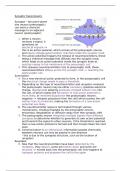
Synaptic transmission:
Synapse – the point where
one neuron (presynaptic)
can send a chemcial
message to an adjacent
neuron (postsynaptic)
1. When a neuron
recieves a signal, it
genertaes an
electircal impulse ->
this is an action potenial, which arrives at the presynaptic neuron
and opens voltage-gated sodium channles inside the synaptic knob
2. The action potential triggers the release of neurotransmitters, these
being a chemical message that diffuses into the synaptic knob,
which leads to an action potential inside the synaptic knob as
vesciles merge to the membrane of the presynaptic cell
3. This releases neurotransmitters into to presynaptic cleft, these
neurotransmitters diffuse across the synaptic cleft -> reaching the
postsynaptic cell
Summation:
4. For a new electircal action potential to form, in the postsynaptic cell
the electrical charge needs to pass a threshold
5. Depending on the type of neurotransmitter and receptors involved,
the postsynaptic neuron may be either excitatory (positive electrical
charge, depolarised) allowing positively charged sodium ions into
the cell, of which makes the formation of new action potential is
more likely, or inhibited (hypolarise the postsynaptic neuron,
negative -> releases potassium from the cell) which pushes the cell
further from its threshold, making the formation of a new action
potential less likely
6. The neurotrasmitter signal is terminated through various
mechanisms, inluding reuptake by the presynaptic neuron,
enzymatuc degradation or diffusion away from thre synaptic cleft
7. The postsynaptic neuron integrates multiple signals from different
synapses to determine whether to generate its own action potential
and trasnmit the signal to other neurons, if the threshold is reached,
then a new action potneial is formed and then travels down the next
axon
8. Communication is uni directional, information passed chemcially
between neurons can only be passed in one direction
- this is due to the synapses structure, such as the location of
receptors
Reuptake:
9. Now that the neurotransmitters have been detected by the
receptors, they detach, some are broken down and some are
recycled -> moved back into the presynaptic cell, this happens at
transport proteins and prepares the cell to fire again
Synapse – the point where
one neuron (presynaptic)
can send a chemcial
message to an adjacent
neuron (postsynaptic)
1. When a neuron
recieves a signal, it
genertaes an
electircal impulse ->
this is an action potenial, which arrives at the presynaptic neuron
and opens voltage-gated sodium channles inside the synaptic knob
2. The action potential triggers the release of neurotransmitters, these
being a chemical message that diffuses into the synaptic knob,
which leads to an action potential inside the synaptic knob as
vesciles merge to the membrane of the presynaptic cell
3. This releases neurotransmitters into to presynaptic cleft, these
neurotransmitters diffuse across the synaptic cleft -> reaching the
postsynaptic cell
Summation:
4. For a new electircal action potential to form, in the postsynaptic cell
the electrical charge needs to pass a threshold
5. Depending on the type of neurotransmitter and receptors involved,
the postsynaptic neuron may be either excitatory (positive electrical
charge, depolarised) allowing positively charged sodium ions into
the cell, of which makes the formation of new action potential is
more likely, or inhibited (hypolarise the postsynaptic neuron,
negative -> releases potassium from the cell) which pushes the cell
further from its threshold, making the formation of a new action
potential less likely
6. The neurotrasmitter signal is terminated through various
mechanisms, inluding reuptake by the presynaptic neuron,
enzymatuc degradation or diffusion away from thre synaptic cleft
7. The postsynaptic neuron integrates multiple signals from different
synapses to determine whether to generate its own action potential
and trasnmit the signal to other neurons, if the threshold is reached,
then a new action potneial is formed and then travels down the next
axon
8. Communication is uni directional, information passed chemcially
between neurons can only be passed in one direction
- this is due to the synapses structure, such as the location of
receptors
Reuptake:
9. Now that the neurotransmitters have been detected by the
receptors, they detach, some are broken down and some are
recycled -> moved back into the presynaptic cell, this happens at
transport proteins and prepares the cell to fire again


