5. SOLIDS, LIQUIDS AND GASES
A – Units:
̊ Kelvin (K), joule (J) kilogram (kg), kilogram/metre 3 (kg/m3), metre
5.1 – use the units: degree Celsius ( C),
(m), metre (m ), metre3 (m ), metre/second (m/s), metre/second2 (m/s2), newton (N) and pascal (Pa)
2 2 3
5.2 – use the following units: joules/kilogram degree Celsius (J/kg C)
̊
B – Density and pressure:
5.3 – know and use the relationship between density, mass and volume
kg g mass ( kg ) ρ = m/v
o Density ( ∨ 3 )=
volume ( m )
3
m cm 3
o 1 g/cm3 = 1000kg/m3
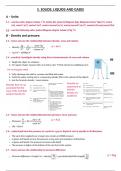
5.4 – practical: investigate density using direct measurements of mass and volume
1. Weigh the object on a balance
2. For regular shape: measure the l,w,h with a ruler find volume by multiplying l,w,h
For an irregular solid:
3. Fully submerge the solid in a eureka can filled with water
4. Catch the water coming out in a measuring cylinder (this is the volume of the object)
5. Use the formula: density = mass/volume
Describe an
Describe how he can
experiment to
accurately find the
find the
mass of the steel bolt
density of a
using its density (5)
marble (5)
5.5 – know and use the relationship between pressure, force and area
o Pressure (
N
∨Pa)=
force ( N ) p = F/A
area ( m2)
2
m
o 1Pa = 1N/m2
5.6 – understand how the pressure at a point in a gas or liquid at rest at equally in all directions
o The same force applied over a larger area creates a LOWER pressure
o In gases and liquids at rest, the pressure at any point acts equally in all directions
o In gases and liquids, the pressure increases with depth
o The pressure is higher at the bottom of the sea that at the surface
5.7 – know and use the relationship for pressure difference
o Pressure difference=height ( m ) × density
( )
kg
m 3
× gravitational field strength
N
kg ( ) p = hρg
A – Units:
̊ Kelvin (K), joule (J) kilogram (kg), kilogram/metre 3 (kg/m3), metre
5.1 – use the units: degree Celsius ( C),
(m), metre (m ), metre3 (m ), metre/second (m/s), metre/second2 (m/s2), newton (N) and pascal (Pa)
2 2 3
5.2 – use the following units: joules/kilogram degree Celsius (J/kg C)
̊
B – Density and pressure:
5.3 – know and use the relationship between density, mass and volume
kg g mass ( kg ) ρ = m/v
o Density ( ∨ 3 )=
volume ( m )
3
m cm 3
o 1 g/cm3 = 1000kg/m3
5.4 – practical: investigate density using direct measurements of mass and volume
1. Weigh the object on a balance
2. For regular shape: measure the l,w,h with a ruler find volume by multiplying l,w,h
For an irregular solid:
3. Fully submerge the solid in a eureka can filled with water
4. Catch the water coming out in a measuring cylinder (this is the volume of the object)
5. Use the formula: density = mass/volume
Describe an
Describe how he can
experiment to
accurately find the
find the
mass of the steel bolt
density of a
using its density (5)
marble (5)
5.5 – know and use the relationship between pressure, force and area
o Pressure (
N
∨Pa)=
force ( N ) p = F/A
area ( m2)
2
m
o 1Pa = 1N/m2
5.6 – understand how the pressure at a point in a gas or liquid at rest at equally in all directions
o The same force applied over a larger area creates a LOWER pressure
o In gases and liquids at rest, the pressure at any point acts equally in all directions
o In gases and liquids, the pressure increases with depth
o The pressure is higher at the bottom of the sea that at the surface
5.7 – know and use the relationship for pressure difference
o Pressure difference=height ( m ) × density
( )
kg
m 3
× gravitational field strength
N
kg ( ) p = hρg