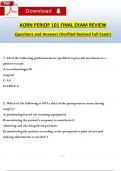
AORN PERIOP 101 FINAL EXAM REVIEW
Questions and Answers (Verified Revised Full Exam)
1. All of the following professionals are qualified to provide anesthesia to a
patient except:
A: anesthesiologist B:
surgeon
C: AA
D: CRNA: B
2. Which of the following is NOT a duty of the perioperative nurse during
surgery?
A: positioning forced-air warming equipment
B: monitoring the patient's response to anesthesia C:
obtaining and checking blood products
D: monitoring the patient according to the preoperative plan of care and
making adjustments as needed: B
,3. Which of the following is not used to secure and manage a patient's airway? A: oral
airway
B: LMA
C: ET tube
D: nasal cannula: D
4. Which of the following monitors assesses depth of anesthesia? A:
pulmonary artery catheter
B: bispectral index monitor
C: transesophageal echocardiography D:
central venous pressure: B
5. Which of the following type of anesthesia must be administered by an
anesthesia professional? Select all that apply:
A: general anesthesia B:
moderate sedation
C: monitored anesthesia care D:
local anesthesia: A, C, D
6. Which of the following type of airway maintenance usually requires muscle
relaxants?
A: spontaneous respiration B:
,endotracheal intubation C:
laryngeal mask airway D:
mask ventilation: B
7. Fentanyl can be revered with which of the following agents? A:
flumazenil
B: neostigmine
, C: naloxone
D: sugammadex: C
8. Which of the following neuraxial anesthesia procedures describes the spinal
block?
A: local anesthetic is injected near nerve bundles
B: local anesthetic is injected into a vein after tourniquet inflation
C: local anesthetic is injected into the space between the ligament flavum and dura
D: local anesthetic is injected into the subarachnoid space: D
9. True or False: LAST occurs as a result of local medication injection directly into a
blood vessel or from slow absorption.: True
10. Sedation can be used with any of the following types of anesthesia except: A:
general
B: monitored
C: regional D:
local: D
11. The most specific sign of an MH crisis is: A: an
increase in end-tidal CO2
B: skin mottling C:
hypertension D:
tachycardia: A
12. Which of the following is associated with increased risk for perioperative
hypothermia?
A: hyperthyroidism B:
Questions and Answers (Verified Revised Full Exam)
1. All of the following professionals are qualified to provide anesthesia to a
patient except:
A: anesthesiologist B:
surgeon
C: AA
D: CRNA: B
2. Which of the following is NOT a duty of the perioperative nurse during
surgery?
A: positioning forced-air warming equipment
B: monitoring the patient's response to anesthesia C:
obtaining and checking blood products
D: monitoring the patient according to the preoperative plan of care and
making adjustments as needed: B
,3. Which of the following is not used to secure and manage a patient's airway? A: oral
airway
B: LMA
C: ET tube
D: nasal cannula: D
4. Which of the following monitors assesses depth of anesthesia? A:
pulmonary artery catheter
B: bispectral index monitor
C: transesophageal echocardiography D:
central venous pressure: B
5. Which of the following type of anesthesia must be administered by an
anesthesia professional? Select all that apply:
A: general anesthesia B:
moderate sedation
C: monitored anesthesia care D:
local anesthesia: A, C, D
6. Which of the following type of airway maintenance usually requires muscle
relaxants?
A: spontaneous respiration B:
,endotracheal intubation C:
laryngeal mask airway D:
mask ventilation: B
7. Fentanyl can be revered with which of the following agents? A:
flumazenil
B: neostigmine
, C: naloxone
D: sugammadex: C
8. Which of the following neuraxial anesthesia procedures describes the spinal
block?
A: local anesthetic is injected near nerve bundles
B: local anesthetic is injected into a vein after tourniquet inflation
C: local anesthetic is injected into the space between the ligament flavum and dura
D: local anesthetic is injected into the subarachnoid space: D
9. True or False: LAST occurs as a result of local medication injection directly into a
blood vessel or from slow absorption.: True
10. Sedation can be used with any of the following types of anesthesia except: A:
general
B: monitored
C: regional D:
local: D
11. The most specific sign of an MH crisis is: A: an
increase in end-tidal CO2
B: skin mottling C:
hypertension D:
tachycardia: A
12. Which of the following is associated with increased risk for perioperative
hypothermia?
A: hyperthyroidism B: