IEB Matric 2019 History
Notes
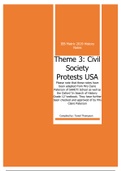
Theme 3: Civil
Society
Protests USA
Please note that these notes have
been adapted from Mrs Claire
Paterson of SAHETI School as well as
the Oxford ‘In Search of History-
Grade 12’ textbook. They have further
been checked and approved of by Mrs
Claire Paterson
Compiled by: Taneil Thompson
, Taneil Thompson
Theme 3
Civil Society Protests USA (1960’s and 1970’s)
Definitions:
1. Women’s Liberation: freeing women from restrictive controls of a
male-dominated society (socially, economically and politically).
2. Lobby: try to influence influential business and government leaders in
order to bring about change
3. Feminist: comes who fights for women’s rights and freedom of choice
and who believes in gender equality
4. Politicise: to make people aware of political issues
5. Boycott: to refuse to use, but or have anything to do with something
as a form of protest
6. Disenfranchise: to take away the voting right of a group of people
7. Draft: the American term for conscription, compulsory military service
8. Veterans: former soldiers who fought in a war
9. Capitol: building in Washington DC where the US congress
(parliament) is situated.
10. Segregation: the racial separation of all public amenities
11. Supreme Court: the highest court in the US, its function is to
ensure that all star and federal laws are in keeping the principles set
down in the Constitution
12. Federal government: the central or national US government in
Washington DC
13. Lynch: to execute someone without a proper trial, used especially
by the Ku Klux Klan to intimidate African Americans
14. Negotiation: to resolve conflict through dialogue and compromise
15. Marshals: government officials who act on behalf of the courts to
ensure that federal laws are carried out in each state
16. Racial Harmony: different races living in peace with each other
17. Notorious: well-known for bad reasons
18. Ghetto: a poor urban neighbourhood usually housing one ethnic
group
19. Police brutality: using unnecessary violence in carrying out duties
20. Looting: stealing by breaking into shops during a riot
21. Conspiracy: plot
22. Solidarity: togetherness
23. Militant: using, or willing to use, force
SAHETI School, 2019
, Taneil Thompson
24. Entrepreneurship: organising and operating business
opportunities
25. Overt: obvious, blatant
26. Marginalised: treated as less important
27. Civil disobedience: peaceful protest in which people break laws
that they think are unjust or unconstitutional
- World War Two was fought for freedom and democracy
- Western countries feel that they have not been granted that
- mass protests
The Women’s Liberation and Feminist Movements in the 1960s
and 1970s
-started in USA
-Aim: improve status of women and end discrimination based on gender
Position of Women in 1950’s-
-middle class, western women stay home, raise families
-limited career opportunities; nurses not doctors, flight attendants not
pilots; skills undermined, no promotions (95% of managers were men);
worked longer hours, got paid less (40% of a man’s salary)
-get married, lose job
Start of the Women’s Movement in the USA-
-1960’s: attitudes begin to change, young women refuse to be treated as
inferior, want greater independence
-1963: attitude inspired by The Feminine Mystique by Betty Friedan
published. “American middle class home had become a ‘comfortable
concentration camp’ for women”. People start talking about ‘Women’s
Liberation’.
-1964: Civil Rights Act in the USA outlawing discrimination on the grounds
of race and gender
-1966: law not being properly implemented. Friedan and others set up
National Organisation for Women (NOW).
-NOW held peaceful demonstrations, used petitions, strikes and legal
actions.
SAHETI School, 2019
Notes
Theme 3: Civil
Society
Protests USA
Please note that these notes have
been adapted from Mrs Claire
Paterson of SAHETI School as well as
the Oxford ‘In Search of History-
Grade 12’ textbook. They have further
been checked and approved of by Mrs
Claire Paterson
Compiled by: Taneil Thompson
, Taneil Thompson
Theme 3
Civil Society Protests USA (1960’s and 1970’s)
Definitions:
1. Women’s Liberation: freeing women from restrictive controls of a
male-dominated society (socially, economically and politically).
2. Lobby: try to influence influential business and government leaders in
order to bring about change
3. Feminist: comes who fights for women’s rights and freedom of choice
and who believes in gender equality
4. Politicise: to make people aware of political issues
5. Boycott: to refuse to use, but or have anything to do with something
as a form of protest
6. Disenfranchise: to take away the voting right of a group of people
7. Draft: the American term for conscription, compulsory military service
8. Veterans: former soldiers who fought in a war
9. Capitol: building in Washington DC where the US congress
(parliament) is situated.
10. Segregation: the racial separation of all public amenities
11. Supreme Court: the highest court in the US, its function is to
ensure that all star and federal laws are in keeping the principles set
down in the Constitution
12. Federal government: the central or national US government in
Washington DC
13. Lynch: to execute someone without a proper trial, used especially
by the Ku Klux Klan to intimidate African Americans
14. Negotiation: to resolve conflict through dialogue and compromise
15. Marshals: government officials who act on behalf of the courts to
ensure that federal laws are carried out in each state
16. Racial Harmony: different races living in peace with each other
17. Notorious: well-known for bad reasons
18. Ghetto: a poor urban neighbourhood usually housing one ethnic
group
19. Police brutality: using unnecessary violence in carrying out duties
20. Looting: stealing by breaking into shops during a riot
21. Conspiracy: plot
22. Solidarity: togetherness
23. Militant: using, or willing to use, force
SAHETI School, 2019
, Taneil Thompson
24. Entrepreneurship: organising and operating business
opportunities
25. Overt: obvious, blatant
26. Marginalised: treated as less important
27. Civil disobedience: peaceful protest in which people break laws
that they think are unjust or unconstitutional
- World War Two was fought for freedom and democracy
- Western countries feel that they have not been granted that
- mass protests
The Women’s Liberation and Feminist Movements in the 1960s
and 1970s
-started in USA
-Aim: improve status of women and end discrimination based on gender
Position of Women in 1950’s-
-middle class, western women stay home, raise families
-limited career opportunities; nurses not doctors, flight attendants not
pilots; skills undermined, no promotions (95% of managers were men);
worked longer hours, got paid less (40% of a man’s salary)
-get married, lose job
Start of the Women’s Movement in the USA-
-1960’s: attitudes begin to change, young women refuse to be treated as
inferior, want greater independence
-1963: attitude inspired by The Feminine Mystique by Betty Friedan
published. “American middle class home had become a ‘comfortable
concentration camp’ for women”. People start talking about ‘Women’s
Liberation’.
-1964: Civil Rights Act in the USA outlawing discrimination on the grounds
of race and gender
-1966: law not being properly implemented. Friedan and others set up
National Organisation for Women (NOW).
-NOW held peaceful demonstrations, used petitions, strikes and legal
actions.
SAHETI School, 2019