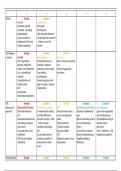
1 2 3 4 5
Wundt Strength Limitation
Scientific Subjective data
Systematic and well- Self-reports
controlled – lab setting Not replicated
Standardisation Only observable behaviour
Can be considered a can be objectively measured
predecessor of the more – Skinner: so can’t be
scientific approaches verified
Psychology as Strength Limitation Limitation
a science Scientific Subjective data Paradigm
Aim of psychology: Humanistic focuses on Kuhn: all sciences must have
describe, understand, individual, subjective one
predict, control behaviour experience, rejects science Internal disagreement –
Lab – controlled and Case studies in pre-science
unbiased psychodynamic
Standardisation and Human beings are active
variable control ppts in research – demand
BUT characteristics
Varied results
Wundt liked reductionism
The Strength Limitation Strength Limitation Limitation
behaviourist Well-controlled research Experiments on animals RWA Environmental determinism Too reductionist
approach Observable behaviour Complex decision-making Token economy systems – Behaviour conditioned by Ignores other approaches
Lab and other differences prisons and psychiatric past and mental processes
Break down behaviour into Innocent creatures – ethics wards Skinner: everything we do is Oversimplifies learning to
basic stimulus-response – harsh, cramped Phobia treatment sum of reinforcement stimulus-reward
units, no EVs conditions, kept hungry Training of animals history All nurture
Cause and effect can be BUT Raising of children No free will or conscious Proof – treatments – with
established Can do experiments on CBT decision-making processes biological and cognitive
BUT lacks in ecological animals we couldn’t on Explanatory power of neo- Negatives individual
authenticity humans due to ethical behaviourism differences
issues
Social Learning Strength Strength Limitation Limitation Strength
Wundt Strength Limitation
Scientific Subjective data
Systematic and well- Self-reports
controlled – lab setting Not replicated
Standardisation Only observable behaviour
Can be considered a can be objectively measured
predecessor of the more – Skinner: so can’t be
scientific approaches verified
Psychology as Strength Limitation Limitation
a science Scientific Subjective data Paradigm
Aim of psychology: Humanistic focuses on Kuhn: all sciences must have
describe, understand, individual, subjective one
predict, control behaviour experience, rejects science Internal disagreement –
Lab – controlled and Case studies in pre-science
unbiased psychodynamic
Standardisation and Human beings are active
variable control ppts in research – demand
BUT characteristics
Varied results
Wundt liked reductionism
The Strength Limitation Strength Limitation Limitation
behaviourist Well-controlled research Experiments on animals RWA Environmental determinism Too reductionist
approach Observable behaviour Complex decision-making Token economy systems – Behaviour conditioned by Ignores other approaches
Lab and other differences prisons and psychiatric past and mental processes
Break down behaviour into Innocent creatures – ethics wards Skinner: everything we do is Oversimplifies learning to
basic stimulus-response – harsh, cramped Phobia treatment sum of reinforcement stimulus-reward
units, no EVs conditions, kept hungry Training of animals history All nurture
Cause and effect can be BUT Raising of children No free will or conscious Proof – treatments – with
established Can do experiments on CBT decision-making processes biological and cognitive
BUT lacks in ecological animals we couldn’t on Explanatory power of neo- Negatives individual
authenticity humans due to ethical behaviourism differences
issues
Social Learning Strength Strength Limitation Limitation Strength