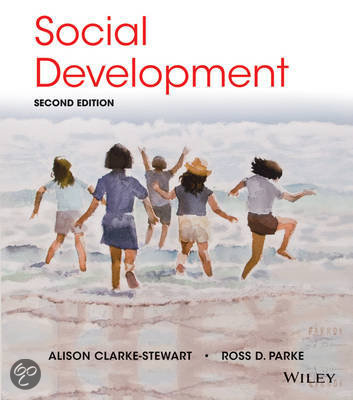
TEST BANK FOR CLARKE-STEWART & PARKE SOCIAL DEVELOPMENT
CHAPTER 1. INTRODUCTION: THEORIES OF SOCIAL DEVELOPMENT
Note: the highlighted items are included in the practice exam questions provided for
students in the Student Resources available at www.wiley.com/college/clarke.
Page numbers in the text are indicated in parentheses () at the end of each multiple
choice, true/false, and short answer test item. Correct answers are indicated with
asterisks (*).
MULTIPLE CHOICE QUESTIONS
1. People who are born within the same time period and share historical experiences are
called: (a) a population (b) *an age cohort (c) a normative event cohort (d) a social dyad
(28)
2. Which of the following is an example of an age cohort? (a) *people born in the 1950s who
were adolescents during the upheaval and social unrest of the late 1960s (b) people living
in the same macrosystem (c) people who share a zone of proximal development (d) all of
the above (28)
3. Which of the following are not among the causes of change outlined by the life span
theory of development? (a) normative events (b) nonnormative events (c) historical events
(d) *critical periods (27)
4. Modifying an existing schema to fit a new experience is called: (a) operant conditioning
(b) *accommodation (c) assimilation (d) classical conditioning (21)
5. Liz has learned how to print her name with both a crayon and a pencil.
Which of the following illustrates accommodation? (a) Her mother gives her an ink pen and
,Liz immediately begins to print her name (b) Her mother gives her an ink pen and
Liz ignores it, keeping the pencil instead (c) Her mother gives her a brush and paint and Liz
writes her name with the brush without putting it into the paint first (d) *Her mother gives
her a brush and paint and Liz learns to place the brush into the paint before trying to print
her name (21)
6. Applying an existing schema to fit a new experience is called: (a) operant conditioning (b)
accommodation (c) *assimilation (d) classical conditioning (20)
7. Liz has learned how to print her name with both a crayon and a pencil.
Which of the following illustrates assimilation? (a) *Her mother gives her an ink pen and Liz
immediately begins to print her name (b) Her mother gives her an ink pen and Liz
ignores it, keeping the pencil instead (c) Her mother gives her a brush and paint and Liz
learns to place the brush into the paint before trying to print her name (d) none of the
above (20)
8. Traditional learning theories emphasize (a) the prediction of overt behavior (b) the
control of overt behavior (c) the continuous nature of development (d) *all of the above
(16)
9. Which of the following is not considered a traditional learning theory? (a) drive reduction
(b) operant conditioning (c) *cognitive social learning (d) classical conditioning (16)
10. The time-based dimension that can alter the operation of all other systems in
Bronfenbrenner’s model is the: (a) temporal system (b) developmental system (c)
*chronosystem (d) macrosystem (23)
11. The fact that over time the relative importance of different people with whom you
interact changes is depicted by the: (a) mesosystem (b) exosystem (c) *chronosystem (d)
microsystem (23)
12. A type of learning in which a new stimulus is repeatedly presented with a familiar
stimulus until an individual learns to respond to the new stimulus in the same way as the
,familiar stimulus is: (a) operant conditioning (b) desensitization (c) *classical conditioning
(d) reciprocal determination (16)
13. Which of the following best illustrates classical conditioning: (a) a parent tells a child he
did a good job after he completes his homework early (b) a parent will not allow a child to
watch TV because she broke a house rule (c) a parent makes sure to reward a child’s
prosocial behavior intermittently instead of continuously (d) *a mother gives her toddler a
snack whenever she hears the toddler’s new baby sibling crying to be nursed (16)
14. A learning theory that stresses the importance of observation and imitation in the
acquisition of new behaviors, with learning mediated by cognitive processes is: (a) drive
reduction theory (b) *cognitive social learning theory (c) social information processing
theory (d) psychosocial theory (17)
15. Which of the following is not emphasized by cognitive social learning theory: (a)
*reinforcement of observed behavior (b) observation and imitation of behavior (c)
motivation to reproduce or imitate behavior (d) attention and retention of observed
behaviors (17)
16. A concept that there is a specific time in an organism’s development during which
external factors have a unique and irreversible impact is: (a) ethology (b) equifinality (c)
*critical period (d) zone of proximal development (25)
17. The concept of a critical period comes from: (a) behavior genetics (b) evolutionary
developmental theory (c) *ethological theory (d) sociocultural theory (25)
18. A type of classical conditioning therapy used to overcome phobias and fears through
exposure to increasingly intense versions of the feared stimulus is: (a) reciprocal
determination (b) operant conditioning (c) *desensitization (d) assimilation (16)
19. Which of the following is not characteristic of systematic desensitization: (a) *sudden
exposure to the feared object or event (b) imagining the feared object or event (c) gradual
exposure to the feared object or event (d) a, b, and c all are characteristic of systematic
desensitization (16)
, 20. The idea that the processes of development are different for different types of behavior
(e.g., moral judgments, manners, and peer relationships) is: (a) egocentricity (b) reciprocal
determination (c) multifinality (d) *domain specificity (22)
21. Domain specificity originates in: (a) ethological theory (b) *cognitive developmental
theory (c) sociocultural theory (d) ecological theory (22)
22. A version of learning theory stating that the association of stimulus and response results
in learning only if it is accompanied by reduction of motivators such as hunger and thirst is:
(a) classical conditioning (b) operant conditioning (c) desensitization (d) *drive reduction
(16)
23. The idea that children learned to love their mothers because their mothers provided
them with food was an example of: (a) cognitive social learning theory (b) generativity (c)
*drive reduction theory (d) a critical period (16)
24. A theory that stresses the importance of the relations between organisms and
environmental systems and the relations between the systems themselves is: (a)
sociocultural theory (b) *ecological theory (c) ethological theory (d) evolutionary
developmental theory (23)
25. Which of the following is not a system associated with Bronfenbrenner’s ecological
theory: (a) exosystem (b) *endosystem (c) macrosystem (d) microsystem (23)
26. In Freud’s theory, the rational component of the personality, which tries to satisfy needs
through appropriate, socially acceptable behaviors is the: (a) id (b) superego (c) *ego (d)
pleasure principle (12-13)
27. A child who lacked an ego would have difficulty in: (a) *satisfying needs through
appropriate, socially acceptable behaviors (b) maximizing pleasure and satisfying needs
immediately (c) applying moral values to his or her own acts (d) initiating an Oedipus or
Electra complex (12)
CHAPTER 1. INTRODUCTION: THEORIES OF SOCIAL DEVELOPMENT
Note: the highlighted items are included in the practice exam questions provided for
students in the Student Resources available at www.wiley.com/college/clarke.
Page numbers in the text are indicated in parentheses () at the end of each multiple
choice, true/false, and short answer test item. Correct answers are indicated with
asterisks (*).
MULTIPLE CHOICE QUESTIONS
1. People who are born within the same time period and share historical experiences are
called: (a) a population (b) *an age cohort (c) a normative event cohort (d) a social dyad
(28)
2. Which of the following is an example of an age cohort? (a) *people born in the 1950s who
were adolescents during the upheaval and social unrest of the late 1960s (b) people living
in the same macrosystem (c) people who share a zone of proximal development (d) all of
the above (28)
3. Which of the following are not among the causes of change outlined by the life span
theory of development? (a) normative events (b) nonnormative events (c) historical events
(d) *critical periods (27)
4. Modifying an existing schema to fit a new experience is called: (a) operant conditioning
(b) *accommodation (c) assimilation (d) classical conditioning (21)
5. Liz has learned how to print her name with both a crayon and a pencil.
Which of the following illustrates accommodation? (a) Her mother gives her an ink pen and
,Liz immediately begins to print her name (b) Her mother gives her an ink pen and
Liz ignores it, keeping the pencil instead (c) Her mother gives her a brush and paint and Liz
writes her name with the brush without putting it into the paint first (d) *Her mother gives
her a brush and paint and Liz learns to place the brush into the paint before trying to print
her name (21)
6. Applying an existing schema to fit a new experience is called: (a) operant conditioning (b)
accommodation (c) *assimilation (d) classical conditioning (20)
7. Liz has learned how to print her name with both a crayon and a pencil.
Which of the following illustrates assimilation? (a) *Her mother gives her an ink pen and Liz
immediately begins to print her name (b) Her mother gives her an ink pen and Liz
ignores it, keeping the pencil instead (c) Her mother gives her a brush and paint and Liz
learns to place the brush into the paint before trying to print her name (d) none of the
above (20)
8. Traditional learning theories emphasize (a) the prediction of overt behavior (b) the
control of overt behavior (c) the continuous nature of development (d) *all of the above
(16)
9. Which of the following is not considered a traditional learning theory? (a) drive reduction
(b) operant conditioning (c) *cognitive social learning (d) classical conditioning (16)
10. The time-based dimension that can alter the operation of all other systems in
Bronfenbrenner’s model is the: (a) temporal system (b) developmental system (c)
*chronosystem (d) macrosystem (23)
11. The fact that over time the relative importance of different people with whom you
interact changes is depicted by the: (a) mesosystem (b) exosystem (c) *chronosystem (d)
microsystem (23)
12. A type of learning in which a new stimulus is repeatedly presented with a familiar
stimulus until an individual learns to respond to the new stimulus in the same way as the
,familiar stimulus is: (a) operant conditioning (b) desensitization (c) *classical conditioning
(d) reciprocal determination (16)
13. Which of the following best illustrates classical conditioning: (a) a parent tells a child he
did a good job after he completes his homework early (b) a parent will not allow a child to
watch TV because she broke a house rule (c) a parent makes sure to reward a child’s
prosocial behavior intermittently instead of continuously (d) *a mother gives her toddler a
snack whenever she hears the toddler’s new baby sibling crying to be nursed (16)
14. A learning theory that stresses the importance of observation and imitation in the
acquisition of new behaviors, with learning mediated by cognitive processes is: (a) drive
reduction theory (b) *cognitive social learning theory (c) social information processing
theory (d) psychosocial theory (17)
15. Which of the following is not emphasized by cognitive social learning theory: (a)
*reinforcement of observed behavior (b) observation and imitation of behavior (c)
motivation to reproduce or imitate behavior (d) attention and retention of observed
behaviors (17)
16. A concept that there is a specific time in an organism’s development during which
external factors have a unique and irreversible impact is: (a) ethology (b) equifinality (c)
*critical period (d) zone of proximal development (25)
17. The concept of a critical period comes from: (a) behavior genetics (b) evolutionary
developmental theory (c) *ethological theory (d) sociocultural theory (25)
18. A type of classical conditioning therapy used to overcome phobias and fears through
exposure to increasingly intense versions of the feared stimulus is: (a) reciprocal
determination (b) operant conditioning (c) *desensitization (d) assimilation (16)
19. Which of the following is not characteristic of systematic desensitization: (a) *sudden
exposure to the feared object or event (b) imagining the feared object or event (c) gradual
exposure to the feared object or event (d) a, b, and c all are characteristic of systematic
desensitization (16)
, 20. The idea that the processes of development are different for different types of behavior
(e.g., moral judgments, manners, and peer relationships) is: (a) egocentricity (b) reciprocal
determination (c) multifinality (d) *domain specificity (22)
21. Domain specificity originates in: (a) ethological theory (b) *cognitive developmental
theory (c) sociocultural theory (d) ecological theory (22)
22. A version of learning theory stating that the association of stimulus and response results
in learning only if it is accompanied by reduction of motivators such as hunger and thirst is:
(a) classical conditioning (b) operant conditioning (c) desensitization (d) *drive reduction
(16)
23. The idea that children learned to love their mothers because their mothers provided
them with food was an example of: (a) cognitive social learning theory (b) generativity (c)
*drive reduction theory (d) a critical period (16)
24. A theory that stresses the importance of the relations between organisms and
environmental systems and the relations between the systems themselves is: (a)
sociocultural theory (b) *ecological theory (c) ethological theory (d) evolutionary
developmental theory (23)
25. Which of the following is not a system associated with Bronfenbrenner’s ecological
theory: (a) exosystem (b) *endosystem (c) macrosystem (d) microsystem (23)
26. In Freud’s theory, the rational component of the personality, which tries to satisfy needs
through appropriate, socially acceptable behaviors is the: (a) id (b) superego (c) *ego (d)
pleasure principle (12-13)
27. A child who lacked an ego would have difficulty in: (a) *satisfying needs through
appropriate, socially acceptable behaviors (b) maximizing pleasure and satisfying needs
immediately (c) applying moral values to his or her own acts (d) initiating an Oedipus or
Electra complex (12)