Finance Tutorial 1
Question 1
a) Compare the Discounted Cash Flow with the Internal Rate of Return valuation method. Which is
better and why?
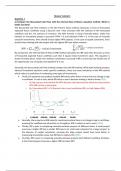
The discounted cash flow method, or the Net Present Value method, discounts a series of forecasted
expected future cashflows using a discount rate r that increases with the riskiness of the forecasted
cashflows and the risk aversion of investors. The NPV formula is shown formally below. Under this
method, an investment project is pursued if NPV > 0, and rejected if NPV < 0. In the case of mutually
exclusive investments, firms should choose higher NPV projects. In the case of capital constraints, firms
should invest starting with the project with the highest NPV per dollar invested.
By comparison, the Internal Rate of Return (IRR) method calculates the IRR value that discounts a series
of forecasted expected future cashflows such that it equals initial investment value. This equation is
shown formally above. Under this method, investment is pursued if IRR is more than the hurdle rate of
the opportunity cost of capital, and rejected if it is not.
Generally, the Discounted Cash Flow method is better than the IRR method. While both methods produce
identical investment decisions under specific conditions, there are many limitations of the IRR method
which reduce its usefulness in evaluating some types of investments.
• Firstly, the equation may produce multiple IRR values when there is more than one change in sign
in cashflows. In such a case, which IRR value to use in decision-making is hard to know (YES!)
o In that case you must look at the NPV-discount rate chart and see which area has positive
NPV (IRR are the x-intercepts).
o Eg. Case where NPV > 0 if discount rate is very low (below IRR1) or high (above IRR2)
o
o
• Secondly, there may be no IRR value for investments where there is no change in sign in cashflows,
meaning the cashflows are all positive or all negative. IRR is useless in such a case s (YES!)
• Thirdly, IRR is poor in comparing mutually exclusive projects of different scales. A small project
may have a higher IRR but a smaller NPV due to its small scale compared to a larger project. In
the absence of capital constraints, pursuing the large project would have been better in
maximising shareholder value, but IRR fails to capture this (YES!)
• Fourthly, IRR is poor in comparing mutually exclusive projects with different cashflow timelines.
A short-lived project may have a higher IRR but lower NPV
, o
• Lastly, the IRR method presumes a constant opportunity cost of capital over time periods, which
is often an inaccurate depiction of reality. The yield curve is seldom flat, and different discount
rates should be applied to cashflows in different periods (YES!)
• Borrowing vs lending case (positive initial cashflow followed by negative cashflows)
o In that case IRR is what you 'pay' and IRR < opportunity cost of capital is desired (means
that the opportunity allows you to borrow at a rate cheaper than opportunity cost of
capital)
While the third and fourth limitations on the comparison of mutually exclusive projects may be mitigated
by conducting IRR analysis on incremental cashflows (the cashflow difference between the two projects),
IRR clearly has several disadvantages that make it inferior to the Discounted Cash Flow method.
b) What are the disadvantages of the payback rule?
The payback rule calculates the time it takes for initial investments to be re-couped and recommends
projects that return the initial investments within a shorter time. Alternatively, the rule can be used as an
initial filter for investment projects, with a cut-off maximum time implemented such that only projects
with payback within the cut-off time are evaluated with alternative methods. This payback rule has two
key flaws:
• Firstly, all cashflows after the payback period is ignored. This could mean great long-term projects
may be overlooked in favour of lower quality short-term projects. (YES!)
• Secondly, all cashflows before the cut-off date are equally weighted, failing to account for the
opportunity cost of capital and time value of money.
However, a modified version of the payback rule, the discounted payback, considers discount rates to
mitigate the second flaw. It finds the time taken for initial investments to be re-couped, in terms of the
present value of future cashflows. Nevertheless, the first flaw still applies to this modified version of the
rule.
The payback rule is most suited for cases where future cashflows are very uncertain, such as in the case
of businesses in unstable political environments, so short term returns are preferred, and investors wish
to re-coup investments as quickly as possible.
• In such cases, NPV can still be used, with a higher discount rate applied to less certain cashflows
in the future
Question 2
Explain the different notions of market efficiency. How can we test for the different notions?
Market efficiency means that asset prices accurately reflect assets' intrinsic values, such that investors
would on average earn the required rate of return associated with the non-diversifiable systematic risk
Question 1
a) Compare the Discounted Cash Flow with the Internal Rate of Return valuation method. Which is
better and why?
The discounted cash flow method, or the Net Present Value method, discounts a series of forecasted
expected future cashflows using a discount rate r that increases with the riskiness of the forecasted
cashflows and the risk aversion of investors. The NPV formula is shown formally below. Under this
method, an investment project is pursued if NPV > 0, and rejected if NPV < 0. In the case of mutually
exclusive investments, firms should choose higher NPV projects. In the case of capital constraints, firms
should invest starting with the project with the highest NPV per dollar invested.
By comparison, the Internal Rate of Return (IRR) method calculates the IRR value that discounts a series
of forecasted expected future cashflows such that it equals initial investment value. This equation is
shown formally above. Under this method, investment is pursued if IRR is more than the hurdle rate of
the opportunity cost of capital, and rejected if it is not.
Generally, the Discounted Cash Flow method is better than the IRR method. While both methods produce
identical investment decisions under specific conditions, there are many limitations of the IRR method
which reduce its usefulness in evaluating some types of investments.
• Firstly, the equation may produce multiple IRR values when there is more than one change in sign
in cashflows. In such a case, which IRR value to use in decision-making is hard to know (YES!)
o In that case you must look at the NPV-discount rate chart and see which area has positive
NPV (IRR are the x-intercepts).
o Eg. Case where NPV > 0 if discount rate is very low (below IRR1) or high (above IRR2)
o
o
• Secondly, there may be no IRR value for investments where there is no change in sign in cashflows,
meaning the cashflows are all positive or all negative. IRR is useless in such a case s (YES!)
• Thirdly, IRR is poor in comparing mutually exclusive projects of different scales. A small project
may have a higher IRR but a smaller NPV due to its small scale compared to a larger project. In
the absence of capital constraints, pursuing the large project would have been better in
maximising shareholder value, but IRR fails to capture this (YES!)
• Fourthly, IRR is poor in comparing mutually exclusive projects with different cashflow timelines.
A short-lived project may have a higher IRR but lower NPV
, o
• Lastly, the IRR method presumes a constant opportunity cost of capital over time periods, which
is often an inaccurate depiction of reality. The yield curve is seldom flat, and different discount
rates should be applied to cashflows in different periods (YES!)
• Borrowing vs lending case (positive initial cashflow followed by negative cashflows)
o In that case IRR is what you 'pay' and IRR < opportunity cost of capital is desired (means
that the opportunity allows you to borrow at a rate cheaper than opportunity cost of
capital)
While the third and fourth limitations on the comparison of mutually exclusive projects may be mitigated
by conducting IRR analysis on incremental cashflows (the cashflow difference between the two projects),
IRR clearly has several disadvantages that make it inferior to the Discounted Cash Flow method.
b) What are the disadvantages of the payback rule?
The payback rule calculates the time it takes for initial investments to be re-couped and recommends
projects that return the initial investments within a shorter time. Alternatively, the rule can be used as an
initial filter for investment projects, with a cut-off maximum time implemented such that only projects
with payback within the cut-off time are evaluated with alternative methods. This payback rule has two
key flaws:
• Firstly, all cashflows after the payback period is ignored. This could mean great long-term projects
may be overlooked in favour of lower quality short-term projects. (YES!)
• Secondly, all cashflows before the cut-off date are equally weighted, failing to account for the
opportunity cost of capital and time value of money.
However, a modified version of the payback rule, the discounted payback, considers discount rates to
mitigate the second flaw. It finds the time taken for initial investments to be re-couped, in terms of the
present value of future cashflows. Nevertheless, the first flaw still applies to this modified version of the
rule.
The payback rule is most suited for cases where future cashflows are very uncertain, such as in the case
of businesses in unstable political environments, so short term returns are preferred, and investors wish
to re-coup investments as quickly as possible.
• In such cases, NPV can still be used, with a higher discount rate applied to less certain cashflows
in the future
Question 2
Explain the different notions of market efficiency. How can we test for the different notions?
Market efficiency means that asset prices accurately reflect assets' intrinsic values, such that investors
would on average earn the required rate of return associated with the non-diversifiable systematic risk