

ECO3020F 2024: TUTORIAL FIVE
Question 1 [11 marks]
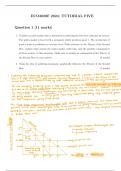
1. Consider a policy-maker who is interested in achieving the first best outcome for society.
The policy-maker is faced with a monopoly which produces good x. The production of
good x leads to pollution in a nearby river. With reference to the Theory of the Second
Best, explain what actions the policy-maker could take, and the possible consequences
of those actions, in this situation. Make sure to include an explanation of the Theory of
the Second Best in your answer. [6 marks]
2. Using the idea of polluting monopoly, graphically illustrate the Theory of the Second
Best. [5 marks]
iiQuestion 2 [10 marks] t.EE i E
For the monopoly producing good x and causing pollutiontheisn't first bestoutcome is MSB mp
a monopoly this feasible Pollutionisshown
But c ompetition underlying
due to a Mechanism Designer concerned with
the perfect
contributing to MPC MSB Thusthe fouroptionsfo
Consider the under-provision of a public good. The
MPC msps monopoly overcharges also
byprovision of the good is determined by the taxes
production and
only competition
utility functions only
policybelow: combinedgreen
the policy maker are nopolicy green
tax and competition policy first best
y = ✓(x1 + x2 + x3 + ... + xn )
and is pareto efficient The othertwo
The first best eliminatesdeadweight loss no1 policy Interventions to corvee
3than under
policies createmoredeadweightu = ✓(x + xloss
A 1 2 n
+ x + ... + x ) 0.5(x ) 2
I
than one
É
is better
fff
1. Mathematically solve for the subsidy the Mechanism Designer would provide to ensure
I
the socially optimal provision of the public good. Show all your working
fff
[6 marks]
prime
2. Explain, using the relevant equations, why the uncoordinated Nash Equilibrium contri-
ii ttit
tf
butions without the hf
i
Mechanism Designer’s interventions are Pareto Inefficient.
i fim.n.mn
marginalsocialcost [4 marks]
I I
xp Quantity of output x
Question 1 [11 marks]
1. Consider a policy-maker who is interested in achieving the first best outcome for society.
The policy-maker is faced with a monopoly which produces good x. The production of
good x leads to pollution in a nearby river. With reference to the Theory of the Second
Best, explain what actions the policy-maker could take, and the possible consequences
of those actions, in this situation. Make sure to include an explanation of the Theory of
the Second Best in your answer. [6 marks]
2. Using the idea of polluting monopoly, graphically illustrate the Theory of the Second
Best. [5 marks]
iiQuestion 2 [10 marks] t.EE i E
For the monopoly producing good x and causing pollutiontheisn't first bestoutcome is MSB mp
a monopoly this feasible Pollutionisshown
But c ompetition underlying
due to a Mechanism Designer concerned with
the perfect
contributing to MPC MSB Thusthe fouroptionsfo
Consider the under-provision of a public good. The
MPC msps monopoly overcharges also
byprovision of the good is determined by the taxes
production and
only competition
utility functions only
policybelow: combinedgreen
the policy maker are nopolicy green
tax and competition policy first best
y = ✓(x1 + x2 + x3 + ... + xn )
and is pareto efficient The othertwo
The first best eliminatesdeadweight loss no1 policy Interventions to corvee
3than under
policies createmoredeadweightu = ✓(x + xloss
A 1 2 n
+ x + ... + x ) 0.5(x ) 2
I
than one
É
is better
fff
1. Mathematically solve for the subsidy the Mechanism Designer would provide to ensure
I
the socially optimal provision of the public good. Show all your working
fff
[6 marks]
prime
2. Explain, using the relevant equations, why the uncoordinated Nash Equilibrium contri-
ii ttit
tf
butions without the hf
i
Mechanism Designer’s interventions are Pareto Inefficient.
i fim.n.mn
marginalsocialcost [4 marks]
I I
xp Quantity of output x


