

ECO3020F 2024
TUTORIAL FOUR [41 MARKS]
Question 1 [10 marks]
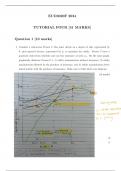
1. Consider a risk-averse Person C who must decide on a degree of risk, represented by
✓, and expected income, represented by ŷ, to maximise her utility. Person C faces a
quadratic risk-return schedule and can buy insurance at price p1 . On the same graph,
graphically illustrate Person C’s; 1) utility maximisation without insurance, 2) utility
maximisation followed by the purchase of insurance, and 3) utility maximisation deter-
mined jointly with the purchase of insurance. Make sure to fully label your diagram.
[10 marks]
Question 2 [20 marks]
For this question, consider the Walrasian Auctioneer and a General Equilibrium allocation
of good x and good y.
insurancepremium Utilitymax
o
1. Explain the process the Walrasian Auctioneer uses to find the market clearing outcome.
T
2. Mathematically show the wealth preservation and distributional neutrality of the First fi
[4 marks]
Welfare Theorem. Assume the price of good y is equal to 1.
ftp
[7 marks]
r
3. Consider a policy-maker who is dissatisfied with the Walrasian Auctioneer’s post-exchange
outcome of point h. The policy-maker prefers a post-exchange outcome of point g. Using
e
TUTORIAL FOUR [41 MARKS]
Question 1 [10 marks]
1. Consider a risk-averse Person C who must decide on a degree of risk, represented by
✓, and expected income, represented by ŷ, to maximise her utility. Person C faces a
quadratic risk-return schedule and can buy insurance at price p1 . On the same graph,
graphically illustrate Person C’s; 1) utility maximisation without insurance, 2) utility
maximisation followed by the purchase of insurance, and 3) utility maximisation deter-
mined jointly with the purchase of insurance. Make sure to fully label your diagram.
[10 marks]
Question 2 [20 marks]
For this question, consider the Walrasian Auctioneer and a General Equilibrium allocation
of good x and good y.
insurancepremium Utilitymax
o
1. Explain the process the Walrasian Auctioneer uses to find the market clearing outcome.
T
2. Mathematically show the wealth preservation and distributional neutrality of the First fi
[4 marks]
Welfare Theorem. Assume the price of good y is equal to 1.
ftp
[7 marks]
r
3. Consider a policy-maker who is dissatisfied with the Walrasian Auctioneer’s post-exchange
outcome of point h. The policy-maker prefers a post-exchange outcome of point g. Using
e


