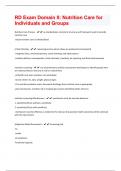
Environmental 101 Binghamton -Test 1 Questions & Answers Already Graded A+
3 Keys for Life on Earth - 1.) One flow of high-quality energy from the sun 2.) Nutrient cycling 3.) Gravity Affluence and Environmental Degradation - disproportionate difference in resource use between developed and developing countries Angiosperms - seed producing plants that have flowers and produce fruit whcih contain seeds Autumn Olive - invasive shrub, aggressive during sucession has edible berries Biodiversity - variety of life forms/species and the genes they contain, variety of ecosystems and ecosystems processes Biological importance of phosphorous - -component of ATP and DNA -we mine phosphate -phosphates cause eutrophication -NOT a renewable resource Biological Species Concept - a species as members of populations that actually or potentially interbreed in nature problem: hybridization carbon cycle - Carbon Cycle - -important to plants -most of carbon is found in ocean sediments -contributes to greenhouse effect Causes of Enviro problems - 1.) Population growth 2.) Unsustainable resource use 3.) Poverty 4.) Excluding environ costs in market prices 5.) Increasing isolation from naturecompetitive exclusion principle - two species with the same niche cannot coexist. One will be outcompeted Components of ecosystem - biosphere ecosystem community population organism decomposers - consumers that in the process of obtaining their own nutrients, release nutrients from the wastes or remains of plants and animals then return those nutrients to earth for reuse by producers. decompsers have feeding mechanisms Definition of science - a systematic attempt to discover how nature works through observation and experimentation Detrivores - INTERNAL DIGESTION, feed on wastes or dead bodies of other organisms ex) earthworms, vultures, insects Earths plant biomass - centered around rainfall constant temp Eastern Hemlock - small flat needles, small pine cones, evergreen Ecological Deficit - When an area's ecological footprint exceeds its biological capacity Ecological Footprint - the amount of land needed to supply a person with renewable resources to meet their needs and absorb their wastes ecosystem - communities of organisms interacting with one another and with the physical environment of matter and energy in which they live in Endemic species - species only found in one particular area Environmental Management View - we are separate from and in charge of nature, that nature exists mainly to meet our needs and increasing wants Environmental Stewardship View - we can and should manage the earth for our benefit, but that we have an ethical responsibility to be caring and responsible managers, or stewards, of the earth Environmental tipping point - point at which a fundamental shift in the behavior of a system occursEnvironmental Wisdom View - we are part of, and dependent on, nature and that the earth's lifesupport system exists for all species, not just for us. Evolution can occur via... - Mutation Migration Drift (random event selects for gene) natural selection Ferns - vascular plants that reproduce via spores First law of Thermo - energy in the universe is constant Fracking - hydraulic fracturing, deep well drilled until it hits shale and then the drill drills horizontally and then water and sand and chems are pumped into the rock. Rocks crack and release gas chemicals pollute groundwater and possibly enhance seismic activity Functional diversity - the range and value of those species and organismal traits that influence ecosystem functioning Fundamental niche vs. Realized niche - Fundamental is where the species could live Realized is where the species does live due to other environmental factors Fungi - heterotropic organisms Generalist - broad niche, more adaptable, occupy more habitats, higher competition, varied diet, high rate of evol, low risk of extinction GPP (Gross Primary Productivity) - The raw amount of energy producers produce before they use any or get eaten Gray Dogwood - white berries not edible, shrub Gymnosperms - seed bearing vascular plant in which ovules or seeds are not enclosed in an ovary Honeysuckle - invasive, gray hollow twigs, deer don't like How are humans effecting Nitrogen cycle? - -fertilizers which are CREATED BY HABER-BOSCH PROCESS -the excess nitrogen we produce can cause cultural eutrophication How efficient is an internal combustion engine? - 15% How many trophic levels does a terrestrial ecosystem have? What about an aquatic ecosystem? Why is there a difference? - 4-57-8 There is less bomass availabe from producers. Impact of soil, climate, and disturbances on succession - soil - impacts the rate of succession climate - heavily influences vegetation that grows there disturbances - natural disasters set succession back, altho some species depend on these distrubances to trigger growth ex) fire casues certain pine cones to grow Indicator species - species that provide early warnings of damage to a community or an ecosystem Inhibition Succession - an early arriving species that makes a site less suitable for others Invasive species - species which hurts the native species or ecosystem IPAT Model - Impact = Population x Affluence x Tech. Keystone species - species whose roles have a large effect on types and abundances of other species in an ecosystem Legume - plants which have nitrogen fixing bacteria colonies amoung their roots, ex) clover, soy beans, lotus Lichens - symbiotic organisms made up of fungi and either algae or cyanobacteria Low quality energy - energy so dispersed that it has little capacity to do work Major types of plants and trees - Moss
Written for
- Institution
- Environmental 101 Binghamton
- Course
- Environmental 101 Binghamton
Document information
- Uploaded on
- June 27, 2024
- Number of pages
- 8
- Written in
- 2023/2024
- Type
- Exam (elaborations)
- Contains
- Questions & answers
Subjects
-
environmental 101 binghamton

Document also available in package deal