"The logical fallacies in Aquinas' first three ways cannot be overcome." Discuss.
(Do the weaknesses outweigh the strengths)
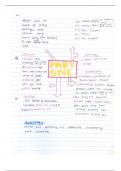
Intro
- Fallacy: unsound belief using inconvenience logic
- Cosmological argument: argument to prove the existence through God through
the empiricist view that God causes everything.
- Unmoved mover, unpaused cause and contingency/necessary are all fallacies
Line of argument: Aquinas’ arguments are inherently flawed and cannot be successfully
defended
Point 1: the fallacy of composition overcomes Aquinas first and second way
Explain
The 1st way asserts how the chain of motion is moved by something else
This movement cannot have gone infinitely into the past
Their must be an unmoved mover of the universe - God
The 2nd way asserts how everything is caused in the universe as nothing could not exist
This cause could not go on infinitely
There must be an uncaused causer of the universe - God.
However,
Hume detailed the absurdity of these fallacies as he described how just because things in
the universe is caused, this gives us no reason to assume that the universe as a whole is
caused. This fallacy of composition is illustrates in Hume’s example: if you find an
explanation for each particle, it would be wrong to seek an explanation for the whole
matter.
Russel would also agree: every man has a mother is no proof that the collective human race
has a mother.
Analysis
This is an influential viewpoint as it is certain that we have not witnessed the cause of the
universe, therefore we cannot state it is specifically caused.
Furthermore we do not need/desire an explanation for the whole universe if we can see and
understand causation in the universe. E.g. we observe water causing flowers to grow.
Therefore we should not apply this knowledge to I the universe. (Phillips: it is beyond our
understanding)
Counter:
However, the fallacy of composition fails as this limits God and his omnipotence.
(Do the weaknesses outweigh the strengths)
Intro
- Fallacy: unsound belief using inconvenience logic
- Cosmological argument: argument to prove the existence through God through
the empiricist view that God causes everything.
- Unmoved mover, unpaused cause and contingency/necessary are all fallacies
Line of argument: Aquinas’ arguments are inherently flawed and cannot be successfully
defended
Point 1: the fallacy of composition overcomes Aquinas first and second way
Explain
The 1st way asserts how the chain of motion is moved by something else
This movement cannot have gone infinitely into the past
Their must be an unmoved mover of the universe - God
The 2nd way asserts how everything is caused in the universe as nothing could not exist
This cause could not go on infinitely
There must be an uncaused causer of the universe - God.
However,
Hume detailed the absurdity of these fallacies as he described how just because things in
the universe is caused, this gives us no reason to assume that the universe as a whole is
caused. This fallacy of composition is illustrates in Hume’s example: if you find an
explanation for each particle, it would be wrong to seek an explanation for the whole
matter.
Russel would also agree: every man has a mother is no proof that the collective human race
has a mother.
Analysis
This is an influential viewpoint as it is certain that we have not witnessed the cause of the
universe, therefore we cannot state it is specifically caused.
Furthermore we do not need/desire an explanation for the whole universe if we can see and
understand causation in the universe. E.g. we observe water causing flowers to grow.
Therefore we should not apply this knowledge to I the universe. (Phillips: it is beyond our
understanding)
Counter:
However, the fallacy of composition fails as this limits God and his omnipotence.