Week 1: Intro, scoping, and screening.
Reading:
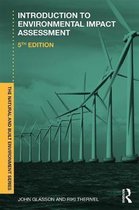
Glasson et al Ch. 1-6
Morgan, RK (2012) Environmental impact assessment: the state of the art, Impact Assessment and Project
Appraisal, 30:1, 5-14, DOI: 10.1080/14615517.2012.661557
GENERAL INTRO/OUTLINE
The UK faces significant pressure for new development to support a greener and
more sustainable economy (National Planning Policy Framework 2018):
o investment by 2020 in new energy infrastructure to support the transition to
a low carbon economy;
o maintain and improve water supply;
o divert waste from landfill and generate more energy from waste
o spending on flood defences to double
o UK population is projected to rise, creating significant demand for more
homes and supporting transport infrastructure
EIA is a process consisting of the preparation both by the developer and from other
sources, of the environmental statement, any consultation, publications or
notifications, and all the steps taken during the determination of an application. It
should be taken into account by the planning authority in forming their judgements
on whether the development should go ahead” (2014 EU Directive)
o The term 'environmental impact assessment' (EIA) describes a procedure that
must be followed for certain types of project (what sort of project? Set out
in legislation: screening to decide which projects require EIA) before they
can be given 'development consent'. The procedure (systematic from early
in project planning, to planning authority decision and beyond) is a means
of drawing together, in a systematic way, an assessment of a project's likely
significant (how can this be decided upon? Is this science? Quantitative or
qualitative, or both?) environmental effects (what is environment? scoping
needed to decide where to focus). This helps to ensure that the importance
of the predicted effects, and the scope for reducing them, are properly
understood by the public and the relevant competent authority before it
makes its decision. (UK, 2000)
10,000 projects in the UK subject to EIA. Almost every country has an EIA system
EIA maps onto the five ‘guiding principles’ of sustainable development
Case study: Great Barrier Reef dredging
Reading:
Glasson et al Ch. 1-6
Morgan, RK (2012) Environmental impact assessment: the state of the art, Impact Assessment and Project
Appraisal, 30:1, 5-14, DOI: 10.1080/14615517.2012.661557
GENERAL INTRO/OUTLINE
The UK faces significant pressure for new development to support a greener and
more sustainable economy (National Planning Policy Framework 2018):
o investment by 2020 in new energy infrastructure to support the transition to
a low carbon economy;
o maintain and improve water supply;
o divert waste from landfill and generate more energy from waste
o spending on flood defences to double
o UK population is projected to rise, creating significant demand for more
homes and supporting transport infrastructure
EIA is a process consisting of the preparation both by the developer and from other
sources, of the environmental statement, any consultation, publications or
notifications, and all the steps taken during the determination of an application. It
should be taken into account by the planning authority in forming their judgements
on whether the development should go ahead” (2014 EU Directive)
o The term 'environmental impact assessment' (EIA) describes a procedure that
must be followed for certain types of project (what sort of project? Set out
in legislation: screening to decide which projects require EIA) before they
can be given 'development consent'. The procedure (systematic from early
in project planning, to planning authority decision and beyond) is a means
of drawing together, in a systematic way, an assessment of a project's likely
significant (how can this be decided upon? Is this science? Quantitative or
qualitative, or both?) environmental effects (what is environment? scoping
needed to decide where to focus). This helps to ensure that the importance
of the predicted effects, and the scope for reducing them, are properly
understood by the public and the relevant competent authority before it
makes its decision. (UK, 2000)
10,000 projects in the UK subject to EIA. Almost every country has an EIA system
EIA maps onto the five ‘guiding principles’ of sustainable development
Case study: Great Barrier Reef dredging