
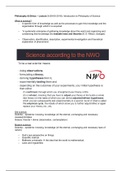
Philosophy & Ethics – Lecture 3 (09-05-2018): Introduction to Philosophy of Science
What is science?
- A specific form of knowledge as well as the processes to gain this knowledge and the
organization through which it is acquired.
- ‘’A systematic enterprise of gathering knowledge about the world and organizing and
condensing that knowledge into testable laws and theories (E.O. Wilson, biologist)
- ‘Observation, identification, description, experimental investigation and theoretical
explanation of phenomena’.
Old science:
Scientia – episteme: knowing, knowledge (of the eternal, unchanging and necessary
causes/principles
Greece: theoria = divine (observation, contemplation)
Modern science:
Scientia – episteme: knowing, knowledge (of the eternal, unchanging and necessary laws of
nature)
- God’s eye perspective on things.
- Scientific method
- Mathesis universalis the idea that the world is mathematical.
- Laws and regularities
, What makes natural science unique?
- Methodical empiricism (empeira: experience)
- Application of mathematics (mathematization)
- Specific social organization
Scientism:
- Ideological conviction of the superiority of the scientific approach to reality (‘only
science knows really’)
- Posits that only scientific explanations of the world are valid and meaningful
- Holds that only natural science provides an adequate representation of reality
- The religious belief that science will ultimately explain everything.
Popular view of science:
- Scientific knowledge is proven knowledge
- Science is based on experience
- Scientific knowledge is objective
- Scientific knowledge is reliable knowledge because: objective and proven
What is philosophy of science?
- Object of research is science itself
- Critical reflection on science, scientific knowledge and scientific practice
- Descriptive and normative activity: studies both how science is and how it should be.
- Questions the validity of scientific knowledge.
Elementary forms of scientific reasoning:
Deduction vs. Induction
- Reasoning from premises W1: logic book 1 is boring
P1: All books about logic are boring W2: logic book 2 is boring
P2: this book is about logic W3: logic book 3 is boring, etc.
----- ---
C: This book is boring C: All books about logic are boring.
- If the premises are true, then the conclusion - Generalization on the basis of a
is also true finite number of particular observtns.
- Deductive reasonings are logically valid. - Inductive reasonings are
logically invalid.
Naive inductivism:
- Induction is logically invalid
- If we observe an object or process A a great number of times in the same way (under
different conditions), and if all those observations exhibit the behavior or property B, then
we may conclude that all A’s are B.
What is science?
- A specific form of knowledge as well as the processes to gain this knowledge and the
organization through which it is acquired.
- ‘’A systematic enterprise of gathering knowledge about the world and organizing and
condensing that knowledge into testable laws and theories (E.O. Wilson, biologist)
- ‘Observation, identification, description, experimental investigation and theoretical
explanation of phenomena’.
Old science:
Scientia – episteme: knowing, knowledge (of the eternal, unchanging and necessary
causes/principles
Greece: theoria = divine (observation, contemplation)
Modern science:
Scientia – episteme: knowing, knowledge (of the eternal, unchanging and necessary laws of
nature)
- God’s eye perspective on things.
- Scientific method
- Mathesis universalis the idea that the world is mathematical.
- Laws and regularities
, What makes natural science unique?
- Methodical empiricism (empeira: experience)
- Application of mathematics (mathematization)
- Specific social organization
Scientism:
- Ideological conviction of the superiority of the scientific approach to reality (‘only
science knows really’)
- Posits that only scientific explanations of the world are valid and meaningful
- Holds that only natural science provides an adequate representation of reality
- The religious belief that science will ultimately explain everything.
Popular view of science:
- Scientific knowledge is proven knowledge
- Science is based on experience
- Scientific knowledge is objective
- Scientific knowledge is reliable knowledge because: objective and proven
What is philosophy of science?
- Object of research is science itself
- Critical reflection on science, scientific knowledge and scientific practice
- Descriptive and normative activity: studies both how science is and how it should be.
- Questions the validity of scientific knowledge.
Elementary forms of scientific reasoning:
Deduction vs. Induction
- Reasoning from premises W1: logic book 1 is boring
P1: All books about logic are boring W2: logic book 2 is boring
P2: this book is about logic W3: logic book 3 is boring, etc.
----- ---
C: This book is boring C: All books about logic are boring.
- If the premises are true, then the conclusion - Generalization on the basis of a
is also true finite number of particular observtns.
- Deductive reasonings are logically valid. - Inductive reasonings are
logically invalid.
Naive inductivism:
- Induction is logically invalid
- If we observe an object or process A a great number of times in the same way (under
different conditions), and if all those observations exhibit the behavior or property B, then
we may conclude that all A’s are B.


