
Tutorial club 4: Cancer & Cell cycle
1. What is the multi-hit model of cancer? Give an example.
The multi-hit model of cancer is a hypothesis stating that cancer is the result of
accumulated mutations to a cell’s DNA, e.g. children which inherited a first mutation of
retinoblastoma, any second mutation would rapidly lead to cancer. While children with
non-inherited retinoblastoma need two ‘hits’ before a tumor could develop.
Carcinogenesis depends on both mutation of proto-oncogenes and on the deactivation
of tumor suppressor genes.
A mutation in both alleles is required, as a single functional tumor suppressor gene is
usually sufficient.
Answer: ±20-30 mutations are needed in order to get cancer.
Cancer happens more in the elderly.
This model is supported by animal models in which transgenic mice overexpress one or
more activated oncogenes. Multiple oncogenes accelerate tumor development. The
multi-hit model is consistent with increasing dedifferentiation of transformed cells and
eventual development of metastasis.
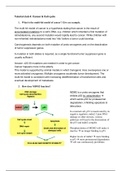
2. How does MDM2 function?
MDM2 is a proto-oncogene that
inhibits p53 by ubiquitination
which sends p53 for proteasomal
degradation, inhibiting apoptosis to
take place.
In a normal cell, p53 is inactivated by its
negative regulator, mdm2. Upon DNA
damage or other stresses, various
pathways will lead to the dissociation of
the p53 and mdm2 complex
Phosphorylation of MDM2 will make it
inactive no longer binding to p53.
Higher levels of mdm2 more binding
to p53 more proteasomal degradation
cell can continuously proliferate.
, 3. Give four examples of mutations leading to an unregulated G1-S transition?
1. Retinoblastoma (Rb) mutations
a. Point-mutations: result in Rb-protein that cannot longer bind E2F.
b. Chromosomal translocation: HPV (and all other DNA tumor viruses) can
express proteins that specifically bind Rb and specifically bind p53. HPV
expresses a protein that binds Rb at its interaction surface with E2F,
thereby blocking Rb from binding to E2F, inhibiting Rb’s repressive
function.
2. G1-cyclins (Cyclin D) mutations Amplification of the genomic region that
encodes for Cyclin D.
3. CIP + INK4(p16) mutations Point-mutation, results in Rb being released from
E2F thus constant transcription taking place.
4. The genes that are needed for ab-production have strong promoters/strong
enhancers Chromosomal translocation occurs, enhancers are now put in front
of the cyclin D gene. So instead of stimulating production of antibodies,
stimulation of cyclin D production occurs.
There are four types of mutations which can occur:
1. Point-mutation loss/gain of function mutation
2. Chromosomal translocation two parts of different chromosomes fuse, resulting
in an aberrant chromosome.
3. Chromosomal translocation different promoter usage
4. Amplification/deletion during replication more gene product, thus more protein.
P16 controls Rb binding to E2F.
Often p16 is removed by a deletion (point mutation)/hypomethylation.
Rb-pathway regulated by p16 will definitely be an exam question!!!!!
4. What is an oncogenic miRNA? Is Let-7 an oncogenic or a tumour suppressor
miRNA? Is miR-15a an oncogenic miRNA?
An oncogenic miRNA is miRNA that shows abnormal patterns of expression?
- Let-7 is a tumor suppressor miRNA, RAS (is a proto-oncogene that) is regulated
by the let-7 miRNA family.
The MAPK pathway leads to cell proliferation.
Reduced expression of let-7 in lung cancer leads to a poor prognosis.
1. What is the multi-hit model of cancer? Give an example.
The multi-hit model of cancer is a hypothesis stating that cancer is the result of
accumulated mutations to a cell’s DNA, e.g. children which inherited a first mutation of
retinoblastoma, any second mutation would rapidly lead to cancer. While children with
non-inherited retinoblastoma need two ‘hits’ before a tumor could develop.
Carcinogenesis depends on both mutation of proto-oncogenes and on the deactivation
of tumor suppressor genes.
A mutation in both alleles is required, as a single functional tumor suppressor gene is
usually sufficient.
Answer: ±20-30 mutations are needed in order to get cancer.
Cancer happens more in the elderly.
This model is supported by animal models in which transgenic mice overexpress one or
more activated oncogenes. Multiple oncogenes accelerate tumor development. The
multi-hit model is consistent with increasing dedifferentiation of transformed cells and
eventual development of metastasis.
2. How does MDM2 function?
MDM2 is a proto-oncogene that
inhibits p53 by ubiquitination
which sends p53 for proteasomal
degradation, inhibiting apoptosis to
take place.
In a normal cell, p53 is inactivated by its
negative regulator, mdm2. Upon DNA
damage or other stresses, various
pathways will lead to the dissociation of
the p53 and mdm2 complex
Phosphorylation of MDM2 will make it
inactive no longer binding to p53.
Higher levels of mdm2 more binding
to p53 more proteasomal degradation
cell can continuously proliferate.
, 3. Give four examples of mutations leading to an unregulated G1-S transition?
1. Retinoblastoma (Rb) mutations
a. Point-mutations: result in Rb-protein that cannot longer bind E2F.
b. Chromosomal translocation: HPV (and all other DNA tumor viruses) can
express proteins that specifically bind Rb and specifically bind p53. HPV
expresses a protein that binds Rb at its interaction surface with E2F,
thereby blocking Rb from binding to E2F, inhibiting Rb’s repressive
function.
2. G1-cyclins (Cyclin D) mutations Amplification of the genomic region that
encodes for Cyclin D.
3. CIP + INK4(p16) mutations Point-mutation, results in Rb being released from
E2F thus constant transcription taking place.
4. The genes that are needed for ab-production have strong promoters/strong
enhancers Chromosomal translocation occurs, enhancers are now put in front
of the cyclin D gene. So instead of stimulating production of antibodies,
stimulation of cyclin D production occurs.
There are four types of mutations which can occur:
1. Point-mutation loss/gain of function mutation
2. Chromosomal translocation two parts of different chromosomes fuse, resulting
in an aberrant chromosome.
3. Chromosomal translocation different promoter usage
4. Amplification/deletion during replication more gene product, thus more protein.
P16 controls Rb binding to E2F.
Often p16 is removed by a deletion (point mutation)/hypomethylation.
Rb-pathway regulated by p16 will definitely be an exam question!!!!!
4. What is an oncogenic miRNA? Is Let-7 an oncogenic or a tumour suppressor
miRNA? Is miR-15a an oncogenic miRNA?
An oncogenic miRNA is miRNA that shows abnormal patterns of expression?
- Let-7 is a tumor suppressor miRNA, RAS (is a proto-oncogene that) is regulated
by the let-7 miRNA family.
The MAPK pathway leads to cell proliferation.
Reduced expression of let-7 in lung cancer leads to a poor prognosis.


