
Tutorial club 2: Questions about post-transcriptional regulation
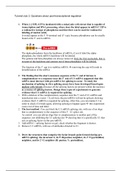
1. When -[ 3 ]-AT is incubated with a eukaryotic cell extract that is capable of
transcription and RNA processing, where does the label appear in mRNA? 3 is
a radioactive isotope of phosphorus and therefore can be used for radioactive
labeling of nucleic acids.
It would appear at the 5’ N-terminal end (5’-cap), because phosphorus can be usually
found at the 5’ end in mRNA
The alpha-phosphates form the backbone of mRNA, if you’d label the alpha-
phosphate, the whole mRNA backbone will be labeled.
The gamma and beta phosphate are always removed. Only the first nucleotide, that is
not part of the backbone and consists out of three phosphates will be labeled.
The function of the 5’ cap is to stabilize mRNA removing the cap will result in
destabilization of the mRNA.
. The finding that the short consensus sequence at the 5´ end of introns is
complementary to a sequence near the 5´ end of U1 snRNA suggested that this
snRNA must interact with pre-mRNA for splicing to occur. To study the
mechanism of splicing in vitro splicing assays have been developed based upon
nuclear cell extracts (because all the splicing factors are present within the nucleus)
as a source of splicing factors. Design three types of experiments to generate
evidence that U1 snRNA is required for splicing.
1. With a deletion of the complementary sequence near the 5’ end of U1 snRNA and
transfection into a vector + E.coli host, the pre-mRNA will not be spliced, showing
evidence that U1 snRNA is required for splicing. After this, you can mutate U1 in
order to check if it binds again, allowing splicing to happen again this experiment
costs a lot of time and labor.
2. The best method: You can block the U1 snRNA splicing site, with use of an oligo
that is complementary to the sequence of this 5’ U1 splice site.
As control: you can add an oligo that is complementary to another part of the
sequence, not inhibiting the U1 splicing site showing that it is specifically U1 that
acts as splicing factor on this pre-mRNA.
3. Add mRNA + splicing factors on gel, check whether the fragment is shorter.
4. Remove U1 snRNA, with use of antibodies directed to U1.
3. Draw the structures that comprise the lariat branch point formed during pre-
mRNA splicing: the invariant A, its 5’-R(purine) neighbor, its 3’-Y(pyrimidine)
neighbor, and its ’-G neighbor (R: purine; Y: pyrimidine).
, There is a additional (unique) linkage to the 2’ end.
DNA does not have the 2’ oxygen, so it cannot form a branch point.
4. SnRN -dependent splicing of pre-mRNA is thought to have evolved from the
self-splicing properties inherent in the sequence of either group I or II introns.
Alternative splicing of pre-mRNAs processed in spliceosomes has been
demonstrated, whereas this phenomenon does not occur in RNA transcripts that
undergo self-splicing. Explain this difference.
Group I and group II introns have perfectly evolved into structures, which allow formation of
the self-splicing reaction, whereas mRNAs processed in spliceosomes is surrounded by a huge
complex where mRNA can bind to and be spliced. Based on the different structures of mRNA
it binds to the spliceosome at a certain site.
5. Transcripts of the rat fast skeletal muscle troponin T gene can be alternative spliced.
This gene consists of 18 exons, 11 of which are found in all mature mRNAs and thus are
constitutive. Five exons, those numbered 4 through 8, are combinatorial in that they
may be individually included or excluded, in any combination, in the mature mRNA.
Two exons, 16 and 17, are mutually exclusive: one or the other is always present, but
never both. Sixty-four different mature mRNAs can be generated from the primary
transcript of this gene by alternative splicing.
a. Draw a schematic illustration of the organization of this gene and of the mature
mRNAs. ?? (google, plaatje uit Lodish)
b. Suppose exon 17 were deleted from this gene. How many different mRNAs could now
be generated by alternative splicing?
32 different mRNAs.
c. Suppose that exon 7 in a wild-type troponin T gene were duplicated. How many
different mRNAs might be generated from a transcript of this new gene by alternative
splicing?
96
1. When -[ 3 ]-AT is incubated with a eukaryotic cell extract that is capable of
transcription and RNA processing, where does the label appear in mRNA? 3 is
a radioactive isotope of phosphorus and therefore can be used for radioactive
labeling of nucleic acids.
It would appear at the 5’ N-terminal end (5’-cap), because phosphorus can be usually
found at the 5’ end in mRNA
The alpha-phosphates form the backbone of mRNA, if you’d label the alpha-
phosphate, the whole mRNA backbone will be labeled.
The gamma and beta phosphate are always removed. Only the first nucleotide, that is
not part of the backbone and consists out of three phosphates will be labeled.
The function of the 5’ cap is to stabilize mRNA removing the cap will result in
destabilization of the mRNA.
. The finding that the short consensus sequence at the 5´ end of introns is
complementary to a sequence near the 5´ end of U1 snRNA suggested that this
snRNA must interact with pre-mRNA for splicing to occur. To study the
mechanism of splicing in vitro splicing assays have been developed based upon
nuclear cell extracts (because all the splicing factors are present within the nucleus)
as a source of splicing factors. Design three types of experiments to generate
evidence that U1 snRNA is required for splicing.
1. With a deletion of the complementary sequence near the 5’ end of U1 snRNA and
transfection into a vector + E.coli host, the pre-mRNA will not be spliced, showing
evidence that U1 snRNA is required for splicing. After this, you can mutate U1 in
order to check if it binds again, allowing splicing to happen again this experiment
costs a lot of time and labor.
2. The best method: You can block the U1 snRNA splicing site, with use of an oligo
that is complementary to the sequence of this 5’ U1 splice site.
As control: you can add an oligo that is complementary to another part of the
sequence, not inhibiting the U1 splicing site showing that it is specifically U1 that
acts as splicing factor on this pre-mRNA.
3. Add mRNA + splicing factors on gel, check whether the fragment is shorter.
4. Remove U1 snRNA, with use of antibodies directed to U1.
3. Draw the structures that comprise the lariat branch point formed during pre-
mRNA splicing: the invariant A, its 5’-R(purine) neighbor, its 3’-Y(pyrimidine)
neighbor, and its ’-G neighbor (R: purine; Y: pyrimidine).
, There is a additional (unique) linkage to the 2’ end.
DNA does not have the 2’ oxygen, so it cannot form a branch point.
4. SnRN -dependent splicing of pre-mRNA is thought to have evolved from the
self-splicing properties inherent in the sequence of either group I or II introns.
Alternative splicing of pre-mRNAs processed in spliceosomes has been
demonstrated, whereas this phenomenon does not occur in RNA transcripts that
undergo self-splicing. Explain this difference.
Group I and group II introns have perfectly evolved into structures, which allow formation of
the self-splicing reaction, whereas mRNAs processed in spliceosomes is surrounded by a huge
complex where mRNA can bind to and be spliced. Based on the different structures of mRNA
it binds to the spliceosome at a certain site.
5. Transcripts of the rat fast skeletal muscle troponin T gene can be alternative spliced.
This gene consists of 18 exons, 11 of which are found in all mature mRNAs and thus are
constitutive. Five exons, those numbered 4 through 8, are combinatorial in that they
may be individually included or excluded, in any combination, in the mature mRNA.
Two exons, 16 and 17, are mutually exclusive: one or the other is always present, but
never both. Sixty-four different mature mRNAs can be generated from the primary
transcript of this gene by alternative splicing.
a. Draw a schematic illustration of the organization of this gene and of the mature
mRNAs. ?? (google, plaatje uit Lodish)
b. Suppose exon 17 were deleted from this gene. How many different mRNAs could now
be generated by alternative splicing?
32 different mRNAs.
c. Suppose that exon 7 in a wild-type troponin T gene were duplicated. How many
different mRNAs might be generated from a transcript of this new gene by alternative
splicing?
96


