RSK3701/202/1/2018
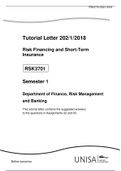
Tutorial Letter 202/1/2018
Risk Financing and Short-Term
Insurance
RSK3701
Semester 1
Department of Finance, Risk Management
and Banking
This tutorial letter contains the suggested answers
to the questions in Assignments 02 and 03.
, CONTENTS
1 INTRODUCTION................................................................................................................. 2
2 GUIDELINES FOR COMPLETING ASSIGNMENT 02 ........................................................ 2
3 GUIDELINES FOR COMPLETING ASSIGNMENT 03 ........................................................ 6
4 CONCLUDING REMARKS ............................................................................................... 11
Please note/important notes:
Kindly register as a myUnisa user as soon as possible – it is free of charge. Visit
https://my.unisa.ac.za for details. myUnisa will enable you to get in touch with fellow students, to
submit assignments, update your details, participate in discussion forums and blogs, and give you
access to important announcements regarding this module.
It is also important that you provide Unisa with your cellphone number, because important
announcements may be sent to you via SMS.
1 INTRODUCTION
Dear Student
The purpose of this tutorial letter is to provide you with guidelines on completing
Assignments 02 and 03.
2 GUIDELINES FOR COMPLETING ASSIGNMENT 02
Question 1: Correct option - 1
Refer to Study unit 12 in the Unisa RSK3701 study guide.
Working capital reflects the liquidity of the business. A range of between 1% and 25% of
working capital is considered as a guideline to be used when deciding on the amount to be
reserved for loss assumption. Where the current assets of a business cannot be easily
liquidated, or where the liquidity levels fluctuate throughout the financial period, the lower
end of the scale should be considered for loss assumption. The higher end of the scale
applies to stable and higher liquidity ratios.
The working capital ratios reflected in the scenario set out in this question are indicative of a
liquid working capital position and the business is in a good position to handle current
liabilities. The working capital ratios of the business are favourable for a risk retention
2
Tutorial Letter 202/1/2018
Risk Financing and Short-Term
Insurance
RSK3701
Semester 1
Department of Finance, Risk Management
and Banking
This tutorial letter contains the suggested answers
to the questions in Assignments 02 and 03.
, CONTENTS
1 INTRODUCTION................................................................................................................. 2
2 GUIDELINES FOR COMPLETING ASSIGNMENT 02 ........................................................ 2
3 GUIDELINES FOR COMPLETING ASSIGNMENT 03 ........................................................ 6
4 CONCLUDING REMARKS ............................................................................................... 11
Please note/important notes:
Kindly register as a myUnisa user as soon as possible – it is free of charge. Visit
https://my.unisa.ac.za for details. myUnisa will enable you to get in touch with fellow students, to
submit assignments, update your details, participate in discussion forums and blogs, and give you
access to important announcements regarding this module.
It is also important that you provide Unisa with your cellphone number, because important
announcements may be sent to you via SMS.
1 INTRODUCTION
Dear Student
The purpose of this tutorial letter is to provide you with guidelines on completing
Assignments 02 and 03.
2 GUIDELINES FOR COMPLETING ASSIGNMENT 02
Question 1: Correct option - 1
Refer to Study unit 12 in the Unisa RSK3701 study guide.
Working capital reflects the liquidity of the business. A range of between 1% and 25% of
working capital is considered as a guideline to be used when deciding on the amount to be
reserved for loss assumption. Where the current assets of a business cannot be easily
liquidated, or where the liquidity levels fluctuate throughout the financial period, the lower
end of the scale should be considered for loss assumption. The higher end of the scale
applies to stable and higher liquidity ratios.
The working capital ratios reflected in the scenario set out in this question are indicative of a
liquid working capital position and the business is in a good position to handle current
liabilities. The working capital ratios of the business are favourable for a risk retention
2