CBSE Quick Revision Notes (Class-11 Biology)
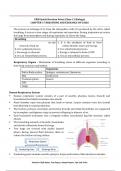
CHAPTER-17 BREATHING AND EXCHANGE OF GASES
The process of exchange of O2 from the atmosphere with CO2 produced by the cell is called
breathing. It occurs in two stages of inspiration and expiration. During inspiration air enters
the lungs from atmosphere and during expiration air leaves the lungs.
Breathing Respiration
a. It is simply an intake of fresh air and a. It is the oxidation of food to form
removal of foul air. carbon dioxide, water and energy.
b. It is a physical process. b. It is a biochemical process.
c. No energy is released. c. Energy is released in form of ATP.
d. It is an extracellular process. d. It is an intracellular process.
Respiratory Organs – Mechanism of breathing varies in different organism according to
their body structure and habitat.
Respiratory Organs Organisms
Entire Body surface Sponges, coelenterate, flatworms.
Skin Earthworm.
Tracheal system Insects
Gills Pieces, arthropods.
Lungs Amphibians, mammals.
Human Respiratory System
Human respiratory system consists of a pair of nostrils, pharynx, larynx, bronchi and
bronchioles that finally terminates into alveoli.
Nasal chamber open into pharynx that leads to larynx. Larynx contains voice box (sound
box) that help in sound production.
The trachea, primary, secondary and tertiary bronchi and initial bronchioles are supported
by incomplete cartilaginous rings to prevent collapsing in absence of air.
Each bronchiole terminates into a irregular walled, vascularized bag like structure called
alveoli.
The branching network of bronchi, bronchioles
and alveoli collectively forms the lungs.
Two lungs are covered with double layered
pleura having pleural fluid between them to
reduce the friction on lung surface.
Respiratory System
Conducting Parts Exchange Parts
Conducting parts includes nostrils, pharynx, larynx and trachea. Main functions includes-
Portal for CBSE Notes, Test Papers, Sample Papers, Tips and Tricks
CHAPTER-17 BREATHING AND EXCHANGE OF GASES
The process of exchange of O2 from the atmosphere with CO2 produced by the cell is called
breathing. It occurs in two stages of inspiration and expiration. During inspiration air enters
the lungs from atmosphere and during expiration air leaves the lungs.
Breathing Respiration
a. It is simply an intake of fresh air and a. It is the oxidation of food to form
removal of foul air. carbon dioxide, water and energy.
b. It is a physical process. b. It is a biochemical process.
c. No energy is released. c. Energy is released in form of ATP.
d. It is an extracellular process. d. It is an intracellular process.
Respiratory Organs – Mechanism of breathing varies in different organism according to
their body structure and habitat.
Respiratory Organs Organisms
Entire Body surface Sponges, coelenterate, flatworms.
Skin Earthworm.
Tracheal system Insects
Gills Pieces, arthropods.
Lungs Amphibians, mammals.
Human Respiratory System
Human respiratory system consists of a pair of nostrils, pharynx, larynx, bronchi and
bronchioles that finally terminates into alveoli.
Nasal chamber open into pharynx that leads to larynx. Larynx contains voice box (sound
box) that help in sound production.
The trachea, primary, secondary and tertiary bronchi and initial bronchioles are supported
by incomplete cartilaginous rings to prevent collapsing in absence of air.
Each bronchiole terminates into a irregular walled, vascularized bag like structure called
alveoli.
The branching network of bronchi, bronchioles
and alveoli collectively forms the lungs.
Two lungs are covered with double layered
pleura having pleural fluid between them to
reduce the friction on lung surface.
Respiratory System
Conducting Parts Exchange Parts
Conducting parts includes nostrils, pharynx, larynx and trachea. Main functions includes-
Portal for CBSE Notes, Test Papers, Sample Papers, Tips and Tricks