

BINOMIAL THEOREM
MAIN CONCEPTS AND RESULTS
** Binomial theorem for any positive integer n
n
a bn n C0a n n C1a n 1.b n C2a n 2 .b2 ... n Cn 1a.bn 1 n Cn bn n Ck a n k bk
k 0
n
** The coefficients C r occurring in the binomial theorem are known as binomial coefficients.
** There are (n +1) terms in the expansion of a b , i.e., one more than the index.
n
** 1 x n C0 n C1x n C 2 x 2 ... n C n 1x n 1 n C n x n
n
** 1 x n C0 n C1x n C 2 x 2 ... 1 n C n x n .
n n
** n C0 n C1 n C2 n C3 ... n Cn 2n .
** n C0 n C1 n C2 n C3 ... 1 n Cn 0 .
n 1
** General Term in the expansion of a b = t r 1 n Cra n r .br
n
** Middle term in the expansion of a b
n
th th th
n n 1 n 1
(i) 1 term if n is even (ii) and 1 terms if n is odd.
2 2 2
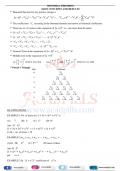
**Pascal’s Triangle
ILLUSTRATIONS :
EXAMPLE 1:No. of terms in 1 + 3x + 3x 2 + x 3 6
is
(A) 7 (B) 6 (C) 17 (D) 19
Ans: D 19
1 + 3x + 3x 2 + x 3 6 = 1 + x)3 6
= (1 + x)18
n=18 ∴ no. of terms = 19
EXAMPLE 2:nC 0 + nC 1 + nC 2 + ⋯ + nC n −1 + nC n =
(A)2n (B) 2n (C) 2n−1 (D) none of these
Ans: B 2n
(1 + a)n = nc 0 a0 + nc 1 a1 + nc 2 a2 + ⋯ + nc n −1 an−1 + nc n an
put a=1
EXAMPLE 3:In 1 + x3 5
coefficient of x 9 is
51
, (A) 5 (B) 10 (C) 1 (D) NONE
Ans: B 10
1 + x 3 5 = 5C 0 + 5C 1 x 3 + 5C 2 (x 3 )2 + 5C 3 (x 3 )3 + 5C 4 (x 3 )4 + 5C 5 (x 3 )5
= 5C 0 + 5C 1 x 3 + 5C 2 x 6 + 5C 3 x 9 + 5C 4 x12 + 5C 5 x15
∴the coefficient of x 9 is 5C 3 i.e. 10
9 9
EXAMPLE 4:Number of terms in 1 + 5 2x + 1 − 5 2x ifx > 0 𝑖𝑠 _______
(A) 3 (B) 5 (C) 4 (D) 6
Ans: B 5
2 8
EXAMPLE 5:Find 6th term in 3x −
3x
Solution :Tr+1 = nC r x n−r ar
2 5
T6 = T5+1 = 8C 5 (3x)8−5 (− )
3x
2 5 1729 1
=56 ×33 ×x 3 × − 3x = - 9 x2
EXAMPLE 6:Find the value of (101)4 by using Binomial theorem :
n
Solution : 1 + x = nC 0 x 0 + nC 1 x1 + nC 2 x 2 + ⋯ + nC n −1 x n−1 + nC n x n
4 4
101 = 1 + 100
= 4C 0 (100)0 + 4C 1 (100)1 + 4C 2 (100)2 + 4C 3 (100)3 + 4 100 4
= 1 + 4 100 + 6 10000 + 4 1000000 + 100000000 = 104060401
EXAMPLE 7:Which of the following is larger9950 + 10050 or10150
50 50
Solution : 101 = 1 + 100
= 50C 0 (100)50 + 50C 1 (100)49 + 50C 2 (100)48 + ⋯ + 50C 49 (100)1 + 50C 50 100 0
50 50
99 = 100 − 1
= 50C 0 (100)50 − 50C 1 100 49
+ 50C 2 100 48
+ ⋯ − 50C 49 (100)1 + 50C 50 100 0
50 50
101 − 99 =2{50C 1 (100)49 + 50C 3 (100)47 + ⋯ + 50C 49 (100)1 }
50 50
101 − 99 =100 × (100)49 + 2{50C 3 (100)47 + ⋯ + 50C 49 (100)1 }
50 50
101 − 99 − (100)50 =2 50C 3 100 47
+ 50C 4 100 46
+ ⋯ + 50C 49 100 1
>0
50 50
101 > 99 + (100)50
50
Therefore , 101 islarger
52
MAIN CONCEPTS AND RESULTS
** Binomial theorem for any positive integer n
n
a bn n C0a n n C1a n 1.b n C2a n 2 .b2 ... n Cn 1a.bn 1 n Cn bn n Ck a n k bk
k 0
n
** The coefficients C r occurring in the binomial theorem are known as binomial coefficients.
** There are (n +1) terms in the expansion of a b , i.e., one more than the index.
n
** 1 x n C0 n C1x n C 2 x 2 ... n C n 1x n 1 n C n x n
n
** 1 x n C0 n C1x n C 2 x 2 ... 1 n C n x n .
n n
** n C0 n C1 n C2 n C3 ... n Cn 2n .
** n C0 n C1 n C2 n C3 ... 1 n Cn 0 .
n 1
** General Term in the expansion of a b = t r 1 n Cra n r .br
n
** Middle term in the expansion of a b
n
th th th
n n 1 n 1
(i) 1 term if n is even (ii) and 1 terms if n is odd.
2 2 2
**Pascal’s Triangle
ILLUSTRATIONS :
EXAMPLE 1:No. of terms in 1 + 3x + 3x 2 + x 3 6
is
(A) 7 (B) 6 (C) 17 (D) 19
Ans: D 19
1 + 3x + 3x 2 + x 3 6 = 1 + x)3 6
= (1 + x)18
n=18 ∴ no. of terms = 19
EXAMPLE 2:nC 0 + nC 1 + nC 2 + ⋯ + nC n −1 + nC n =
(A)2n (B) 2n (C) 2n−1 (D) none of these
Ans: B 2n
(1 + a)n = nc 0 a0 + nc 1 a1 + nc 2 a2 + ⋯ + nc n −1 an−1 + nc n an
put a=1
EXAMPLE 3:In 1 + x3 5
coefficient of x 9 is
51
, (A) 5 (B) 10 (C) 1 (D) NONE
Ans: B 10
1 + x 3 5 = 5C 0 + 5C 1 x 3 + 5C 2 (x 3 )2 + 5C 3 (x 3 )3 + 5C 4 (x 3 )4 + 5C 5 (x 3 )5
= 5C 0 + 5C 1 x 3 + 5C 2 x 6 + 5C 3 x 9 + 5C 4 x12 + 5C 5 x15
∴the coefficient of x 9 is 5C 3 i.e. 10
9 9
EXAMPLE 4:Number of terms in 1 + 5 2x + 1 − 5 2x ifx > 0 𝑖𝑠 _______
(A) 3 (B) 5 (C) 4 (D) 6
Ans: B 5
2 8
EXAMPLE 5:Find 6th term in 3x −
3x
Solution :Tr+1 = nC r x n−r ar
2 5
T6 = T5+1 = 8C 5 (3x)8−5 (− )
3x
2 5 1729 1
=56 ×33 ×x 3 × − 3x = - 9 x2
EXAMPLE 6:Find the value of (101)4 by using Binomial theorem :
n
Solution : 1 + x = nC 0 x 0 + nC 1 x1 + nC 2 x 2 + ⋯ + nC n −1 x n−1 + nC n x n
4 4
101 = 1 + 100
= 4C 0 (100)0 + 4C 1 (100)1 + 4C 2 (100)2 + 4C 3 (100)3 + 4 100 4
= 1 + 4 100 + 6 10000 + 4 1000000 + 100000000 = 104060401
EXAMPLE 7:Which of the following is larger9950 + 10050 or10150
50 50
Solution : 101 = 1 + 100
= 50C 0 (100)50 + 50C 1 (100)49 + 50C 2 (100)48 + ⋯ + 50C 49 (100)1 + 50C 50 100 0
50 50
99 = 100 − 1
= 50C 0 (100)50 − 50C 1 100 49
+ 50C 2 100 48
+ ⋯ − 50C 49 (100)1 + 50C 50 100 0
50 50
101 − 99 =2{50C 1 (100)49 + 50C 3 (100)47 + ⋯ + 50C 49 (100)1 }
50 50
101 − 99 =100 × (100)49 + 2{50C 3 (100)47 + ⋯ + 50C 49 (100)1 }
50 50
101 − 99 − (100)50 =2 50C 3 100 47
+ 50C 4 100 46
+ ⋯ + 50C 49 100 1
>0
50 50
101 > 99 + (100)50
50
Therefore , 101 islarger
52


