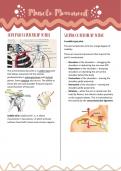
A saddle-type joint
The sternoclavicular joint has a large degree of
mobility.
There are several movements that require this
joint’s involvement:
- Elevation of the shoulders – shrugging the
shoulders or abducting the arm over 90º
- Depression of the shoulders – drooping
The acromioclavicular joint is a saddle-type joint shoulders or extending the arm at the
that allows movement of the clavicle, shoulder behind the body
predominantly in anteroposterior and vertical - Protraction of the shoulders – moving the
planes. Some rotation also occurs. The ability to shoulder girdle anteriorly
thrust the arm and shoulder forward requires - Retraction of the shoulders – moving the
sound function of this joint. shoulder girdle posteriorly
- Rotation – when the arm is raised over the
head by flexion, the clavicle rotates passively
as the scapula rotates. This is transmitted to
the clavicle by the coracoclavicular ligament
Saddle joint; biaxial joint i.e., it allows
movements in two planes- in which articular
surfaces have both convex and concave regions.
The sternoclavicular joint has a large degree of
mobility.
There are several movements that require this
joint’s involvement:
- Elevation of the shoulders – shrugging the
shoulders or abducting the arm over 90º
- Depression of the shoulders – drooping
The acromioclavicular joint is a saddle-type joint shoulders or extending the arm at the
that allows movement of the clavicle, shoulder behind the body
predominantly in anteroposterior and vertical - Protraction of the shoulders – moving the
planes. Some rotation also occurs. The ability to shoulder girdle anteriorly
thrust the arm and shoulder forward requires - Retraction of the shoulders – moving the
sound function of this joint. shoulder girdle posteriorly
- Rotation – when the arm is raised over the
head by flexion, the clavicle rotates passively
as the scapula rotates. This is transmitted to
the clavicle by the coracoclavicular ligament
Saddle joint; biaxial joint i.e., it allows
movements in two planes- in which articular
surfaces have both convex and concave regions.