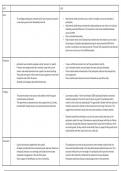
AO1 AO3
Aims:
- To investigate participants conformity to the roles of guard or prisoner in + High internal validity since there was a control of variables, such as the selection of
a role-playing exercise that stimulated prison life. participants.
+ High internal validity because emotionally stable participants were chosen so it ruled out
individual personality differences. This means that a link can be established between
cause and effect.
+ Was a controlled observation.
+ High mundane realism since Zimbardo found evidence that the situation was very real to
the participants. Qualitative data gathered during the study showed that 90% of the
prisoner’s conversations were about prison life. ‘Prisoner 416’ expressed the view that the
prison was a real one, just run by different people.
Procedure:
- participants were randomly assigned as either ‘prisoners’ or ‘guards’. - It was an artificial environment so it can't be generalised to real life.
- Prisoners were stripped naked, skin searched, issued with a prison - Lack of mundane realism since participants were play-acting to stereotypes.
uniform, and needed permission from a guard to do almost anything. - There could be demand characteristics if the participants acted how they thought they
- The guards were given uniforms and mirrored sunglasses and were told were supposed to.
to keep the order within the prison. - There could have been observer bias since Zimbardo was part of the study.
- Zimbardo and colleagues observed their behaviour.
Findings:
- The prisoners became more passive and obedient, while the guards - Low temporal validity - Reicher and Haslam (2006) replicated Zimbardo’s research by
invented nastier punishments. randomly assigning 15 men to the role of prisoner or guard. The participants didn’t
- The experiment was abandoned early (was supposed to last 2 weeks, conform to their social roles automatically. The guards didn’t identify with their status and
but ended after 6 days) because some prisoners became distressed. refused to impose their authority so the prisoners then took charge of the prison. This
suggests that conformity to social roles may not be automatic as Zimbardo implied.
- Zimbardo implied that conforming to a social role comes naturally and easily so the
participants acted in the way of the behaviour expected of people with that role. Riecher
and Haslam thought that Zimbardo’s explanation didn’t account for the behaviour of the
non-brutal guards. So they used the social identity theory to argue that the guards had to
actively identify with their social roles to act as they did.
Conclusion:
- Guards and prisoners adopted their roles quickly. - The participants who were due to play prisoners were arrested at night in their own
- Zimbardo concluded that the environment (social role) does influence an homes and handcuffed outside in the street before being bundled into police cars. This
individual’s behaviour since seemingly well-balanced men became was done without their prior knowledge. The participants didn’t give their informed
unpleasant and aggressive in the role of the guard. consent to this treatment and therefore this experiment involves deception.
- Shows support for identification as a form of conformity. - Participants experience physical and psychological harm in this experiment.
Aims:
- To investigate participants conformity to the roles of guard or prisoner in + High internal validity since there was a control of variables, such as the selection of
a role-playing exercise that stimulated prison life. participants.
+ High internal validity because emotionally stable participants were chosen so it ruled out
individual personality differences. This means that a link can be established between
cause and effect.
+ Was a controlled observation.
+ High mundane realism since Zimbardo found evidence that the situation was very real to
the participants. Qualitative data gathered during the study showed that 90% of the
prisoner’s conversations were about prison life. ‘Prisoner 416’ expressed the view that the
prison was a real one, just run by different people.
Procedure:
- participants were randomly assigned as either ‘prisoners’ or ‘guards’. - It was an artificial environment so it can't be generalised to real life.
- Prisoners were stripped naked, skin searched, issued with a prison - Lack of mundane realism since participants were play-acting to stereotypes.
uniform, and needed permission from a guard to do almost anything. - There could be demand characteristics if the participants acted how they thought they
- The guards were given uniforms and mirrored sunglasses and were told were supposed to.
to keep the order within the prison. - There could have been observer bias since Zimbardo was part of the study.
- Zimbardo and colleagues observed their behaviour.
Findings:
- The prisoners became more passive and obedient, while the guards - Low temporal validity - Reicher and Haslam (2006) replicated Zimbardo’s research by
invented nastier punishments. randomly assigning 15 men to the role of prisoner or guard. The participants didn’t
- The experiment was abandoned early (was supposed to last 2 weeks, conform to their social roles automatically. The guards didn’t identify with their status and
but ended after 6 days) because some prisoners became distressed. refused to impose their authority so the prisoners then took charge of the prison. This
suggests that conformity to social roles may not be automatic as Zimbardo implied.
- Zimbardo implied that conforming to a social role comes naturally and easily so the
participants acted in the way of the behaviour expected of people with that role. Riecher
and Haslam thought that Zimbardo’s explanation didn’t account for the behaviour of the
non-brutal guards. So they used the social identity theory to argue that the guards had to
actively identify with their social roles to act as they did.
Conclusion:
- Guards and prisoners adopted their roles quickly. - The participants who were due to play prisoners were arrested at night in their own
- Zimbardo concluded that the environment (social role) does influence an homes and handcuffed outside in the street before being bundled into police cars. This
individual’s behaviour since seemingly well-balanced men became was done without their prior knowledge. The participants didn’t give their informed
unpleasant and aggressive in the role of the guard. consent to this treatment and therefore this experiment involves deception.
- Shows support for identification as a form of conformity. - Participants experience physical and psychological harm in this experiment.