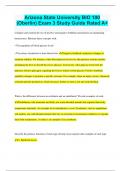
Arizona State University BIO 100 (Oberlin) Exam 3 Study Guide Rated A+
Arizona State University BIO 100 (Oberlin) Exam 3 Study Guide Rated A+ Compare and contrast the use of positive and negative feedback mechanisms in maintaining homeostasis. Illustrate these concepts with: • The regulation of blood glucose levels • The release of platelets to form blood clots. Negative feedback counteracts changes to maintain stability. For instance, when blood glucose levels rise, the pancreas secretes insulin, prompting the liver to absorb the excess glucose. Conversely, when glucose levels fall, the pancreas releases glucagon, signaling the liver to release stored glucose. Positive feedback amplifies changes to promote a specific outcome. For example, when an injury occurs, chemicals stimulate platelet production, which increases further to form a clot and stop bleeding. What is the difference between an ectotherm and an endotherm? Provide examples of each. Endotherms, like mammals and birds, are warm-blooded animals that regulate their body temperature internally. An example of an endotherm is a cow. Ectotherms, such as amphibians and reptiles, are cold-blooded animals that rely on external environmental conditions to regulate their body temperature. A snake is an example of an ectotherm. Describe the primary functions of each type of body tissue and provide examples of each type. a. Epithelial tissue: i. External: Skin and the lining of organs ii. Functions: Protection, secretion, and absorption b. Connective tissue: i. Types: 1. Loose connective tissue (between skin and muscle) 2. Blood 3. Adipose (fat) 4. Fibrous (ligaments and tendons) 5. Cartilage 6. Bone c. Muscle Tissue: i. Types: 1. Smooth muscle (surrounds internal organs, involuntary, no striation) 2. Skeletal muscle (facilitates movement, voluntary) 3. Cardiac muscle (around the heart, involuntary) d. Nervous tissue: i. Function: Communication Why do herbivorous mammals have extremely long digestive systems, omnivores have intermediate lengths, and carnivores have very short intestines? Herbivores require long digestive systems to efficiently break down and absorb nutrients from fibrous plant material. Omnivores have intermediate length intestines to process both plant and animal matter. Carnivores have short intestines because animal proteins and fats are easier to digest and require less time for nutrient absorption. Why do strict vegetarians (vegans) have to be more careful of their choices of food than do vegetarians that also eat cheese, eggs, and dairy products? Proteins (made from amino acids). 9 of the 20 amino acids are essential (cannot make them in your body). In order to ensure that you have all of those essential amino acids, you have to eat a wider variety of foods when vegan. Describe the process of breathing. In your explanation of inhalation and exhalation be sure to describe positive and negative pressure and include the actions of the diaphragm. Inhale - Pressure decreases and volume increases Exhale - Pressure increases and volume decreases Explain how vaccines work. A killed or weakened version of the virus is given to a person, which causes the b cells to defend the body and causes the production of memory cells. Then, when the body encounters that pathogen again, it knows how to defend itself. In Southern Copperhead snake venom, you'll find a protein called a disintegrin. Disintegrins bind to a class of membrane receptors called integrins. Platelets use integrin receptors to aggregate at a site of tissue damage. What effect do you think disintegrin has on the snake's prey? The blood cannot clot and the venom can then more efficiently flow through the blood stream, making the prey die quicker. Anatomical designs that increase surface area are common in many body systems. Give examples of how surface area is maximized in the digestive, respiratory, and nervous systems of humans. In the digestive system, the most of the absorption of nutrients occurs in your small intestine (20 feet long). The nutrients defuse over the lining of the intestine into the blood. The folds in the villi (the folds and hair like micro villi) increase the surface area making it more efficient. In the lungs, the alveoli (like clusters of grapes) defuse the oxygen into the blood. By having multiple alvei instead of one large one, there is more surface area for absorption. The brain has wrinkles to increase surface area and absorption without increasing the size of the brain. 10. Compare and contrast the immune system's three lines of defense. First line: nonspecific (does not target a particular pathogen); skin, mucus and mucus membranes (think of a cold). Second line: also nonspecific; macrophages (pac men), fever, inflammation (histamines increase the size of the blood vessels), compliment proteins. Third Line (Antibody Immunity): specific; only binds to particular
École, étude et sujet
- Établissement
- Arizona State University BIO 100
- Cours
- Arizona State University BIO 100
Infos sur le Document
- Publié le
- 23 juin 2024
- Nombre de pages
- 8
- Écrit en
- 2023/2024
- Type
- Examen
- Contenu
- Questions et réponses
Sujets
-
arizona state university bio 100 oberlin exam 3

Document également disponible en groupe