

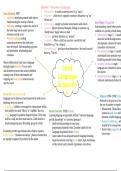
Halliday's 7 Functions of Language
1. Instrumental - to satisfy a material need (e.g. "nana").
Jean Aitchson 1987
o 2. Regulatory - child tries to organise someone's behaviour e.g. "up"
Labelling- associating sounds with objects.
(lift me up)
Understanding the concept of labels. Jean Piaget (Cognitive)
o 3. Interactional – simply to promote conversation with others.
Packaging- starting to explore the extent of Understanding comes before produc
4. Personal - Express personal thoughts, feelings or opinions e.g.
the label stage where under and over outlined in 4 specific periods during
"daddy home" happy when see dad.
extension mostly occur. 1. Sensor-motor stage (0-18 month
o 5. Heuristic - question function e.g. "wassat".
Network building- making about the world through senses.
6. Imaginative - When a child can conceive a world that isn't
connections between the labels they development is limited to learnin
immediate e.g. "I'm a dragon".
have developed. Understanding opposites immediate environment.
7. Representational - give facts about themselves / the world around
and similarities, relationships and 2. Pre-operational stage (18month
them e.g. "I'm six".
contrasts. understand basic symbolic repre
Children generalise about things
Shows children don’t just learn a language 3. Concrete operational stage (7-11
through simple imitation. It's an active
and deductive process that involves children Child language use is limited by having
life objects.
making sense of their environment and
mapping out connections between words Language 4. Formal operational stage (11+ye
with and understand abstract id
and the world.
Acquisitio
Bruner (Social interaction) n Skinner 1904-1990 (Beha
Language can be influenced and improved by adult carers
Believed in the process of imi
adjusting their own speech:
o Scaffolding- children encouraged to communicate within the use of positive or negative
o Behaviourist, Tabula Rasa
their ability- the adult "fills in" or "scaffolds" the rest. Noam Chomsky 1928 (Innate)
o LASS- Language Acquisition Support System. There may possess a blank state and l
Learning language is impossible without "universal language-
imitation of adult language
well be a LAD, but there must also be a LASS. Refers to specific knowledge" or "universal grammar". o Operant conditioning - wh
family/playgroup/peer/friendship group of a child. o Hard-wired knowledge of some basic
shaped by its consequence
grammatical/syntactic rules. Chomsky called this our o Doesn’t take pragmatics in
Constantly provide opportunities for a child to acquire a Language Acquisition Device (LAD).
mother tongue: "ritualised scenarios"- phases of interaction some ways.
o Input cannot be an adequate basis for language learning.
are rapidly recognised & predicted by the infant. o Input has natural occurring errors (slurs, slips, hesitations
or false starts) and is devoid of grammar corrections.
1. Instrumental - to satisfy a material need (e.g. "nana").
Jean Aitchson 1987
o 2. Regulatory - child tries to organise someone's behaviour e.g. "up"
Labelling- associating sounds with objects.
(lift me up)
Understanding the concept of labels. Jean Piaget (Cognitive)
o 3. Interactional – simply to promote conversation with others.
Packaging- starting to explore the extent of Understanding comes before produc
4. Personal - Express personal thoughts, feelings or opinions e.g.
the label stage where under and over outlined in 4 specific periods during
"daddy home" happy when see dad.
extension mostly occur. 1. Sensor-motor stage (0-18 month
o 5. Heuristic - question function e.g. "wassat".
Network building- making about the world through senses.
6. Imaginative - When a child can conceive a world that isn't
connections between the labels they development is limited to learnin
immediate e.g. "I'm a dragon".
have developed. Understanding opposites immediate environment.
7. Representational - give facts about themselves / the world around
and similarities, relationships and 2. Pre-operational stage (18month
them e.g. "I'm six".
contrasts. understand basic symbolic repre
Children generalise about things
Shows children don’t just learn a language 3. Concrete operational stage (7-11
through simple imitation. It's an active
and deductive process that involves children Child language use is limited by having
life objects.
making sense of their environment and
mapping out connections between words Language 4. Formal operational stage (11+ye
with and understand abstract id
and the world.
Acquisitio
Bruner (Social interaction) n Skinner 1904-1990 (Beha
Language can be influenced and improved by adult carers
Believed in the process of imi
adjusting their own speech:
o Scaffolding- children encouraged to communicate within the use of positive or negative
o Behaviourist, Tabula Rasa
their ability- the adult "fills in" or "scaffolds" the rest. Noam Chomsky 1928 (Innate)
o LASS- Language Acquisition Support System. There may possess a blank state and l
Learning language is impossible without "universal language-
imitation of adult language
well be a LAD, but there must also be a LASS. Refers to specific knowledge" or "universal grammar". o Operant conditioning - wh
family/playgroup/peer/friendship group of a child. o Hard-wired knowledge of some basic
shaped by its consequence
grammatical/syntactic rules. Chomsky called this our o Doesn’t take pragmatics in
Constantly provide opportunities for a child to acquire a Language Acquisition Device (LAD).
mother tongue: "ritualised scenarios"- phases of interaction some ways.
o Input cannot be an adequate basis for language learning.
are rapidly recognised & predicted by the infant. o Input has natural occurring errors (slurs, slips, hesitations
or false starts) and is devoid of grammar corrections.


