

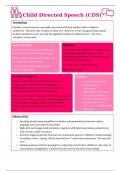
Child Directed Speech (CDS)
Terminology
Initially, researchers were especially concerned with how mothers talk to children –
‘motherese’. This led to the creation of ‘fatherese’. However, it was recognised that natural
mothers and fathers were not only the significant adults in children’s lives – the term
‘caregiver’ is now used.
Lexis & semantics Phonology
Use of concrete nouns (most common in Use exaggerated ‘singsong’ intonation, which
child’s vocabulary) and dynamic verbs. helps to emphasise key words. Also to
exaggerate the difference between questions,
Adopt a child’s own words for things such
statements and commands.
as doggie, wickle and babbit.
Use a higher and wider pitch range.
Frequent use of child’s name and an
absence of pronouns. Speak more slowly.
Problems & negatives Grammar
However, some argue that baby talk “moo-cow”, o Simpler constructions
“doggie” and so on interferes with language o Frequent use of
development because it gives children a distorted, imperatives
unnatural and inaccurate version of speech. o High degree of repetition
CDS may aid language acquisition, but it doesn’t appear o Use of personal names
to be essential. There are cultures where caregivers do instead of pronouns (e.g.
not modify their language (Samoa and Papua New ‘mummy’ instead of ‘I’
Guinea) and these children still develop at the same o Fewer verbs, modifiers and
rate. adjectives.
Effects of CDS:
o Speaking slowly/using simplified vocabulary and grammatical structures makes
language more accessible for the child.
o High pitch and exaggerated intonation (together with facial expressions and gestures)
help to keep a child’s attention.
o Research suggests that the frequent use of questions improves children’s understanding
of auxiliary verbs – saying “did the man fall over?” rather than statements “The man fell
over.”
o Asking questions and then pausing for a reply helps to introduce children to the rules of
conversations (pragmatics). Children become used to the idea of turn-taking.
[Type here]
Terminology
Initially, researchers were especially concerned with how mothers talk to children –
‘motherese’. This led to the creation of ‘fatherese’. However, it was recognised that natural
mothers and fathers were not only the significant adults in children’s lives – the term
‘caregiver’ is now used.
Lexis & semantics Phonology
Use of concrete nouns (most common in Use exaggerated ‘singsong’ intonation, which
child’s vocabulary) and dynamic verbs. helps to emphasise key words. Also to
exaggerate the difference between questions,
Adopt a child’s own words for things such
statements and commands.
as doggie, wickle and babbit.
Use a higher and wider pitch range.
Frequent use of child’s name and an
absence of pronouns. Speak more slowly.
Problems & negatives Grammar
However, some argue that baby talk “moo-cow”, o Simpler constructions
“doggie” and so on interferes with language o Frequent use of
development because it gives children a distorted, imperatives
unnatural and inaccurate version of speech. o High degree of repetition
CDS may aid language acquisition, but it doesn’t appear o Use of personal names
to be essential. There are cultures where caregivers do instead of pronouns (e.g.
not modify their language (Samoa and Papua New ‘mummy’ instead of ‘I’
Guinea) and these children still develop at the same o Fewer verbs, modifiers and
rate. adjectives.
Effects of CDS:
o Speaking slowly/using simplified vocabulary and grammatical structures makes
language more accessible for the child.
o High pitch and exaggerated intonation (together with facial expressions and gestures)
help to keep a child’s attention.
o Research suggests that the frequent use of questions improves children’s understanding
of auxiliary verbs – saying “did the man fall over?” rather than statements “The man fell
over.”
o Asking questions and then pausing for a reply helps to introduce children to the rules of
conversations (pragmatics). Children become used to the idea of turn-taking.
[Type here]


