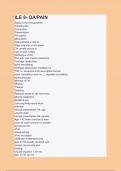
ILE 8- OA/PAIN
Steps of Pain progression
Transduction
Conduction
Transmission
Perception
Modulation
Osteoarthritis is due to
Wear and tear on the joints
OA usually occurs in
hips, knees, hands
pathophys of OA
Peri-artic ular muscle weakness
Cartilage destruction
bone remodeling
Cartilage destruction mediated by
TNF, IL, receptors and transcription factors
bone modulators such as __ regulate remodeling
biphsophonate
etiology of OA
Obesity
Trauma
Genetics
Reduces levels of sex hormones
Muscle weakness
Reptitive use
Jobs requiring heavy labor
Infection
clinical presentation OA: age
Usually older
clinical presentation OA: gender
Age < 45 more common in men
Over 45 more common in women
symptoms OA
-Pain
-Deep aching
-Pain on motion
-Stiffness in affected joints
pain in OA usually resolved with
motion, recurs with rest
Gelling
Usually duration < 30 min
pain in OA can be
, weather-related
non-pharm OA
Exercise
Weight loss
Patient education
Assistive device
Shoe insoles
Heat
NSAIDS inhibit action of
cyclooxygenase
cyclooxygenase is responsible for converting
arachidonic acid to prostaglandins
Two types of cyclooxygenase
COX 1 and 2
Throughout body
Cell signaling and tissue maintenance
Undesirable side effects when inhibited
COX 1
Expressed in inflammatory cells
Makes prostaglandins
COX 2
COX 2 has 3 domains
Binding site for EGF
Membrane binding
Catalytic domain
Major actions of prostaglandins
PGD2
Weak inhibitor of platelet aggregation
Major actions of prostaglandins
PGE1
-Vasodilation
-Inhibitor of lipolysis
-Inhibitor of platelet aggregation
-Bronchodilation
-Contraction of smooth GI
Major actions of prostaglandins
PGE2
-Stimulates hyperalgesic response
-Renal vasodilation
-Stimulates uterine smoothe muscle contraction
-Protect GI
-Reduce secretion of stomach acid
Major actions of prostaglandins
PGF2
Steps of Pain progression
Transduction
Conduction
Transmission
Perception
Modulation
Osteoarthritis is due to
Wear and tear on the joints
OA usually occurs in
hips, knees, hands
pathophys of OA
Peri-artic ular muscle weakness
Cartilage destruction
bone remodeling
Cartilage destruction mediated by
TNF, IL, receptors and transcription factors
bone modulators such as __ regulate remodeling
biphsophonate
etiology of OA
Obesity
Trauma
Genetics
Reduces levels of sex hormones
Muscle weakness
Reptitive use
Jobs requiring heavy labor
Infection
clinical presentation OA: age
Usually older
clinical presentation OA: gender
Age < 45 more common in men
Over 45 more common in women
symptoms OA
-Pain
-Deep aching
-Pain on motion
-Stiffness in affected joints
pain in OA usually resolved with
motion, recurs with rest
Gelling
Usually duration < 30 min
pain in OA can be
, weather-related
non-pharm OA
Exercise
Weight loss
Patient education
Assistive device
Shoe insoles
Heat
NSAIDS inhibit action of
cyclooxygenase
cyclooxygenase is responsible for converting
arachidonic acid to prostaglandins
Two types of cyclooxygenase
COX 1 and 2
Throughout body
Cell signaling and tissue maintenance
Undesirable side effects when inhibited
COX 1
Expressed in inflammatory cells
Makes prostaglandins
COX 2
COX 2 has 3 domains
Binding site for EGF
Membrane binding
Catalytic domain
Major actions of prostaglandins
PGD2
Weak inhibitor of platelet aggregation
Major actions of prostaglandins
PGE1
-Vasodilation
-Inhibitor of lipolysis
-Inhibitor of platelet aggregation
-Bronchodilation
-Contraction of smooth GI
Major actions of prostaglandins
PGE2
-Stimulates hyperalgesic response
-Renal vasodilation
-Stimulates uterine smoothe muscle contraction
-Protect GI
-Reduce secretion of stomach acid
Major actions of prostaglandins
PGF2